Aitch-Bar

Writing About (Mostly) Not Astrophysics


Leave a comment

Cosmic Comic Warp Wrapup

Edited from a Crosspost to Adventures in Poor Taste

The AiPT crew asked if I could explain the weird physics in Fantastic Four #10, where an alien spaceship seems to struggle with its spacetime warping engines. I may not be a Fantastic Four expert, but I know the basics. All classic groups are foursomes, and the FF are no different. Ninja Turtles, A-Team, Beatles, Sex and the City, the four fundamental forces of nature, etc. The quadriad heroes tend to compliment each others’ skills, getting into lots of situations that are aided by a combination of invisible lady, stretchy guy, strong big guy, and fiery guy. Is one such situation a spacetime anomaly? We’re about to find out.

Ryan North and Leandro Fernández’s Fantastic Four #10 features a story told in five 100 year chunks, as the caretakers of an alien starship full of passengers in suspended animation ponder their vessel’s frozen state. The ship awakens them one by one to maintain the engines, but instead, they find that the starship is motionless in space. What’s more, they individually observe the Fantastic Four members (though they have no idea that’s what they are) moving within and outside the ship in extremely slow motion.

Someone familiar with special relativity might suspect this involves relativistic time dilation: the phenomena whereby something traveling near the speed of light experiences the passage of time more slowly than objects at rest. In fact, the ship is genuinely motionless. Or more specifically, frozen in a warped region of spacetime.
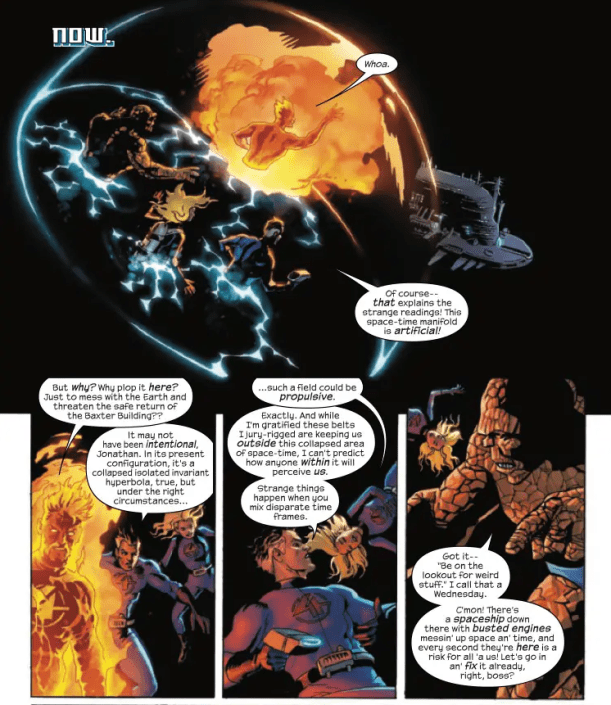
Fantastic Four #10–now with 50% more spacetime manifolds!

Of course–that explains the strange readings! This space-time manifold is artificial!

In its present configuration, it’s a collapsed isolated invariant hyperbola, true, but under the right circumstances…such a field could be propulsive.

Exactly. And while I’m gratified these belts I jury-rigged are keeping us outside this collapsed area of space-time, I can’t predict how anyone within it will perceive us. Strange things happen when you mix disparate time frames.

Fascinating. Their instantaneous appearance implies time is moving much faster for them than it is for us.

So to anyone on board, we look like–what, statues?

Given the temporal frame conflict, it’s likely we’re appearing at multiple and disparate times, locations and relative speeds. It would be quite challenging to predict.

It is interesting that the crew of a ship that operates through warping spacetime would be unfamiliar with the notion of different relativistic frames of reference. (It is implied that the shipbuilders were “ancient.” I guess their wisdom didn’t extend to the notion that they should make sure to pass down the basics of spaceflight.)

The description in the issue implies that the ship is designed to move by warping spacetime itself, without specifying how exactly. If that sounds like utter and complete gobbledegook, it may surprise you to learn that physicists merely consider it far-fetched-but-remotely-plausible gobbledegook. General relativity theorists have proposed spacetime geometries that would allow objects to circumvent light speed — the universe’s speed limit.

The best known of these is the Alcubierre drive, a hypothetical geometry first proposed in 1994 by Miguel Alcubierre, whereby space is contracted in front of an object, and expanded behind it. Superluminal travel is accomplished by moving space around the ship, which remains below light speed itself.

Easy enough, right? Wrong.

While dense matter or energy can contract spacetime, like a heavy object creating an indentation on a trampoline, there’s no known substance which can produce the opposite effect. Without a means of expanding space, like a source of negative energy, creating the spacetime geometry of a “warp bubble” is impossible.

Even if there were such a means, the amount of energy needed to distort space this way is implausibly enormous. Various proposals to operate an Alcubierre warp drive more efficiently have focused on methods that would reduce the amount of energy needed from that of the entire observable universe, to only that of several solar masses, or half a planet the size of Jupiter.

Other complications involve the fact that the warp bubble would violate relativistic causality – arriving at its destination before it would have seemed to have left. Light from the ship at its point of departure could reach the ship at its eventual end point, making it appear to exist in two places at once. The universe tends to have a problem with that sort of thing, as it implies a form of backwards time travel has occurred. Stephen Hawking’s chronology protection conjecture theorized that unspecified (maybe quantum) effects would intervene to prohibit the creation of time paradoxes. How or whether this would actually work, though, remains an open question.

Now if only we could get off this weird grid thing

Even if an Acubierre warp drive could work, it’s been calculated that a build-up of energetic particles caught up in the warp bubble over the trip would be released as the ship decelerated from superluminal velocity, and if a planet or object were along that direction of motion, this burst could destroy the destination itself.

Normally, an utter inability to accomplish something tends to dissuade people’s interest in it, but warp drive is a pretty tantalizing idea. As a result, nearly every article a theorist publishes relating to these models gets written up by pop-science sites. A sample of recent headlines include:

A warp drive is theoretically possible without breaking known physics

Alien ‘warp drives’ may leave telltale signals in the fabric of space-time, new paper claims

Warp Drives Might Be Real, and We’ll Find Them With Lasers: Study

Scientists Just Made a Breakthrough For Interstellar Travel

Faster-than-light ‘warp speed’ interstellar travel now thought to be possible

Scientists Get Serious in the Search for a Working Warp Drive

First-of-its-kind model makes warp drives feasible for space travel

Government-Funded Study Explores Warp Drives as Means of Faster-Than-Light Communication through “Hyperwaves”

If Warp Drives are Impossible, Maybe Faster Than Light Communication is Still on the Table?

I hate to be the bearer of bad news, but very little to increase the likelihood of warp travel within our lifetimes has actually transpired here. Rather, clickbait science sites are seizing on fairly hypothetical and insubstantial developments (like journal articles touching on minor refinements of theoretical work). Until humanity starts making big strides in folding spacetime around itself, we won’t be seeing anything like warp travel.

And it’s a shame! The universe is huge, and it would be exciting to be able to see more of it at close range. But without discovering some new physics, missions of interstellar exploration will require decades, if not centuries. We still have a lot to learn about gravity, so maybe 500 years stuck in one place would do it.

Leave a comment

The Final-ish Frontier

Crossposted from Adventures in Poor Taste

USS Enterprise

Pink galaxy at morning, starship take warning. Pink galaxy at night, starship’s delight.

Is Star Trek’s Galactic Barrier Real?

(No, but there’s some weird stuff out there)

Star Trek: Discovery comes to an end this year, after a run that successfully rescued the franchise from the clutches of J.J. Abrams’ two-dimensional alternate universe movies and brought it back to television, where it belongs. While views of the show are mixed, there’s no doubt that Discovery made brave choices and ultimately reignited the current era of boundless Trek. It brought an enthusiasm for science, with a litany of new concepts, a character named for a mushroom researcher, and an irrepressible ensign who’d say things like, “I f*cking love math!” For all its many invented technologies, Star Trek has been relatively faithful to scientific reality — in spirit, if not in details.

The science fictional elements are typically grounded in at least some speculative ideas about nature, or relate to a concept that scientists would recognize. This doesn’t mean that things like matter-transporting and faster than light travel are actually possible, but understanding they’re not, the creators of the shows typically build in explanations. The abrupt ship maneuvers that would flatten the crew as a starship accelerates? Inertial dampeners. Quantum indeterminacy impeding the ability of the transporter to precisely image an object? Heisenberg compensators. Someone to cook disgusting food, endanger the crew with pointless detours, and date a 2-year-old? Neelix.

One area where Star Trek series have tended to stumble is with actual astronomical phenomena. Many of the interest points in the shows have to do with fictitious yet frequent anomalies that could never do what they’re depicted doing. “Subspace temporal vortexes,” “quantum folds,” and  “warp bubbles” are fine and all, but astronomy has plenty of weird, speculative stuff already! Quark stars, cosmic strings, magnetic monopoles, several types of supernovae, black hole collisions. Admittedly, writers do have to come up with about 26 episodes a season, but it’s always felt as if they’ve never come close to exhausting the smorgasbord of real or near-real phenomena that astrophysics has to offer.

There is even one recurring structure which has been used repeatedly, despite being the opposite of a real astronomical feature — the Galactic Barrier.

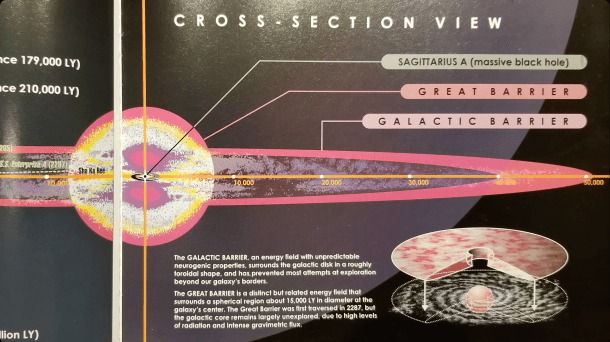
Star Trek is set entirely within our galaxy, the Milky Way; a stage that gives the franchise at least 100 billion star systems to work with. For scale, Voyager, stranded on the far side, is 70 years from home at top speed. The fictional Galactic Barrier is a region enveloping either the rim or the entire exterior of the Milky Way. It may also dip down into the core to surround the disappointing God-planet in Star Trek V. It supposedly consists of “negative energy,” which can damage ships and has the counterintuitive property of being invisible from far away and bright purple as it’s approached.

As you might guess, there’s nothing like this in our galaxy. The Milky Way, shaped like a pancake of stars, gas, and dust 90,000 light years across, with a slight bulge in the center, has the rather pedestrian quality of petering out in density as you leave the disk in any direction. The edges get increasingly diffuse. (However empty and diffuse you think space is, it is far more empty and diffuse than we can possibly comprehend.)

But that’s not the whole story! Past the visible edge of our galaxy (and others) extends a halo of dark matter. We know this because the speed with which stars orbit the center of the galaxy does not decrease as you go outward in the disk. If only the visible matter of stars and gas were present, it would. In that gravitational discrepancy, invisible matter is hiding. Dark matter, as far as we currently know, is a type of massive particle which doesn’t interact electromagnetically. This is why it doesn’t emit light.

For that reason, dark matter doesn’t form bonds like those holding regular atoms and molecules together, nor does it undergo the friction-like breaking interactions that would make it shed energy and slow down enough to coalesce into stars or nebulae. Having not given up energy as luminous matter does, it distributes itself (approximately) within a spherical clump around the galaxy’s center of mass and extends out far beyond the stars, gas, and dust we see.

That is not how Star Trek‘s Galactic Barrier works. In the shows, the ship comes upon it suddenly, and it presents itself as sort of a glowy, purple cloud wall that only becomes visible within a light year or less. Spock’s analysis describes it as, “Density negative. Radiation negative. Energy negative.” Of course, neither density nor radiation can be “negative,” since they describe physical quantities, but I suppose that’s part of the mysteriousness. Ships trying to pass through this region suffer a widely inconsistent set of phenomena, belying its inconsistent amount of danger.

The barrier first appears in the Star Trek original series episode “Where No Man Has Gone Before (AKA “the Gary Mitchell episode”). After finding wreckage from a ship lost to the barrier 200 years previously, the crew resolves to fly the Enterprise into it out of curiosity, to see if anti-galactic barrier technology has improved. They expect damage, and after some consoles explode and it’s casually reported that nine crew members died, the real weirdness begins. The Galactic Barrier turns Mitchell into a psychokinetic spooky man. Needless to say, this is not astronomically accurate.

Discovery confronts the edge of the galaxy, after a color palate reboot

We next see the Galactic Barrier in “By Any Other Name,” in which Kelvans from Andromeda travel to our galaxy on generation ships. The barrier has wrecked their vessels, forcing them to escape on lifepods, and they hijack the Enterprise to return home. Despite the fact that the edge of our galaxy is clearly transparent, they claim that they can’t get a message through it, so flying back is their only chance. Though they never say whether they modified the Enterprise, everyone gets through without much fuss, and it seems odd that the Kelvans’ seemingly more-advanced technology had a problem with it in the first place.

The crew sees it once more in Is There in Truth No Beauty?” and they pass through it without any trouble, only to be “stranded” in the void outside the galaxy, without any reference points to navigate by. Considering that this thing is supposed to be invisible, that doesn’t make a lot of sense. Can’t they just look back over their shoulders at the galaxy behind them? By the final original series encounter with this force field, which is called the “Great Barrier around the center of the Milky Way” in Star Trek V: The Final Frontier, it barely attempts to live up to its reputation — the Enterprise passes through it easily.

This would have been a great point to leave this silly concept behind. Subsequent series don’t mention the barrier, and actually hint that people are exploring extragalactic space or traveling to the Small Magellanic Cloud (a dwarf galaxy near our own). But after a nearly 40 year absence, the crew of Star Trek: Discovery brings it back in season 4, with another overhyped journey through the barrier, to reach the homeland of the season’s adversary. Even this show’s earnest ethos of “science is great!” couldn’t resist the appeal of resurrecting a baffling impossibility.

Star Trek is “about” many things, but perhaps most essentially, roaming the galaxy gives the crew the chance to encounter a wide diversity of life and cultures, all new to them. The distances may technically be astronomical, but on Trek, the cosmos is teeming with life and activity. The diplomacy between the Federation, the planets within it, and the brave new worlds it forges relationships with often mirror conflicts seen in our present day, and analogize social issues that we 21st century Earthlings contend with. As often as the stories feature a point of alienness, they resolve through cooperation across those differences.

So maybe putting a wall around the galaxy – foreboding, but not impermeable – is a reminder that for all the differences across our worlds, these civilizations share a place. An area removed from their interstellar neighborhood exists, and some unknown force is reminding the crew not to stray too far from the light of home stars. Moving toward total isolation and setting yourself apart is an action that damages and changes you. But the appearance of the Galactic Barrier is an illusion that can be surmounted by strong desire. The frontier stops at the coast, even though there’s an ocean to cross beyond, and worlds anew on the other side.

Is Star Trek's 'Galactic Barrier' real?

Or maybe the creators of Star Trek had a swirling pink cloud effect on hand back in 1966, and they wanted to throw around a neat-o phrase like “galactic barrier,” and they’d fill in the details later.


1 Comment

Pseudohistory Repeats Itself, Part 2

Face of a Robert E. Lee Statue being cut by a welding torch

What if the movie Face-off had been set during the 1860’s? I think it would have gone a little something like this. (Photo NYTimes)

The first half of this piece can be found at Pseudohistory Repeats Itself, Part 1, an extended fisking of is School Choice Is Not Enough: The Impact of Critical Social Justice Ideology in American Education by Zach Goldberg & Eric Kaufmann 


Guilt by Association

Over and over, Goldberg & Kaufmann (G&K) express concern about white kids who fear that they will be perceived as racist:

As a likely consequence of this fear, those exposed to CRT become less willing to criticize a black schoolmate, preventing black pupils from hearing useful feedback from classmates.

And,

[T]he teaching of CRT is likely to significantly impair the peer feedback process for black students, limiting potential opportunities for black students’ intellectual growth.

“Useful feedback” is the most euphemistic way of describing racially-motivated bullying I’ve ever heard.

They attempt to quantify this phenomenon by asking how comfortable someone feels criticizing their peers of different races. People reporting more exposure to teaching about racial injustice tend to be more concerned about criticizing students of color, whereas students of color feel more comfortable criticizing their white peers. The latter case is, presumably, the thing that really scares them. Especially scary since it appears to increase the more “CRT”  they report having been exposed to. Suddenly, instead of being “helpful feedback,” (like when Black kids are on the receiving end), for some reason, it is now described in grave-sounding tones. They don’t seem quite so worried that white kids will lose out on the benefits of this criticism.

Until, hilariously, G&K realize the implicit contradiction and make sure to wedge this sentiment into the very end of the section (in defiance of the article’s primary thrust about the dangers of CRT):  “[T]hese results would suggest that teaching more CRT is likely to benefit white students by introducing a greater willingness among pupils to criticize them while harming black students by withholding the criticism that might further their intellectual development.”

Saved it at the last minute!

Whites who say they were taught three or more CRT concepts were nearly 13 points more likely to say they would have been uncomfortable criticizing a black schoolmate compared to whites who were taught no CRT. Ironically, the effect of CRT is to discourage criticism that might help to improve the very minority outcomes that CRT claims to care about.

This is not, in fact, a thing “that CRT claims to care about.” Critical race theory seeks to explain broadly disparate life circumstances among racial groups. It is concerned with matters of wealth, power, and law. It spends considerably less time (in my understanding) on whether it would be helpful for Trevor to tell his classmate to consider whether all lives actually matter.

Yet, they cannot help themselves. They go further still: white kids should not be made to learn anything that causes them to have an emotional reaction.

We find that white respondents with higher CRT-related exposure feel more guilty about their race, experiencing negative sentiment toward their own group. Whereas 39% of whites who did not report any CRT-related classroom exposure indicated feeling “guilty about the social inequalities between white and black Americans,” this share rises to 45% among whites who reported being taught one or two CRT-related concepts, and to between 54% and 58% among whites who reported being taught three or more concepts. Here, we should also note that levels of agreement with this statement are considerably and significantly higher among white liberals (65%) than white conservatives (29%), which accords with the findings of past research.

No one alive currently should, in fact, feel shame or guilt about the past. We weren’t there. It wasn’t us. Even people whose direct ancestors did awful things are not, themselves, responsible for those acts. To live otherwise would be to inhabit a prison of unatonable regret.

This does not imply that downplaying the evils of history is necessary. Rather, the fact of our innocence and non-involvement is what allows us to deal honestly with those evils. Only someone who felt kinship with the past’s worst racists would feel a need to make justifications and excuses for them. Obfuscating the truth about historical actors aligns oneself with those whose reputation the lies burnish.

As far as the “guilt” described in that survey, the extent of distress it causes is unclear. It is possible, of course, to feel guilt within one context without it being an ever-present part of your day-to-day life. Someone can say they feel “guilt” over things which they understand not to be their own literal fault. I might say I feel “guilty” that I missed your birthday party because my flight was canceled. Or I might say that I feel “guilty” that I relished tearing apart your idiotic CRT push-poll faux research article. Of course, I would not feel true guilt in either of these cases. I would feel rhetorical guilt, rather than the emotion of guilt. It is even possible to recognize a certain level of group culpability, without feeling as if you have a personal relationship to it. Needless to say, the potential meanings of “guilt” used here are broad. And its negative effect on students is unspecified.

Good old-fashioned civic engagement

Continue reading


1 Comment

Pseudohistory Repeats Itself, Part 1

Colored postcard showing Charlotteville's Robert E. Lee statue dedication in 1924

A product of concerted pro-Confederate ‘Lost Cause’ historical revisionism: Charlottesville’s 1924 dedication ceremony for one of history’s biggest losers, Robert E. Lee. Fewer tiki torches visible at this gathering than the one 93 years later, but they’re there in spirit.

The gilded pricks who populate think tanks will stake out a justification for whatever deranged policy ideas it is in their interest to. Having been inoculated against the Dunning-Kruger Effect by years of steady income telling rich people what they want to hear, they feel perfectly comfortable wading into any area and splashing their ignorance across any op-ed pages that will have them. They’re not writing for scholars, they’re writing to prop up profitable political interests by giving their desires a thin veneer of intellectual plausibility.

So ordinarily the faux “studies” cranked out by such groups are beneath consideration, but I ran across one by accident and found it so dense with bad reasoning, historical inaccuracy, and paranoia that it renewed my belief in whatever the opposite of the authors beliefs were. It was begging for someone to write a scornful blog post about. It’s shameful that politicians use articles like this as cover for hobbling education in red states, an effort which has kept pace with the radicalizing authoritarianism of the right.

After all, by receiving a PhD, I became duty-bound to defend the search for knowledge and the dissemination thereof. Under a moonless sky, I pledged a blood-oath to denounce really bad scholarship, contrived in service of illiberal ends, whenever and wherever it was reasonable for me to do so. As long as I felt like it.

I have fairly low respect for sociology as it is, but this motivated-reasoning sociology has got to be as bad as it gets.

School Choice Is Not Enough: The Impact of Critical Social Justice Ideology in American Education by Zach Goldberg & Eric Kaufmann 


Image

A primary inspiration for the desire to remake education in the graven image of right-wing hagiography can be found on the collapsing husk of twitter, where one of the authors shared a thread expounding on his belief that younger people are trending more Democratic than previous generations. They draw a straight line from this to modern schooling. This is the kind of view that everyone’s loud conservative uncle has, but Goldberg & Kaufmann (G&K) are determined to bring rigor to it!

He points to the eye-watering turn away from conservatism pictured in this graphic. Unlike previous generations, millennials aren’t voting for Republicans as much as they get older. Without bothering to compare this idea to any other theories, G&K declare that educational wokeness must be the reason. Surely, nothing else about politics or the world could be different than 30 years ago. It must be the kryptonite…of critical race theory…which is warping these children’s view of the world!

It should be fairly obvious that there might be a few flaws here.

Continue reading


2 Comments

Avatar: The Way of Sascha

Screengrab from It's Always Sunny of Dennis saying "It's about the thrill of wearing another man's skin."

Pictured: Me

Back in 2010 I was out at a bar with some friends of my then-girlfriend when a couple young women cautiously approached me. They asked “Excuse me, are you Sascha?” and without hesitation I somehow had the wherewithal to answer “Yes, I am!” They then pulled me aside to compliment me on the talk I had given at RISD earlier that day, and we had a 7-10 minute conversation on “my work” which I gradually ascertained was some kind of social art collective in New York City, where I, apparently, lived.

I don’t know whether they eventually got suspicious that I was who they had assumed, but if so, they never let on. And I remain proud to this day of my quick-witted choice to lie to these unsuspecting strangers. (As it turns out, I looked pretty similar to this guy, but I’m still surprised that they saw and heard both of us in person on the same day and decided we matched.)

In the same spirit, I enjoy being catfished as much as the next guy, so when an unknown Whatsapp user starts texting me out of the blue, in Spanish, fun can only be right around the corner.

It is hard to know what this person was trying to get out of me, but I appreciated her desire to avoid believability. She was from LA, but currently living in Iraq, with her “only daughter.” What was she doing there? She was “posted” there. With whom? With all these random pictures of people in body armor. The army lets you bring your kids now? Yes, if they are very small.

I used Google Translate because I don’t speak Spanish, but that wasn’t much help when she dropped an Indonesian sentence in there and then seemed to understand my response, in Indonesian. Here is the excerpt:

Jenny: I’m Jenny good morning from here
Sorry I misspelled a number when trying to text a friend and your number came up
Sorry if I bother you, can I know your name please?

Ryan: I’m Ryan. Good evening.

Jenny: WOW, it’s morning here now 04:47
Where do you live?
I am from Los Angeles but am currently in Iraq.

[This was one-hour later than the current time in Iraq]

Ryan: Iraq? What are you doing there? i’m in Boston.

Jenny: i’m posted here
I work here and live with my only daughter.

Ryan: Posted in what?

Jenny:

(Would you believe it if I told you reverse image-searching these turn up generic “girls with ammo” pictures on gun-fetish pintrest?)

that’s it
so nothing much
I was here for the other government. We have been in the second troop for 8 months.
Can I know the time there now?

[I quickly double-check whether there are still American troops in Iraq because I’m honestly not sure. ]

Ryan: It’s like 8 o’clock. I’m surprised the army would let you take your daughter with you.

Jenny: yes because she is very small
Aku tidak bisa tinggal jauh darinya (Indonesian: “I can’t stay away from him”)
that’s Lillian that’s her name

Ryan: Tunggu, apakah kita berbicara bahasa Indonesia sekarang? (Indonesian: “Wait, are we speaking Indonesian now?”)

Jenny: (back to Spanish)

No, I wrote to my friend here to find her a child, so I didn’t change it.
Sorry, he was the wrong guy.
Who lives with you?

[At this point my wife, who has been following along with this saga solemnly places her hand on my shoulder and beseeches that I don’t fall in love]

Ryan: You won’t believe when I tell you: I live in a lighthouse

Jenny: wow, it’s nothing, I mean, do you live with your family?
I am a simple girl ok not rich
I live with my daughter alone, who do you live with?

Ryan: The sea is my family. The waves, my lovers. Whales and starfish, my cousins.

Jenny: oh that’s amazing
Are you married or single?
I’m separated I only have one daughter
I turn 25 next month

Ryan: I have no one to call my own, just the lonely expanse of the sea. The heartless void of the abyss.

Jenny: how old are you now my good friend
Don’t you feel lonely sometimes?
Do you want to be single forever?
I am looking for a decent man you are handsome but I don’t know your attitude
What is your occupation do you work?
Ryan… Really great
I am Jenny
Take care I have to rest a bit so I can arrive early for my duty

Once she’d started glitching, the magic kind of went out of it. And I was already married to the sea. Still, what a deep backstory! Just a simple girl not rich trying to make her way in this world. The last American soldier stationed in Iraq, with her small daughter.


Leave a comment

Stilloob

In April 2020 I had tickets to see proto-quirk band They Might Be Giants perform their classic 1990 album Flood for the tour marking it’s 30th anniversary. Or at least, I had tickets from when I bought them in about December 2019 until March 2020, when the tickets evaporated into a powdery mist and blew away, carried forth into an unknowable future date. For much of the following year I went to great lengths to avoid mists of all types.

They tentatively pushed the show back a year, then readjusted, then rescheduled the readjustment, the tide came in, the tide went out, flowers bloomed in the meadow, streams became choked with salmon, a thousand Tuscan suns blazed to life, shone for an eternity, and dwindled to cosmic embers. Somewhere a little after that, a firm date was finally decided upon this past September. Even that was briefly in doubt as John Flansburgh was seriously injured in a car accident this June, one night after managing to commence the tour.

Since the initial cancellation, I’d spent over a year working remotely, got vaccinated, finally saw my friends and family again after the long absence, welcomed a daughter…you get the idea. By the time it finally rolled around, I was a completely different person.

Unfortunately, the person I was now was was a sleepy dad. The kind of guy who wants to want to go to concerts, but doesn’t actually want to go to concerts. And my pal who’d planned to go with me back in 2020 was similarly crushed under the weight of his 2022 life. So I gave my tickets away. C’est la vie. While I’d held out this future event as a personal marker of the end of my pandemic for two years, once it came time to mark it I’d been so battered by those years that I was in no mood. Seems appropriate.

Sensing, I assume, my particular circumstances, TMBG streamed the Minneapolis performance from the tour I missed. So after putting to bed the offspring that was nothing more than a twinkle in my eye when this endeavor began I finally saw my Flood show. It was lovely to hear them do a bunch of album tracks that they wouldn’t have played live in concerts for 30 years, or ever.

The most surprising of these was their treatment of Sapphire Bullets of Pure Love. Specifically, they played it backwards.

Flansburgh told the audience to cheer and applaud before the song, and they proceeded to do it in reverse. It has a geometric plinky-plonky riff and it’s fairly short, so it was a good choice for this kind of thing. The backwards version is called Stilloob, a fittingly imprecise reversal of ‘bullets’. This became evident later in the show when they played the recording of the reversed version backwards, to hear how similar it was to the original. The direction of time, nothing more than impediment. Truly, the Tenet of songs.


Leave a comment

Part of my head

The enigma of Saint James | Sophia Deboick | The Guardian

In the halcyon days of 2005, when Lost & Desperate Housewives were climbing the charts, and Kelly Clarkson’s Since U Been Gone was setting hearts alight, I wrote a blog post about a section of a strange old book I have. It details the supposed resting places of supposed sections of supposed saints. That is to say: it’s about religious relics. There are a surprising number of places claiming to posses body parts that were formerly in the possession of god’s chosen lackeys. Or perhaps what I found truly surprising was how frequently they seemed to be near to each other, or were specimens that no one ought to be be curious about, like “part of a head.”


the heads of st. james are very numerous: there is one in toulouse, while two are at venice (one in the church of st. george, another in the monastery of ss. philip and james). there are a skull and a vessel of the saint’s blood in the church of the apostles at rome, a head at valencia, another at amalfi, still another at st. vaast in artois, and part of a head at pistoja. bones, hands, and arms of the saint are scattered about in great numbers, and are shown at troyes, in sicily, on the island of capri, at pavia, in bavaria, at liege, at cologne, and in other places. some bones of the saint are shown in the escorial.”

so for those of you playing the home game that’s like 15 whole bodies for one person.

can you imagine the rivalry between those two churches in the same town that both say they’ve got this guy’s head?


In the time since I wrote that, all-lower-caps writing has gone out of style, then back into style again, and a digitized version of the book I mention, Curiosities of Popular Customs and of Rites, Ceremonies, Observances, and Miscellaneous Antiquities by William S. Walsh has been made available online.

I was reminded of my morbid interest in this topic recently when I came across Atlas Obscura’s rundown of The Ultimate Guide to Scattered Body Parts which covers some of the same ground, but with a less 1898 point of view.

One assumes that this particular form of historical artifact preservation is a thing of the past, but you never know. Trends have a way of coming back around. There are a few figures from our era that might leave a bit of themselves for future generations to stick in a museum (or whatever the equivalent of museums end up being in the future). It’s well-known that Einstein’s brain was preserved after death, as well as was Ted Williams’…almost. Gene Roddenberry was launched into orbit, and Hunter S. Thompson was blasted out of a cannon. (Maybe someone still has the cannon.) Walt Disney was supposed to have been frozen, but that’s a myth. (A fable as firmly lodged in public imagination as his eponymous corporation’s dubious legal hold over its intellectual properties.) The blood-stained pink Chanel suit that Jackie Kennedy wore to her husband’s assassination is stored out of sight at the national archives, where it could go on display in the year 2103 at the earliest, as long as whoever JFK’s descendants are at the time decide it’s OK.

So having come to the end of this brief list I conjured out of my memory without trying very hard, I’m forced to admit that we’re not really any better than the people, centuries ago, who ended up creating the two-heads-in-a-town scenario from before. I didn’t want to have to hand it to them and their disturbing hobby, but I guess they showed me. Sorry historical weirdos.


Leave a comment

Max Planck & Having Only Bad Choices Under Fascism

If you were looking for a 32-minute video about the dilemmas that faced celebrated physicist Max Planck as the German science academe fell under the control of the Nazi party in the 1930’s, this is the one for you. Science historian Kathy Joseph expounds, rivetingly, on how Planck, a major leader in the development of quantum physics and beloved national figure, wrestled with how much public opposition he could wisely muster to the regime. Initially convinced that the buffoonish right-wingers who came to power in 1933 were a temporary blip, he did his best to preserve the continuity of the German physics community and protect Jewish scientists under his responsibility as president of the Kaiser Wilhelm Society (predecessor to the institution bearing his name). It is striking that while he miscalculated the course of the fascist movement in some ways, it seems unlikely that there is much he could have done differently to oppose their oppressive policies.


Leave a comment

It’s Only A Paper Moonfall

Screw the moon

You dumb moon! Don’t you know it’s day!?

Crossposted from Adventures in Poor Taste

Emmerich’s new spectacle involves a dubious premise that hits the planet in the face, but what do unlikely scientific theories look like when they end up being true?

Roland Emmerich’s newest disaster film Moonfall came out in theaters last week, and while I’m curious to see it, I’m also on paternity leave. My daughter’s as much explosive entertainment as I can take at the moment, so while I can’t evaluate the scientific reality of the movie, I’m not sure I’d even want to at this stage of the Emmerich oeuvre (especially not for a film that seems to involve the idea that the Moon is some kind of alien megastructure).

What I can do instead is pontificate a number of half-formed thoughts based on how the trailer looks! No longer content to merely destroy the surface of the Earth, Emmerich posits a baffling scenario in which Earth’s Moon gradually gets closer and closer to us, wreaking havoc, demolishing cities, and somehow culminating in shuttles scrawled with “Screw The Moon” flying up to fight … what seem to be robots? As custom dictates in such a film, one of the main characters appears to be a scrappy outsider whose hacking/amateur astronomy/conspiracy-theorizing skills bring them to the center of the elite governmental apparatus on a mission to confront the unfolding disaster.

Moonfall conspiracy theorist

John Bradley’s “Moonfall” character (probably) expounding on an imprecise array of questions, which, by sheer luck, happen to have merit in the universe of Roland Emmerich.

John Bradley (best known from his Game of Thrones role as Jon Snow’s guileless friend from the Night’s Watch, who exists to make Jon seem cooler by comparison) mugs his way through the trailer, implying that though he doesn’t work for the government, he knows more about the unfolding calamity than everyone else. This is a hacky archetype at this point, and one that’s gone some way toward convincing society that geniuses working in isolation, shunned by the establishment, are likely to be brave truth-tellers. (With vaccine hesitancy promoted by hucksters under that mantle having led to hundreds of thousands of unnecessary deaths in the past year, we can see what that notion has done for us.)

But what’s it actually like to be a scientific loner? What do you do when you think you’ve discovered something no one else accepts yet? Imagine you’re an amateur astronomer, unaffiliated with any institution, and you think you’ve discovered that the Moon’s orbit is decaying. How would you get anyone to listen to you?

Continue reading


Leave a comment

Could We Not?

Benchy McBenchface

What could be more normal than three people sitting at perfectly-spaced distances from each other right here?

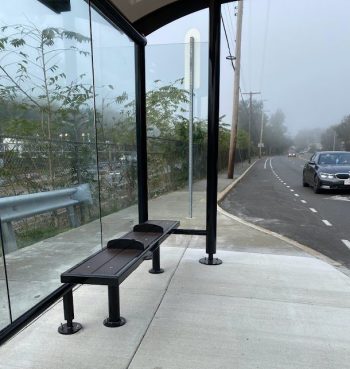
I live in the Boston suburbs. On a foggy walk home one morning, I wandered past this bus stop, noticed this bench, and felt disappointed in everyone involved in creating it.

Benches like this are subtle forms of “hostile architecture“—versions of public infrastructure that are designed to ward off use by the least fortunate in society. Spikes where someone might lie down for shelter, oddly angled seats that discourage getting comfortable, etc. These sorts of decisions are sometimes justified, in places with lots of foot traffic, or to prevent damage from, say skateboards. But more often then not, they’re used to prevent penniless people from sleeping somewhere sheltered or dry. Special constructions designed to ward off use by its user. They’re a way of looking at people who have absolutely nothing, nowhere to go, who are seeking an ounce of comfort from their surroundings, and denying it to them.

Inanimate objects themselves, most would say, are not inherently good or evil. Rather it’s how they’re used, and the intentionality behind their construction and placement that matters. That’s why there would be nothing hostile about anti-sleeping bench in a high-traffic place where there were people lingering or taking up too much space at once, or there was lots of other seating around. But place it somewhere that a desperate person might try to sleep inconspicuously, as a last resort, and it becomes cruel.

The area where I encountered this one isn’t really either of those things. It’s just sitting out on a wide street with no cover nearby, and no houses on that side. I don’t think I’ve ever even seen anyone waiting for a bus here. People take public transportation and there are plenty of pedestrians, but nobody’s lingering. There’s not even visible homelessness around that would prompt a reaction to install a specific anti-homeless-person bench.

Which means that the city either chose this model on purpose, or the bench company makes this kind by default and it’s cheaper. Either someone in city government chose to be cruel without even the excuse of plausibly being afraid of the homeless, or our civic life is so degraded and distrustful that bench manufacturers find it profitable to sell mass-produced hostile benches as the discount option.

I could check I suppose, but why bother? Which option would even be worse? [Note: I just thought about it for 5 sec and realized that the latter case would, because it would represent a more widespread issue.] Fortunately, the main victims of this particular bus stop are mopey citizens like me who find hostile benches depressing, as opposed to any actual hard-up person who needs a bench to sleep on. It’s mostly cruel in a theoretical sense. But just as a prevalence of umbrellas in the hands of Seattleites is a marker of their familiarity with rain, the normality of rude architecture marks a society’s callousness towards the destitute. It would be nice if things like this felt a little bit less normal.