

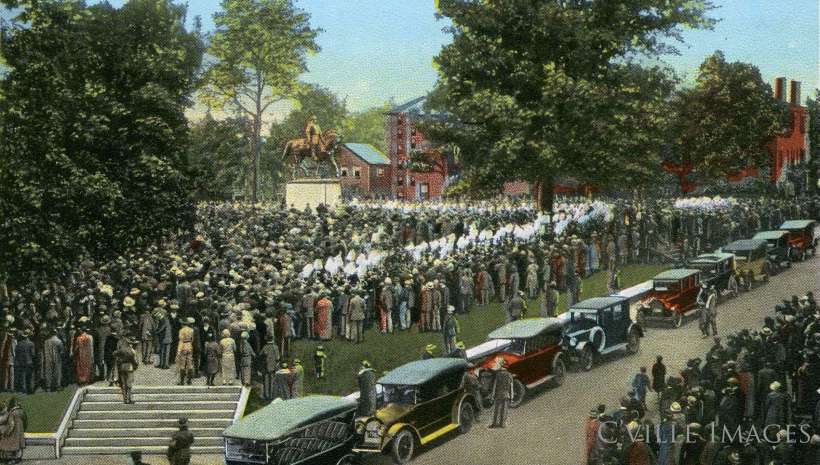
A product of concerted pro-Confederate ‘Lost Cause’ historical revisionism: Charlottesville’s 1924 dedication ceremony for one of history’s biggest losers, Robert E. Lee. Fewer tiki torches visible at this gathering than the one 93 years later, but they’re there in spirit.
The gilded pricks who populate think tanks will stake out a justification for whatever deranged policy ideas it is in their interest to. Having been inoculated against the Dunning-Kruger Effect by years of steady income telling rich people what they want to hear, they feel perfectly comfortable wading into any area and splashing their ignorance across any op-ed pages that will have them. They’re not writing for scholars, they’re writing to prop up profitable political interests by giving their desires a thin veneer of intellectual plausibility.
So ordinarily the faux “studies” cranked out by such groups are beneath consideration, but I ran across one by accident and found it so dense with bad reasoning, historical inaccuracy, and paranoia that it renewed my belief in whatever the opposite of the authors beliefs were. It was begging for someone to write a scornful blog post about. It’s shameful that politicians use articles like this as cover for hobbling education in red states, an effort which has kept pace with the radicalizing authoritarianism of the right.
After all, by receiving a PhD, I became duty-bound to defend the search for knowledge and the dissemination thereof. Under a moonless sky, I pledged a blood-oath to denounce really bad scholarship, contrived in service of illiberal ends, whenever and wherever it was reasonable for me to do so. As long as I felt like it.
I have fairly low respect for sociology as it is, but this motivated-reasoning sociology has got to be as bad as it gets.

A primary inspiration for the desire to remake education in the graven image of right-wing hagiography can be found on the collapsing husk of twitter, where one of the authors shared a thread expounding on his belief that younger people are trending more Democratic than previous generations. They draw a straight line from this to modern schooling. This is the kind of view that everyone’s loud conservative uncle has, but Goldberg & Kaufmann (G&K) are determined to bring rigor to it!
He points to the eye-watering turn away from conservatism pictured in this graphic. Unlike previous generations, millennials aren’t voting for Republicans as much as they get older. Without bothering to compare this idea to any other theories, G&K declare that educational wokeness must be the reason. Surely, nothing else about politics or the world could be different than 30 years ago. It must be the kryptonite…of critical race theory…which is warping these children’s view of the world!
It should be fairly obvious that there might be a few flaws here.
It assumes that education itself is different enough than it used to be in the 1980s that it changes student’s thinking permanently, and indeed that schooling itself is a strong determinant of adult political views. (While most of us probably imagine ourselves coming to our beliefs about politics through a process of learning and reasoning—research suggests that for most people, those things serve more as justification than inspiration.)
As for competing explanations for the difference among Millennials, a few alternatives spring immediately to mind. One would be that the generation currently settling into middle-adulthood has been denied the economic stability that usually ensconces people into the feeling that they have a stake in preserving the conservative status quo. Millennials are worse off in almost every economic sense: paid less, for longer hours, buried under student debt, unable to buy homes (which are, relative to income, about six times more expensive as they were 60 years ago). And all against a preposterous din of stultifying boomeristic obliviousness about the value of hard work. A situation of their own making, as champions of austerity.
Or what about the other ways in which unpopular conservative positions have come to affect younger people and new millennial parents? Abortion rights, climate change, LGBTQ rights, frequent school massacres. Or merely the fact that for the entirety of millennials’ political memory the GOP has been a ghoulish assemblage of hateful little weirdos.
/cdn.vox-cdn.com/uploads/chorus_asset/file/19895361/IMG_3015.jpg)
The authors don’t WANT to find out why people dislike their ideas, they want to turn them into dinosaurs
To even more directly contradict the hypothesis that Millenials’ reluctance to grow more conservative is due to education–the same trend is evident in the UK! This is a good control group. Our educational systems and history are markedly different, but Millenials in both countries are experiencing very similar economies.
For this reason, Kaufmann cropped this chart to avoid showing that the UK was on it, because it would undermine his point if a country with a different history, racial makeup, and educational system exhibited the same trends as us. But indeed, they don’t actually care about understanding this–they care about doing the thing they want to do anyway, which is to warp the history that students are taught in school in the vain hope that it will alter their thinking.
Professor Xavier’s School for Mutant Intellectuals
Conservatives of this ilk often begin by defining a constellation of ideas that make them uncomfortable and then giving them a scary name, to “other-ize” relatively well-accepted facts or reasoning. Fascist thought-leader Christopher Rufo, a successful practitioner of this technique, explained how he does it a couple years ago:

Journalists covering the reactionary hysteria over CRT allowed this admission to slide. By the time this moral panic hit their radar in 2021, it had been all over conservative media for a while (building steam as backlash to 2020’s protests against racialized police violence) and they didn’t feel the need to interrogate its origins when they could simply write “both-sides” stories on it. Instead, these astroturfed campaigns have been treated as good-faith disagreements over how to teach subjects dealing with America’s past, rather than an overt attempt to channel white resentment. Fortunately for racists, there’s nothing remotely difficult about finding kooky-sounding lessons in a country of 350 million, and cherry-picking it for your racist audience to say “see!”
It also escaped the notice of much of the media that Rufo’s earlier career was in pushing creationism for the Discovery Institute–an earlier educational panic that had all the precursors to this one, but with less emotionally-fraught topic (and one which was easier to dismiss as a religious effort that had no place in secular science classes).
It should come as no surprise to see several of Rufo’s ideological collaborators linked to overt white supremacism recently: Nate Hochman, Richard Hanania, along with book-banning, Hitler-quoting, censorship front Moms for Liberty. One of the authors of this very “study” (Kaufman) was even in Hanania’s small think-tank, the Center for the Study of Partisanship and Ideology. And lest one assume that this was a large amorphous group, where he wasn’t close to the famous eugenicist, it was literally three people.
Survey Course
The thesis of this work is that if you are merely exposed to dreaded woke/CRT/social justice theories, even without agreeing, that you are more likely to end up voting for Democrats. What follows are then a series of questionnaire data that they attempt to mangle into this theme. If you don’t want to read an overlong explanation of their bullshit claims and the numerous ways they obfuscate, ignore important correlations, and generally exhibit a degree of carelessness and bias you would expect from a pseudo-academic article written to be printed out and waved around by red-faced Republican town council members–skip to the end.
Never Discuss Outcomes
If you are still here, let’s get into it. The first thing they need to do is describe the boogeyman. Acronyms are scary right? How about one for something called “critical social justice”? “CSJ” is a hodgepodge of views they believe comprise “the left’s post-1960s intellectual shift from economics and class to culture and identity groups.” (We are already almost incoherent.) Some of those things are:
-
The primacy of race, gender, and sexual inequalities over material or psychological forms of inequality;
-
A focus on unmeasurable and unfalsifiable “structures” of oppression that purportedly advantage whites, males, or heterosexuals, and disadvantage racial minorities, women, and sexual minorities;
-
Inequalities of outcome—such as race or gender gaps—used as evidence for both causes (“structural racism”) and effects (“racial disparity”), resulting in circular logic;
The right is very concerned that we never worry about “outcomes.” It isn’t fair, you see.
They make this distinction because a foundational belief of conservatism is that when it comes to money, everyone gets what they deserve. It’s a comforting axiom for people who are terrified of a cold and random universe. Thus, since racism is over, it stands to reason that the massive disparity of wealth between different races in America is either a mere coincidence, or the result of genetics or culture. Either inequality springs into being, unbidden, as an outcome of nothing in particular, or far worse–Black people must be inferior in some way that results in them being at the bottom rung of the country’s economic ladder. People pursuing the line of reasoning that life outcomes are out-of-bounds for investigation, are revealing a conviction that certain people deserve to be poor. Moreover, they are preemptively deciding that they will simply ignore any evidence of structural racism. The fact that they consider inequality perpetuating itself to be some kind of circular logic mind puzzle is really more their problem than anyone else’s.
It’s especially wild that authors who believe that four centuries of oppression haven’t left a verifiable mark on society, are nonetheless concerned with the possibility that “psychological” inequality is a big deal. Conservative victimhood complex never rests.
Differences between “ancestral groups” are cool and good
This is the kind of world-view Goldberg & Kaufmann believe educational institutions ought to be neutral towards:
[T]he idea that blacks, whites, and other racial/ethnic groups would have the same or similar socioeconomic outcomes today if not for that history is a highly contestable and not readily falsifiable claim that has no business being taught as settled fact. As has been noted elsewhere,[10] outcome disparities of varying size between ancestral groups are the norm, not the exception—even among U.S.-born whites of differing European ancestry. And many of these disparities have persisted through time despite having no obvious connection to social oppression.
They evidently believe that humanity exists in a “natural” state in which significant disparities, attributable to nothing in particular, persist between different ethnic groups or nationalities. Even if that were true, would it be desirable? Asserting a “normality” to such a configuration is itself a non-neutral position.
Of course, they are wrong to posit that there are non-historical reasons for racial differences in wealth & education. This is a question that has been settled! Thoroughly! Eugenics is making a comeback on the American right, but not anywhere remotely academic. To them, the idea of genetics explaining the socioeconomics of the world is a comforting mythology, explaining away injustice both past and present. As Adam Serwer has written in discussing the uptick in this thinking “[G]enetic determinism doesn’t just diminish the impact of past oppression; it valorizes it—rendering slavery, segregation, and genocide but the natural consequences of a genetic underclass meeting its betters. The government has no reason, then, to rectify past crimes or resolve present inequalities; they are simply what happens when one group of people is superior to another.”
The Civil Rights Act was only passed in 1964. Jim Crow, segregation, and redlining were widespread legal practices within the lifetimes of student’s grandparents. People like Ruby Bridges, the six-year-old who integrated her all-white Louisiana school, are still around and look like this. Pretending that the aftereffects of these practices have been washed away within the span of a single generation would be a ludicrous disservice to students’ ability to understand the country they live in. If that makes you more liberal, so be it. Facts don’t care about your feelings.
The Forbidden Concepts
As previously mentioned, G&K call anything that touches on issues of race or history “Critical Social Justice” (CSJ). Most of this “study” is just looking at cross-tabs of survey data compared against how many of these dreaded ideas students had “heard of” or been exposed to.
Respondents were asked whether they had been taught these concepts, heard them from an adult at school, had not heard them, or didn’t know. […] Individuals could tick more than one box.
In addition to the six questions in Figure 1, these young people were also asked the following: “During your time in high school, college, or other educational settings, were you ever taught that discrimination is the main reason for differences in wealth or other outcomes between races or genders (Yes/No/DK)”

And here are an array of observably true statements:

These are not neutral opinions for which all views are equally valid and school shouldn’t attempt to disambiguate the truth of. In any paradigm for what “privileged” could mean sociologically, being white just is one of the most important sources of privilege a person could have in America. You live longer, have more money than most, usually see people like yourself reflected in arts culture and positions of authority. It’s not the only possible way of being privileged, but it’s undeniable that it helps compared to the alternatives. A school should teach that kind of thing. Do what you like with the information, but it’s just a fact.
Moreover, these aren’t huge differences. They are attitudinal changes of ~10-20%. Added to which, is the fact that the word “taught” can mean a couple slightly different things to someone taking the poll. I can be “taught” about the beliefs of transcendentalism without coming away from the lesson convinced that I have to move to the woods to be self-sufficient. I’m just learning about how a certain school of thought understands the world. Theories of history are similar. Even the language used in the question is vague: “reported either being taught in class or hearing from an adult in school that…” This could mean a lot of things.
Influenced by Life
If you attempt to understand how people are influenced by their surroundings, you need to grapple with cognitive biases about how attitudes form. Particularly, you need to account for the fact that people who have come to be more liberal (for whatever reasons) will take away from history classes that discrimination leads to wealth disparities because they will interpret the facts as teaching them that. Further, the students who remember having learned about discrimination in school are more likely to be the ones who know about the effects of discrimination. Because they were paying attention.
They see this effect without recognizing it among students of color. They notice that those students repeat back that they have “heard of” and “been taught” about racism and discrimination at a higher rate. Likewise, their white peers at schools in zip codes with more minority students are also more likely to have “heard of” those things. This shouldn’t be surprising–more of them experienced it themselves, or know others who have. Yet G&K are baffled:
“While we can only speculate about why students in more-white zip codes are less exposed to these concepts, we can say there is no evidence that the foregoing pattern is a function of local partisanship”
But these are white kids who are more likely to know Black ones personally as friends. They’re better positioned to know the truth of their experience in the US than ones from whiter districts. This isn’t something where both groups have access to the same information.

Giving up, as usual for this guy
Teach the Controversy
They are aware that their poll questions are basically equivalent to measuring what percentage of students recall hearing about these dangerous woke social theories, as opposed to how many were taught that the dangerous woke social theories were correct. Thus, G&K attempt to preempt this objection by writing a section called “Is CSJ Being Taught as One Perspective, or as Truth?” In this portion, they claim to have polled students on whether they were taught the objections to the things in the previous section. This is essentially asking a question of the form: “Tell me Jaydenn, do you recall having been taught the counterargument to the idea that ‘America was built on stolen land’?” What even would that sound like? People have varying degrees of discomfort with the manner in which America expanded westward, but we all know that it expanded into something…
Since the category of stuff that they’ve defined as “CSJ” is a half-dozen academically uncontroversial ideas, asking students whether they’ve been taught about the “alternative” to those things is ridiculous.
Rolling all these things into a single scary acronym also creates the impression that the basic contours of widely understood racial history is up for debate. If you weren’t taught that slavery might not have been so bad after all, you weren’t really taught an argument against the prevailing “CSJ attitude,” were you? This is akin to proponents of creationism who insisted that students learning about evolution be “taught the controversy” over the theory’s accuracy. A maneuver which diminishes the authoritativeness of a valid theory, while pleading for equal time for an invalid one, in the sake of fairness.
Conveniently, G&K avoid spelling out what those “counterarguments” would be, which helps to gloss over the fact that they want outwardly racist falsehoods taught as those “alternatives” in schools.
Correlation meet Causation

What’s going on with this guy’s shirt?
In the next section G&K draw a connection between students learning that segments of the public hold various political convictions, with the idea that they have internalized those convictions themselves, and that it effected their views. And without demonstrating anything, they simply declare that any alternative explanation for it has only 0.1% chance of explaining the effect. Egads, boys! We’re really doing science now aren’t we!?
Adjusting for alternative explanations using demographic, social, and area control variables has only a minimal moderating effect on the substantial statistically significant difference in attitudes between those taught no CRT concepts and those taught all five.[30] On whites being responsible for the social position of black people, the gap is 43 points between no exposure and maximum exposure; for whites generally considered “racist and mean,” the gap is 32 points; for preferential hiring and promotion of African Americans, 27 points; and for government helping black people, the gap is 37 points. These are nearly all significant at the 99.9% level and show that teaching CRT to children has a massive effect on young people’s policy attitudes. Interestingly, these results are similar for white and nonwhite respondents, though not always of the same magnitude.[31]
(They literally poll people on agreement with the statement “When I think of the manner in which black people have been treated, I sometimes think that white Americans are racist and mean.” Shiver me timbers, someone is implying that people who look like me could be mean!)
Once more, G&K hover near the actual explanation and then dismiss it by simply saying “but what if not?”
Earlier, we showed that self-identified Democrats (and liberals) reported significantly higher levels of CSJ exposure than Republicans—differences that are not entirely explained by the control variables in our dataset. One of the possible explanations we proposed for these differences is that Democrats/liberals are more likely to recall ideologically congruent information than their Republican/conservative counterparts. However, given the relationships we document between exposure and the endorsement of radical gender and racial attitudes, another possibility is that such exposure causally influences political self-identification.
Goldberg & Kaufmann are just saying “A fits our results, nothing disproves it being A, but what if it was B? Saying it was B would really help get us mentioned at a CPAC panel discussion co-chaired by Josh Hawley.”
Don’t even think about it, Red
That’s all for Part 1 of this dive into the murky abyss. Carry on with Part 2 tomorrow, where we learn that we should only ever feel happy and proud about things that happened centuries before we all lived.
Pseudohistory Repeats Itself, Part 2

 Aitch-Bar
Pingback: Pseudohistory Repeats Itself, Part 2 | Aitch-Bar