


What if the movie Face-off had been set during the 1860’s? I think it would have gone a little something like this. (Photo NYTimes)
The first half of this piece can be found at Pseudohistory Repeats Itself, Part 1, an extended fisking of is School Choice Is Not Enough: The Impact of Critical Social Justice Ideology in American Education by Zach Goldberg & Eric Kaufmann
Guilt by Association
Over and over, Goldberg & Kaufmann (G&K) express concern about white kids who fear that they will be perceived as racist:
As a likely consequence of this fear, those exposed to CRT become less willing to criticize a black schoolmate, preventing black pupils from hearing useful feedback from classmates.
And,
[T]he teaching of CRT is likely to significantly impair the peer feedback process for black students, limiting potential opportunities for black students’ intellectual growth.
“Useful feedback” is the most euphemistic way of describing racially-motivated bullying I’ve ever heard.
They attempt to quantify this phenomenon by asking how comfortable someone feels criticizing their peers of different races. People reporting more exposure to teaching about racial injustice tend to be more concerned about criticizing students of color, whereas students of color feel more comfortable criticizing their white peers. The latter case is, presumably, the thing that really scares them. Especially scary since it appears to increase the more “CRT” they report having been exposed to. Suddenly, instead of being “helpful feedback,” (like when Black kids are on the receiving end), for some reason, it is now described in grave-sounding tones. They don’t seem quite so worried that white kids will lose out on the benefits of this criticism.
Until, hilariously, G&K realize the implicit contradiction and make sure to wedge this sentiment into the very end of the section (in defiance of the article’s primary thrust about the dangers of CRT): “[T]hese results would suggest that teaching more CRT is likely to benefit white students by introducing a greater willingness among pupils to criticize them while harming black students by withholding the criticism that might further their intellectual development.”
Saved it at the last minute!
Whites who say they were taught three or more CRT concepts were nearly 13 points more likely to say they would have been uncomfortable criticizing a black schoolmate compared to whites who were taught no CRT. Ironically, the effect of CRT is to discourage criticism that might help to improve the very minority outcomes that CRT claims to care about.
This is not, in fact, a thing “that CRT claims to care about.” Critical race theory seeks to explain broadly disparate life circumstances among racial groups. It is concerned with matters of wealth, power, and law. It spends considerably less time (in my understanding) on whether it would be helpful for Trevor to tell his classmate to consider whether all lives actually matter.
Yet, they cannot help themselves. They go further still: white kids should not be made to learn anything that causes them to have an emotional reaction.
We find that white respondents with higher CRT-related exposure feel more guilty about their race, experiencing negative sentiment toward their own group. Whereas 39% of whites who did not report any CRT-related classroom exposure indicated feeling “guilty about the social inequalities between white and black Americans,” this share rises to 45% among whites who reported being taught one or two CRT-related concepts, and to between 54% and 58% among whites who reported being taught three or more concepts. Here, we should also note that levels of agreement with this statement are considerably and significantly higher among white liberals (65%) than white conservatives (29%), which accords with the findings of past research.
No one alive currently should, in fact, feel shame or guilt about the past. We weren’t there. It wasn’t us. Even people whose direct ancestors did awful things are not, themselves, responsible for those acts. To live otherwise would be to inhabit a prison of unatonable regret.
This does not imply that downplaying the evils of history is necessary. Rather, the fact of our innocence and non-involvement is what allows us to deal honestly with those evils. Only someone who felt kinship with the past’s worst racists would feel a need to make justifications and excuses for them. Obfuscating the truth about historical actors aligns oneself with those whose reputation the lies burnish.
As far as the “guilt” described in that survey, the extent of distress it causes is unclear. It is possible, of course, to feel guilt within one context without it being an ever-present part of your day-to-day life. Someone can say they feel “guilt” over things which they understand not to be their own literal fault. I might say I feel “guilty” that I missed your birthday party because my flight was canceled. Or I might say that I feel “guilty” that I relished tearing apart your idiotic CRT push-poll faux research article. Of course, I would not feel true guilt in either of these cases. I would feel rhetorical guilt, rather than the emotion of guilt. It is even possible to recognize a certain level of group culpability, without feeling as if you have a personal relationship to it. Needless to say, the potential meanings of “guilt” used here are broad. And its negative effect on students is unspecified.
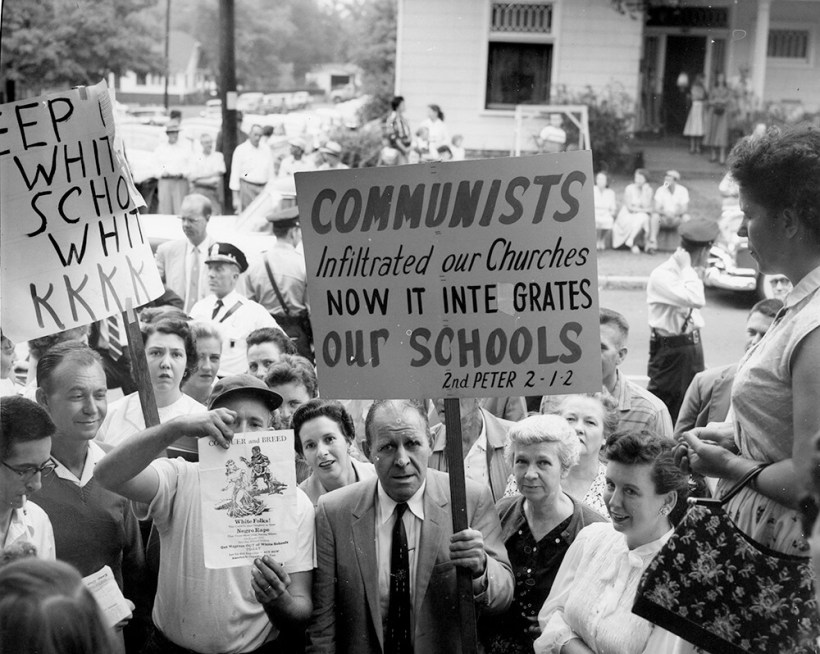
Good old-fashioned civic engagement
Think of the Children
Throughout, G&K seem befuddled by the fact that young people are more liberal. They mistake correlation between liberal parents and their liberal kids (more young people vote Democratic, obviously) for causation.
The first point to note is that Democratic parents are better able to pass their political affiliation on to their children than Republicans. Why might this be? One reason could be that schools tend to reinforce the political leanings of the parents and to socialize children in a leftward direction.
 They do tricky stuff to manipulate how many respondents are included in the sample. Their results included lots of people who are independent/“don’t know” their political views but they didn’t include them on the chart. Instead, they only show the various kids on the extremes who saw none of, or all six of their dangerous lefty ideas. The extreme ends of the range happen to align with the point they are trying to make, whereas including the numbers in the middle might make it look uncorrelated. So they simply don’t show them. Their eventual sample sizes are quite small, but they represent them as percentages—another technique often used by people who are exaggerating.
The total numbers (in parenthesis above) back up the fact that this is a correlation. There are far more “High CSJ” students (120) with Democratic families than “No CSJ” ones (43) and among their percentages, the most Dem-leaning group was the ones who had a lot of this education and had Dem families. They are the most able to recognize ideas that they have seen in school, in their home, and in their political milieu–of course they would say that they learned about the concept of “patriarchy” in school–they know how to recognize that word!
G&K state that children’s political beliefs are most strongly linked to those of their mothers. But women, on the whole, are more Democratic-leaning, as are young people. They’ve simply observed that both groups are both more liberal than average and decided that they are causally linked. It is hard for me to believe that anyone could actually be this bad at this.
As if in answer to my prayer of disbelief, in the Appendix they fully admit that these are not causal relationships! Hidden away, on a separate page that hopefully no one will click through to, Goldberg & Kaufmann admit that their central thesis is wrong!
First, the cross-sectional structure of the data does not permit us to infer or demonstrate causal relationships. For instance, we cannot in any way conclude that greater exposure to CRT-related instructions causes increases in “woke” racial attitudes. Being able to do as much in the current data would require a) identifying and controlling for all (confounding) variables that cause both exposure and attitudes, and b) excluding the possibility of reverse causation (i.e., attitudes cause exposure).
[T]hough we think it is far more plausible that exposure causes attitudes, we do not have the means to rule out the reverse possibility.
And this is actually the mechanism by which they’ve left open a door for correlations: the survey questions rely on students’ impression of what their lessons meant. You will perceive more “exposure” to being “taught” something if you draw that conclusion from the evidence. Unsurprisingly, there is going to be a connection between believing that you learned about racial inequality in school if you are liberal, and if you don’t think there is any, you won’t tell a pollster that that was “taught” to you, because you don’t think that it exists!
A second notable limitation is that our measures of students’ past learning experiences (including their exposure to CSJ-related concepts) unavoidably rely on respondent recollection. Consequently, the accuracy of these measures hinge on the ability of respondents to accurately recall and faithfully report past events.
That’s the ballgame, folks.
Recommendations
Eventually, after what feels like an endless slog of mild, manipulated correlations between tepidly liberal views and a person saying “yes” when asked to recall whether they “learned in school” that discrimination happens, we arrive at the ultimate point of this craven exercise:
[M]any conservatives seek to reduce the impact of the public school system by emphasizing school choice, private schools, and homeschooling. But this strategy hinges on whether school type matters. If CSJ is being taught in private, religious, and charter schools, then expanding them will have little impact on the indoctrination of pupils. If CSJ can be acquired from social media, entertainment, and peers, then homeschooling will not prevent young people from acquiring these ideas.
If “CSJ” can be acquired from every form of human communication that an adolescent is likely to engage in, no policy could stop any of this. So why bother?
They are bothering because they are so afraid of “CSJ” that they can’t risk contamination from public school kids leaking into the protective bubble of homeschooled children, or traversing teen cyberspace to cross town or state lines. They must thwart anti-racist attitudes wherever they have the chance.
In fact, less than a quarter of the first time someone sees the scary left-wing ideas is school:
When asked where they first encountered the CSJ concepts they were asked about, “school” (23%) was second only to social media (40%); “friends in conversation” (12%); “parents” (10%); “movies, music” (7%)
and,
Our findings further suggest that homeschooling, parochial schooling, or (non-religious) private schooling are only minimally effective in preventing CSJ from being taught
Thus they conclude that conservatives have no choice but to impose their views on schools. They can’t simply encourage close-minded parents to take their kids out of school to ensure that they (a) have no friends, (b) maybe have a slight chance of never encountering the idea of “white privilege.” School simply seems to be the only one of these settings that they might have any influence over.

Faithful and accurate depiction of Confederate general Nathan Bedford Forrest
Let’s Wash Some Brains
G&K have arrived at the conclusion that conservatives must fight educational freedom by way of this sloppy, ad hoc discussion of which forms of instruction “lead to a greater transmission of political beliefs.” These are people who understand how deeply unappealing their views are to anyone learning about the world for the first time. After spending the whole article beating around the bush, it is a refreshing burst of honesty to hear them concern themselves with how best to raise a Republican, at long last.
Manipulating political attitudes is the only thing in question here. Consideration for which concepts are objectively right, or whether educators possess their own expertise in crafting school curricula absent interference from half-wit state legislators…is entirely beside the point. Truly galling stuff for anyone viewing education as a common good that isn’t about achieving partisan objectives:
If political capital is scarce, it should be expended on reforming the public school system in states where a particular party has the advantage. In red states, this means Republican energy should go to school reform more than school choice. There is no “exit” shortcut. Instead, “voice” to reform public schools is the best option. On the other hand, in blue states, Republicans would be better served focusing on school choice or homeschooling. Democrats supportive of CSJ, meanwhile, should opt for the reverse approach, favoring “exit” in red states if they cannot protect the curriculum and using their political “voice” to boost the CSJ curriculum in blue states.
It is fun that they pretend to be non-partisan in their analysis for the Manhattan Institute.
For progressive Democrats who favor these concepts, the long-term strategy should be to encourage CSJ in teachers’ colleges and materials while opposing CSJ bans and curriculum transparency wherever possible, while focusing less on whether schooling is provided publicly or privately. Of course, in terms of immediate electoral priorities, the fact that CSJ instruction is unpopular[58] among voters … Democrats may not wish to defend CSJ if it costs them elections, and they may wish to oppose school choice if that opposition is what their union constituency prioritizes.
Aw, shucks. Guess we’re just living in a tug of war over whether we can convince kids that the Trail of Tears was bad. You know, for votes.
They recommend banning “critical” studies of “race, gender, and sexuality as political, not as a consensus of moral values.” Whatever G&K think “critical” means is anyone’s guess. They, of course, want to ban diversity programs on the basis of some unquantifiable characteristics (or at least weigh them down with diagnostic requirements):
Conduct a rigorous and representative, not qualitative, impact assessment of Diversity, Equity, and Inclusion (DEI) instruction. If measurable positive effects do not outweigh negative effects in statistical analysis of large-scale datasets, DEI instruction should cease until such time as randomized control trials with reformed curricula can be shown to work.
Apparently proper instruction of history should hedge and make excuses for particular groups, lest any of the students actually start to notice how patterns of supremacy function:
-
Ensure that teaching about American history and society balances the need to acknowledge when the country has failed to live up to its ideals with the need for national pride, which is important for social cohesion.
-
Ensure that teaching of past wrongs (i.e., slavery, fascism, colonialism, conquest, and discrimination) be contextualized by teaching about similar excesses in the non-European past and present, including the excesses of communism and other left-wing movements.
As mentioned earlier, it is always telling when someone’s main point of concern is in justifying injustice. Why should we care if dead Europeans get a worse rap than others for past misdeeds? Are we actually worried that the typical education won’t also prominently feature plenty of positive contributions from dead white guys? How does it increase social cohesion to tell minority students with direct familial experience of oppression that it wasn’t actually so big a deal? Who is this for?

Virginia textbook used in the 1950s-70s. Look how “neutral” history used to be.
Conclusions
Goldberg & Kaufmann claim that this is a dispassionate analysis of whether teaching schoolchildren about common interpretations of history and takes on social issues turns them into Democrats. The results came back with a resounding “sort of!” because they observe a loose correlation between people holding left-wing views and people remembering having learned about topics that people with left-wing views consider important. G&K even admit as much, burying the recognition that the direction of the causal relationship between those two things is unclear in the appendix.
In light of that fact, this fails not only as scholarship, but as a useful guide to achieving its unstated (but obvious) goal to create the best educational environment for fostering a future generation of conservatives. There is no reason to believe that the kinds of lessons G&K dislike actually have the effect they believe. (There’s no reason not to believe it either, but they simply haven’t shown that there is with this data.) And they certainly have not established that there is any way of accurately teaching history which won’t make kids more liberal.
It is, after all, an incredible coincidence that the very things they object to about education, as ideas, happen to be the ones that they claim end up influencing kids into being liberal. And thus, conveniently, Republicans can tell themselves that they have a political self-interest in banning them–so as to achieve “non-partisan” education. (To outsiders, “non-partisan,” and to each other, winkingly, help for their side.) Each proposition reinforcing and justifying the other. “I’m not against lessons on Jim Crow, it’s just that too much emphasis on this ‘race’ stuff is a Democrat plot to brainwash kids.” Strangely, both of those complaints are unacceptable, but by relating them to each other, each on its own only becomes just half of the reason rather than the full reason. Each mitigating the objectionableness of the other.
Let’s be honest: papers like this are a series of justifications for doing the thing that authoritarians already want to do anyway. Restrict what is taught in schools, reinforce hierarchies of race, class, gender, and sexuality, and try to make sure that students don’t learn to recognize parallels between historical injustices and modern-day ones. That they found a way to generate it with the imprimatur of an arcane-sounding think tank gives censorious state-level ideologues a citation to attach to book-banning bills and misleading education policies.
Reactionaries have intensified their assault on education over the past several years. From Florida tearing up the AP African-American Studies course, incoherent attacks on “CRT” in schools, to widespread attempts to ban books from schools and libraries, to harassment of teachers, we are in the midst of a reactionary backlash. It also happens to serve the function of undermining public education in favor of charter schools and conservative institutes of higher ed, which they can then use to funnel public money to rightwing investors.
Since the days of William F. Buckley’s God and Man At Yale the specter of lefty academic indoctrination has floated menacingly above aging conservatives. They recoil at tales of offspring sent to college, only to return having rejected the repugnant views they were raised with. Surely, colleges have brainwashed the youth! The truth, of course, is rather more complicated. Exposure, often for the first time, to other students of varying backgrounds and identities, along with learning how to think critically about how the world works, tends to shake up the outlook of kids who have never before given much deep thought to political matters. If broadening one’s mind with education makes students more progressive, so be it. Get a better philosophy if it bothers you so much.
Since these authors seem obsessed with minorities getting the “benefit” of peer criticism, and Goldberg & Kaufmann are increasingly in the minority, allow me to offer some thoughts, as a peer white. Fellas, this article sucks. You should find different careers. Or, if you have to keep flogging this kind of dreck, maybe head back to creationism, at least that was funny.

 Aitch-Bar
Pingback: Pseudohistory Repeats Itself, Part 1 | Aitch-Bar