I wanted to use a clever name for a running series of miscellaneous hodgepodge so I thought “there’s probably some zany Germanic compound word for a collection of random artifacts. It’ll be a translation of a common thing that contains random items.” Well, as you may have guessed, it is kram schublade, literally, ‘stuff compartment’ in German. Despite the length and fun to say, it doesn’t appear to be a well-celebrated term. The Germans are very efficient when it comes to junk storage, one assumes, and people who store their junk this way are probably socially ostracized.
It seems like it’s supposed to be two words, really, but compound words are more fun. And now that summer is on the way and people are getting vaccinated, what better time to cram some clams? (Where by “clams” I mean “miscellaneous information,” that is.)
Ernst Thälmann Island
Bring me the head of Ernst Thälmann!
And speaking of German, East Germany! There is an oft-repeatedgeographycurio that goes like this: a small uninhabited island off the coast of Cuba was ceded to East Germany back when there was an East Germany as a gift between allies. When East Germany ceased to exist, the reunification treaty didn’t specifically mention this island, so, by implication, the German Democratic Republic lives on there, a smoldering ember of a once mighty Eastern Bloc.
It’s an appealing sort of myth–that some geographic technicality undoes a basic fact about the world that most people think they know. In this case, the technicality itself isn’t true: the “gift” that Cuba made was only ever in spirit, never a formal thing. They just did a little renaming ceremony so that the diplomats could get a picture together for the newspaper. The Cubans renamed their uninhabited isle after Ernst Thälmann, a German communist who opposed (and was eventually murdered by) the Nazis, and “ceremonially” gave it to them and erected a bust of the man himself on the beach.
But it is worth observing that even if it were “true” it wouldn’t really be. Things like the existence or non-existence of countries isn’t based on deciphering obscure bits of information, they’re based on mutual understanding, which is sort of the opposite. Unlike a question like “how many atoms make up the moon?” which has a precise, real answer, there is no cosmic ledger that says which countries exist and which don’t. They’re based on whether you can get a sufficient number of people to treat them as valid, so even if the architects of German reunification had forgotten about this windswept isle, it wouldn’t mean anything, and the Stasi wouldn’t get to start prowling around the Caribbean, wiretapping coconuts and whatnot.
Cash rules everything around me. [Ed: this graph is technically extrapolated from low-wage worker statistics specific to several urban localities, but proportions ought to be broadly true.]
Wage theft is the most common form of stealing in the US. That is, companies underpaying workers what they are owed. And because of the obvious difficulty in bringing legal challenges against an employer, nearly impossible to redress.
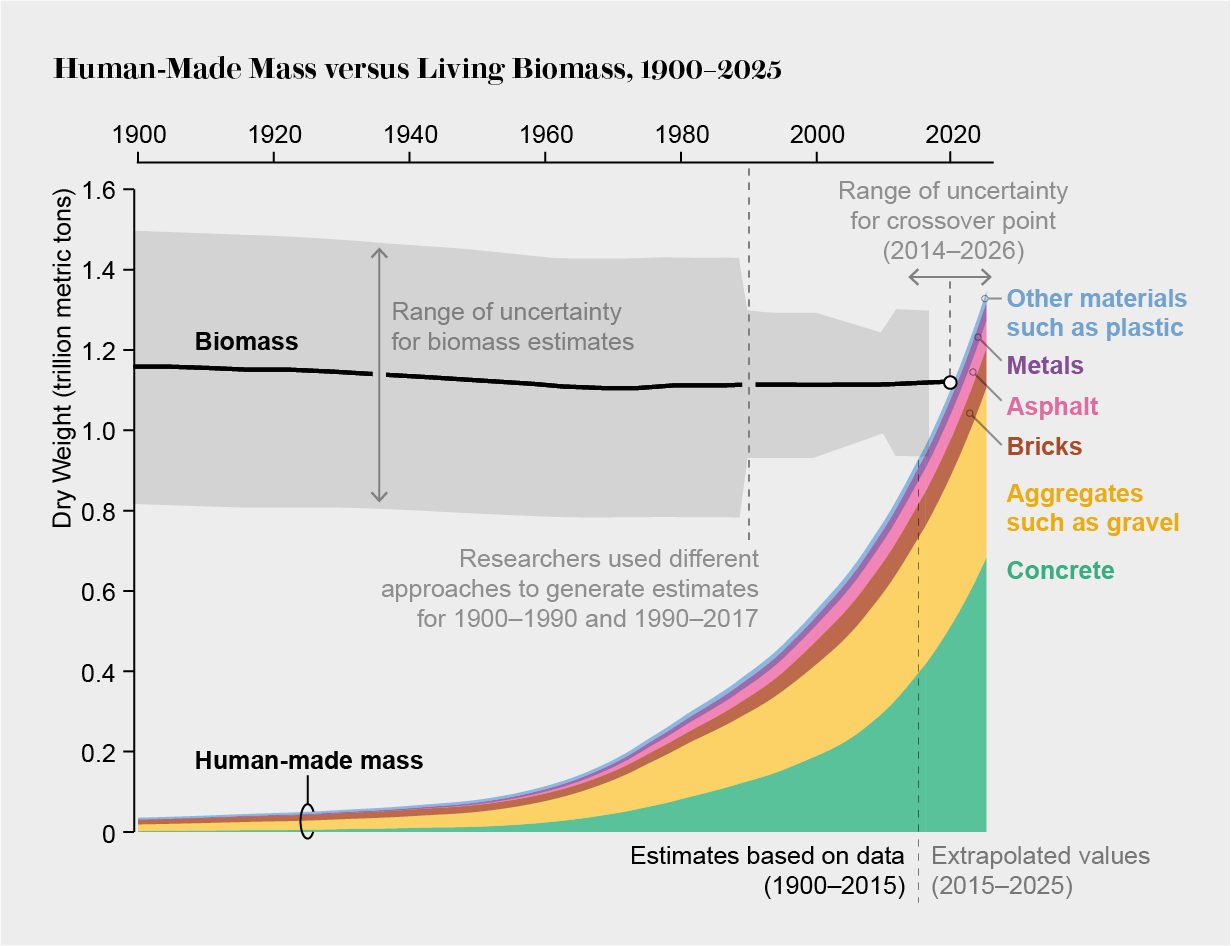
Credit: Amanda Montañez; Source: “Global Human-Made Mass Exceeds All Living Biomass,” by Emily Elhacham et al., in Nature. Published online December 9, 2020
The implications of these findings, published on Wednesday in Nature, are staggering. The world’s plastics alone now weigh twice as much as the planet’s marine and terrestrial animals. Buildings and infrastructure outweigh trees and shrubs. “We cannot hide behind the feeling that we’re just a small species, one out of many,” says study co-author Ron Milo, who researches plant and environmental sciences at the Weizmann Institute of Science in Israel. […]
He and his team had previously published an estimate of the amount of biomass on Earth, which led to the question of how it compared with the mass of artificial objects. Emily Elhacham, then a graduate student at the Weizmann Institute, led the effort to pull together disparate data sets on the flow of materials around the world. The researchers found that human-made, or anthropogenic, mass has doubled every 20 years since 1900. Total biomass remained more stable in that time period, though plant biomass has declined by approximately half since the dawn of agriculture some 12,000 years ago. The team estimates that anthropogenic mass crossed over to exceed biomass this year, plus or minus six years. […]
Whatever the moment when humanity’s production eclipsed nature’s, the study points to a larger narrative in which humans are modifying the planet to such an extent that we have created a new geologic epoch called the Anthropocene, says Waters, who has been active in research seeking out geologic markers of this proposed division of time.
“Greetings, Earthling. Would you like to play this game I bought?”
Occasionally, I write pieces for Adventures in Poor Taste, a cool site about all things pop culture, and even, sometimes, science! I recently reviewed the hit board game ‘The Search for Planet X‘ which falls squarely into the intersection of those two subjects. And after you check that out, have a look at my buddy Chris’s far more popular columns about X-Men comics.
The logical eventuality of electing the world’s stupidest authoritarian
Usually when trying to understand politics, we all grasp for historical precedents or analogies to situations that the founders envisioned. Most political commentary consists of those kinds of warring analogies, like “during the pandemic of 1918 city governments in San Francisco did X, while St Louis did Y” or “the writers of the Constitution wrote the Second Amendment to reserve militia powers to the states, which they believed were…” And a lot of the disagreement between different camps comes from various ways of interpreting the will of the people from the revolutionary era who envisioned how the government ought to do things.
Probably the largest gap in our understanding of how the government ought to work is due to the fact that the Constitution makes no references at all to political parties. This seems to have been the most significant oversight of the founders, who imagined that the three branches of government would be competing with one another, rather than cooperating across them based on factional affiliation to parties. That tension has been increasingly obscured over time despite the founders’ interest in preventing “factionalism.”
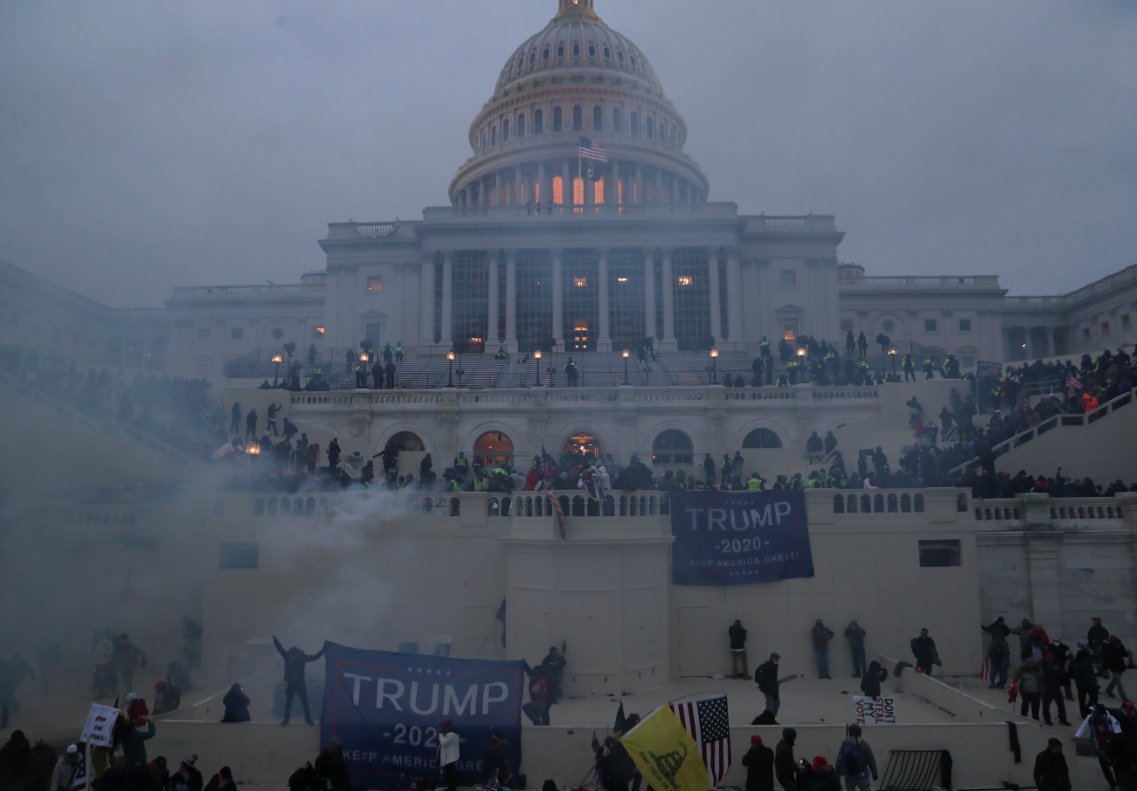
That obscurity has caused some number of people to miss an important bit of context in interpretations of last Wednesday’s events: that this scenario was exactly kind of thing that the framers of the constitution spent a lot of time thinking about. In fact, it was pretty much the most obvious political crime.
The president incited a mob to attack the congress during a transition of power. Strip away the particularities of our current age, the party affiliations of the various actors, the more recent historical examples of right-wing authoritarianism which this act was an outgrowth of, and the specific vectors which carried the false narratives that precipitated it. (Violent authoritarianism is almost always based on fraudulent beliefs.)
“What if the president doesn’t like something that congress is doing, and he sends the military to arrest all of them? Or he ignores the laws they pass over his veto? Or he whips up a mob to invade the capitol?” These are the kinds of questions we all game out when learning about the U.S. Constitution in middle-school history. It’s something that lots of people have thought about! Including, importantly, the very people who came up with the idea that there should be such a thing as a president and a legislature, and who enumerated the powers they ought to be granted to deal with one another. Unlike most of the political questions people debate, we don’t need to imagine what the founders would have thought about this—they spent ample time explaining their thinking about lawless rulers and the ability of government to constrain in situations exactly like this!
This is going to be the thing that schoolchildren learn about Donald Trump in 2076. That he lost re-election and then attempted to remain in power using every possible bullshit recourse. Because it is such a clear object lesson on how the various parts of the federal government and political representation as delegated to the states are all designed to interact as to make a perfect writing prompt for kids writing papers in class. They will be given essay assignments on how these events were a violation of the separation of powers, and be able to easily cite the steadily escalating constitutional abuses in the years running up to Wednesday’s debacle. Depending on the way the next 11 or so days play out, the extremely straightforward way in which he tried and failed to do this ought to clarify and distill all of his other actions over the past five years. We’ve been the frog in the pot as it heats up, getting acclimated to each transgression as it passes without consequence, waiting for the bubbles to start frothing over. (Or at least those of us without the wherewithal to look over the edge of the pot at any point and notice the burner.)
The specific lies which have facilitated this attempted power grab are so comically bogus and premeditated as to be unworthy of taking seriously, and have been roundly discredited by anyone even remotely tethered to reality at this point. Some people, by wandering into that mire and looking around, have gotten a bit hung up on the specifics of that alternate reality universe, missing the important consideration that any fascist uprising would, of necessity, be marinated in a sauce of dishonesty. It is always thus with demagogues, and it is indeed important not to ignore the chain of custody tying it to traits of right-wing thinking that led inevitably to this. The right is always a force for authoritarianism and enemies of a free and just society.
Yet that should not completely overshadow the fact that Trump sicced his bloodthirsty deplorables on Republicans as well as Democrats. People in the crowd were most eager to hang the Vice-President (working in his capacity as president of the Senate) and the Republican legislators whom they saw as obstacles to the executive seizing power. They ran roughshod over the seat of government, roaming around the corridors with zip ties to kidnap lawmakers and vandalizing their chambers. It’s a textbook definition of the kind of mob chaos that Madison et al imagined a president would attempt if the other branches were not given the ability to retaliate. Any senator or representative who doesn’t currently understand that they were attacked in their capacity as a legislator rather than as a member of a party “faction” right now needs a wake up call stronger than their own attempted murder, apparently. (The Republicans who voted to sustain objections to the electoral college votes after the incident belong in this category).
Such congresspeople may also apparently need to be reminded that failing to punish not only the president, but also the members of their own ranks who abetted this attack on representative democracy, will invite future attempts, and weaken the United States as a concept.
While I was watching the crisis unfold on Wednesday and seeing the flood of images that emerged afterwards (many gleefully filmed by the perpetrators themselves, who chose this particular moment to not wear masks in a turn of self-incriminating thinking that would be hilarious if it weren’t packaged with an adjacent cruelty towards others that is a hallmark of the year of Covid), I found myself becoming genuinely angry in a way I didn’t expect. I’m usually pretty above it, when it comes to sanctimonious outrage at offensive acts towards patriotic symbols, but as an American, it was infuriating to watch it all come to this in a way that I had cynically believed myself unable to feel at this point. Of all the disgraceful behavior of the right in our recent time period: suppressing votes, stealing a Supreme Court seat, extorting our foreign allies for domestic political advantage, stalling assistance to the country as it suffers through a health crisis, corrupting the justice system, and cheering on basically every variety of brutality towards Black people or immigrants—this was so obviously seditious that anyone who wasn’t shocked by it can safely be written off as unshockable. Anyone with a modicum of affection for this country (or at least good neo-classical architecture) was revolted.
Though this travesty was in some ways the least consequential of the events of the past year for the actual lives of people living in the United States, it was the most forthrightly symbolic of the right’s utter disregard for our shared civic spirit. If this isn’t enough for the people who preen and pose as if they honor our national values to realize that the forces they’ve been stoking are vile and un-American, what else possibly could be? It isn’t like the founders didn’t try to warn them about this guy.
As the sand runs out of the quadrennial hourglass, and the administration of our nation’s foremost very stable genius prepares to drunkenly lie down in a snow bank and go to sleep forever, it seems a natural time to pause for reflection on the many lessons that he has taught us.
Donald Trump’s presidency has truly shown that more than anything, America is a nation of laws.
It must surprise you that I am suggesting this. That is because you sense about me that you be would annoyed about how much I disliked him if you didn’t dislike him also. People around my age who wear medium-fashionable eyeglasses have predictable political views, and those views are never that the 45th president is paragon of lawfulness and virtue.
You can relax and rest assured that, predictably, I am asserting no such thing. I am not proposing that Donald Trump himself has been respecting the law, but rather that the fact of his presidency demonstrates how much we respect it. This is because any country that would allow him to become and act as our president must be full of people who respect the law so deeply that they would all be forced to agree with one another that he had technically fulfilled the legal requirements to do so, and that we therefore had to let him. He certainly shouldn’t have been able to, and we have since produced hundreds of overlapping theories as to why he did; and yet it was impossible to show that he hadn’t. Only in a country that truly loved following the law could such a thing happen, despite it going so definitively against everyone’s better judgement.
Let’s cast our minds back to 2015 when this all started. And remember how preposterous the idea initially seemed that someone that narcissistic and oafish would ever be allowed to hold power. How completely obvious to everyone across the width and breadth of the political spectrum, and indeed all of American society, that he lacked the wherewithal and emotional maturity to manage an after-work softball team, much less the apparatus of the executive branch. To get to a place where he ended up actually ended up executing the office of president of the United States required a lot of people following a lot of laws.
As the whole dreadful process wound its way through our history, from the first clerk in a state election office building squinting at a submitted form that someone had really written “Donald J. Trump” on, to the person shrugging and turning on the machine that prints lawn signs, to the Secret Service lady driving one of those decoy SUVs in the motorcade on the way to the inauguration, some part of everyone involved was thinking– we all know that this is a joke person and we shouldn’t be allowing this but there are laws and we’ve all got to follow them no matter how weird the result of doing that is.
Even now, in the junky caboose of this Snowpiercer-esque presidency, people have had to dress up and go to work in courthouses to rifle through legal briefs full of misspellings and dream logic about voter fraud and pretend to take their arguments seriously. As we do these things, a part of us knows how ridiculous it all is, and yet we must, because the law compels us. We are Americans, and if there is one thing that we love more than anything, it is laws, and the following of those laws.
Back in those waning days of 2016, as we grappled with how following our laws about democracy had forced us to acknowledge that the person who had gotten fewer votes in the election had ‘won’ in a odd, technical, but extremely legal manner, many assumed that doing all this had probably gone against his own better judgement as well. That he’d just been doing it for attention but that the whole thing had gotten out of hand and he wasn’t really expecting to win, just shout a lot and rile people up and then get to have some TV show or something. As we prepared ourselves for what we accurately assumed would be a four-year psychological assault, somewhere deep in the recesses of his mind, he was no doubt dimly aware that his irrepressible zest for scamming his way through life was about to collide with a governmental power to do so, inevitably leading towards some kind of downfall. He might have even imagined a future time when he was on the verge of becoming powerless, with about 51% of the country calling for him to be drawn and quartered, with dozens of crimes waiting to spring out and yell “surprise!” when Joe Biden walks through the door on January 20th and turns on the lights.
And the reason that he was dreading that day? Because he knew how much we love following the law.
Evidence of perhaps the least consequential Republican crime of the last 20 years.
When I was in college at Dartmouth, one of the worst people in my extended social group was a skinny super-buttoned up college Republican type. A friend of some friends. Most of us were not very interested in politics, but it was the post-9/11 early Bush years and a higher than normal amount of them were from conservative parts of the country or otherwise sympathetic to that kind of jingoistic nonsense. This kid, Michael Ellis, hung around at the Dartmouth Review, the vile right-wing campus rag obsessed with clinging to the racist Indian mascot that the college had jettisoned years ago. (When I was there, they also spread misinformation about students registering to vote in NH losing their financial aid somehow, so as to tamp down on us poors voting in a swing state.) He also took part of a year off to work for Karl Rove in Bush’s 2004 re-election. I remember having lunch with him once where people pelted him with “you know those guys are evil right?” sort of questions, and he kept smirkily giving them “I do, but we’re getting away with it” responses. Another time, he got extremely drunk on scotch and blathered at everyone about how much he loved Richard Nixon for some goddamn reason. He sucked. Supposedly, his parents were quite liberal so he had gone full-Goebbels to anger them.
Once, fatefully, I mentioned to him that there was an episode of Monty Python with his name, “Michael Ellis” in the last season of that show. It’s a bad episode from the end-run of Flying Circus after John Cleese left, but I had the whole series on DVD. It was the extravagant thing I bought myself after a summer working for minimum wage as a dishwasher in high school. It came in a beautiful multi-colored set of 14 DVDs and cost about $150, which was a fortune for me at the time. He asked to borrow the DVD of his episode, as he’d never seen it, and I lent it to him. After it took him a very long time to return the disk, I managed to run into him and ask for it back, or at least money to replace it, and he tried to blow me off. He claimed that I should have asked for it back sooner, as if it was my fault that he’d just kept it.
Since I hated him, I didn’t bother keeping in touch after college. But I was aware that he was in Washington being a lawyer or something, which sounded about right for the kind of dickhead who steals your Monty Python DVD and then tries to blame you for it. I doubt I’ve thought about him for years. He’s been off doing his stuff (law?) and I’ve been doing mine (astronomy, technology, not being an ethical monstrosity). Cut to this morning, where I read that he is one of the Trump administration flunkies that they are trying to “burrow” into government prior to their eviction. Quoth CNN: “Michael Ellis, an official on the National Security Council, shifted over to the National Security Agency as legal counsel, which takes him out of a political appointee role at the White House and into a civil servant position, two sources confirmed to CNN. This makes Ellis harder to fire once the Biden administration comes in.”
Not only that, but he was also “in the room when Alexander Vindman reported his concerns about Trump’s 2019 call with Ukrainian President Volodymyr Zelensky” and was apparently one of the people, if not the person who decided to cover it up by moving it to a secure server—a key reason for Trump’s impeachment.
Hopefully, he’ll be ousted from whatever utility closet they try to hide him in when the Biden administration does a sweep of these kind of amoral stooges. People sometimes tell themselves that Republicans under Trump were something different and worse than in previous times, but it isn’t so. These kind of sneering, power-grabbing, un-American shitheads were like this as college freshmen. It is fundamentally who they are as people, and indeed it is why they are Republicans. The Bush administration was just as unethical at every layer of government, stacked with the same kind of well-dressed liars and thieves, using their gilded qualifications as a distraction from their utter moral depravity. The next (Republican) one will be too, unless they’re hounded out of public life, as they deserve to be. If we’re lucky, prosecutors will find the backbone to bring charges against the mid-level thugs known to have committed crimes over the past four years; and for people in the grey area, legally-speaking, efforts like The Trump Accountability Projectare a worthy start at alienating them from polite society.
We sometimes talk about the people at this level of government as if they’re automatons, or hear about how they have friends who like them outside of politics, or pretend that you can separate out the work part of their life from the social parts as if they aren’t connected. Well, I barely knew this guy, in college, when everyone is supposed to have been at their most fun and carefree, and he was brazenly shitty about petty stuff back then! You can draw a straight line from covering up stealing my Monty Python disk to covering up the Ukraine extortion, it’s really just a matter of scale. He probably recalled his college experiences to draw up legal memos that justify seizing blankets from caged refugee children if they didn’t ask for them back soon enough or something.
I couldn’t remember whether I’d replaced my DVD. As I said, it’s from late in the show and I doubt I’d watched it more than once. So I checked. It’s still missing. Because of course it is.
Back in May there were sandwich boards around town soliciting pictures for a photography exhibit about the initial months of the pandemic. Being the sensitive and artistic soul that I know myself to be, I thought “I’ve got just the picture!” and scrolled back through my camera roll to the grey early days of our now-perpetual state. Back when people were still leaving their mail untouched for a day, when we’d only just begun to mentally size up the airflow in every new interior space upon entering. The days before fear gave way to sadness, and we weren’t yet numb to the multi-faceted tragedy of what we’re still watching unfold.
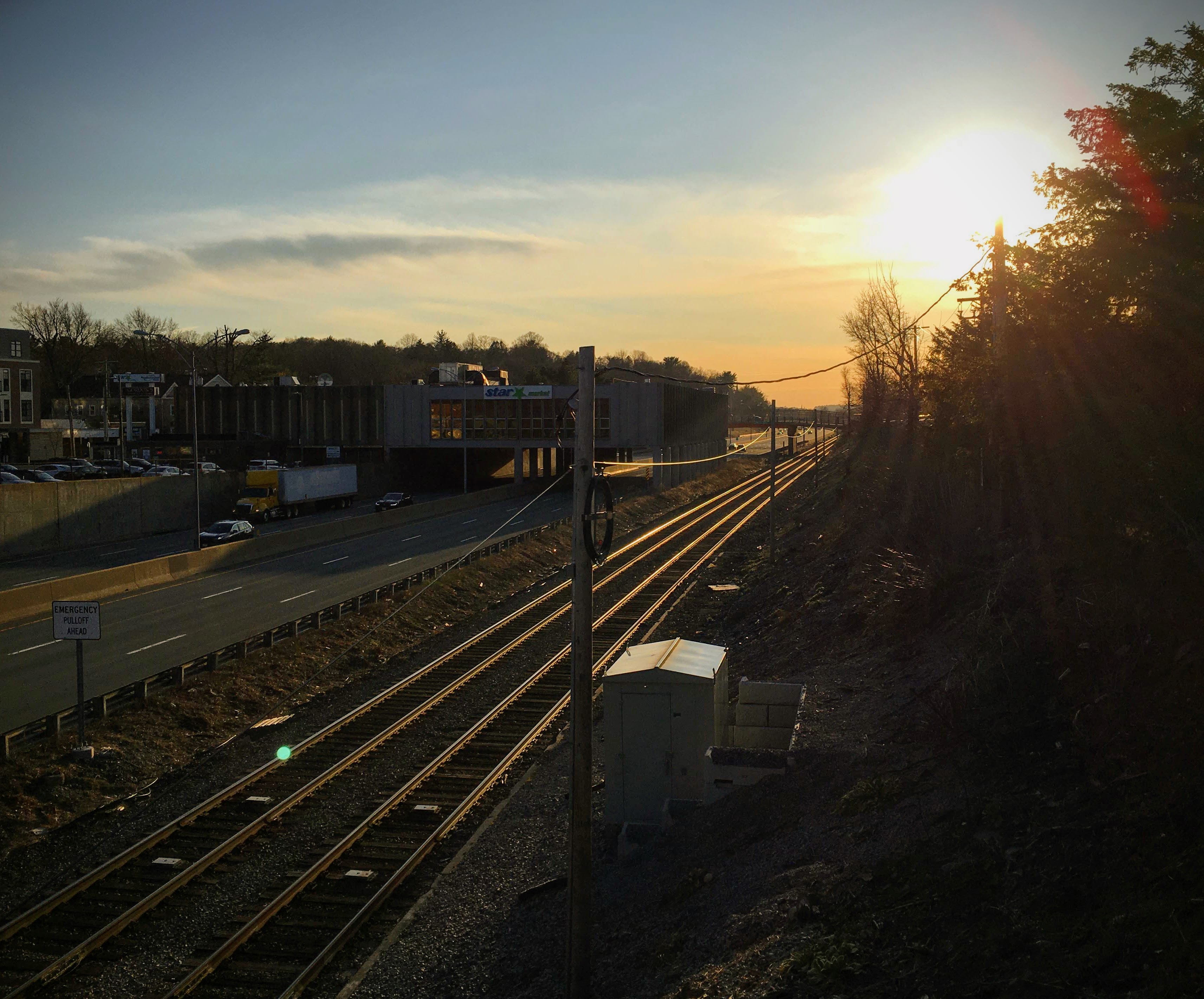
My submission didn’t make it in. It probably got edged out by a photo of a cat watching Tiger King or something. No problem, I’ve got this blog I can put it on instead. Basically what you’re looking at here is a picture I took one day while out with my wife on one of those walks we all have to take now so we don’t go crazy. The Mass Pike runs through the area and I’d been fixated on how the ever-present crush of Boston traffic had dwindled to nothing seemingly overnight. I can see part of the pike out of the corner of my eye from my desk at home so I’d been tracking it unintentionally as society went into lockdown.
This was two weeks into isolation for us. On the 12th as cancellations and scary news alerts were steadily pinging away, I took a day off work to rush down to RI to stock my mother with groceries and convince her to stay put for a while. I never returned to the office—we went remote the next day. A couple days later my wife’s did too. I was proud of how a patchwork of local authorities and employers here had taken these extreme steps to help slow or prevent the elderly and vulnerable from dying—a shared decision made by ordinary people in the almost total absence of national leadership.
When we came up on this highway bridge it really was shocking to see the highway this deserted. But I knew that that doesn’t necessarily come across in a still image, so I had to try to take a few and make them a bit arty while still showing the maximum possible extent of the road without cars on it. I liked this one the best, but it’s funny that I thought I could make a photo featuring the weird grocery store perched over the pike “arty.”
The contest required a description under 100 words, thus quashing my desire to write an extended reverie on the idea that under normal circumstances, at the time and date I took this, the Red Sox would have been playing their opening game. The road would have been filled with cars holding people listening to it on their radios. How poetic!
Here’s what I wrote instead:
I live close enough to the pike to hear it whooshing through a quiet night. It crowds with crawling cars twice a day and only ever subsides to a steady thrum. As ordinary life shut down for many of us, and my world shrank to the blocks around my apartment, I couldn’t help but gawk at the abrupt lack of traffic; an eerie absence that substantiated the magnitude of the crisis. Yet, far from being ominous, the quiet road was evidence of our enormous collective effort to save each other’s lives. I took this picture on a Thursday evening in late March, at what would have been the height of rush hour.
It’s the holiday season, so Merry Christmas, Chappy Chanukkah, Happy New Year, and so on!
People are pretty down on 2016, with good reason. Personally though, it was a pretty good year for me, and hopefully for many others. I got married (was my co-blogger a groomsman? of course he was!), and many people I care for got engaged, married, had children, and/or any other variety of personal milestones–which is great!
Among the fun things was visiting my wife’s home of Minnesota (a state you are only allowed to enter following marriage to a current or former resident). I wrote about visiting Prince already but when we were up in the northern part of that state we got a photo op with a local hero (inspired by my new brother-in-law & his fiance), and it is one of my favorite photos. I only wish that I had known to wear blue pants! So I’m going to post it as a way of bragging that I had a pretty good 2016.
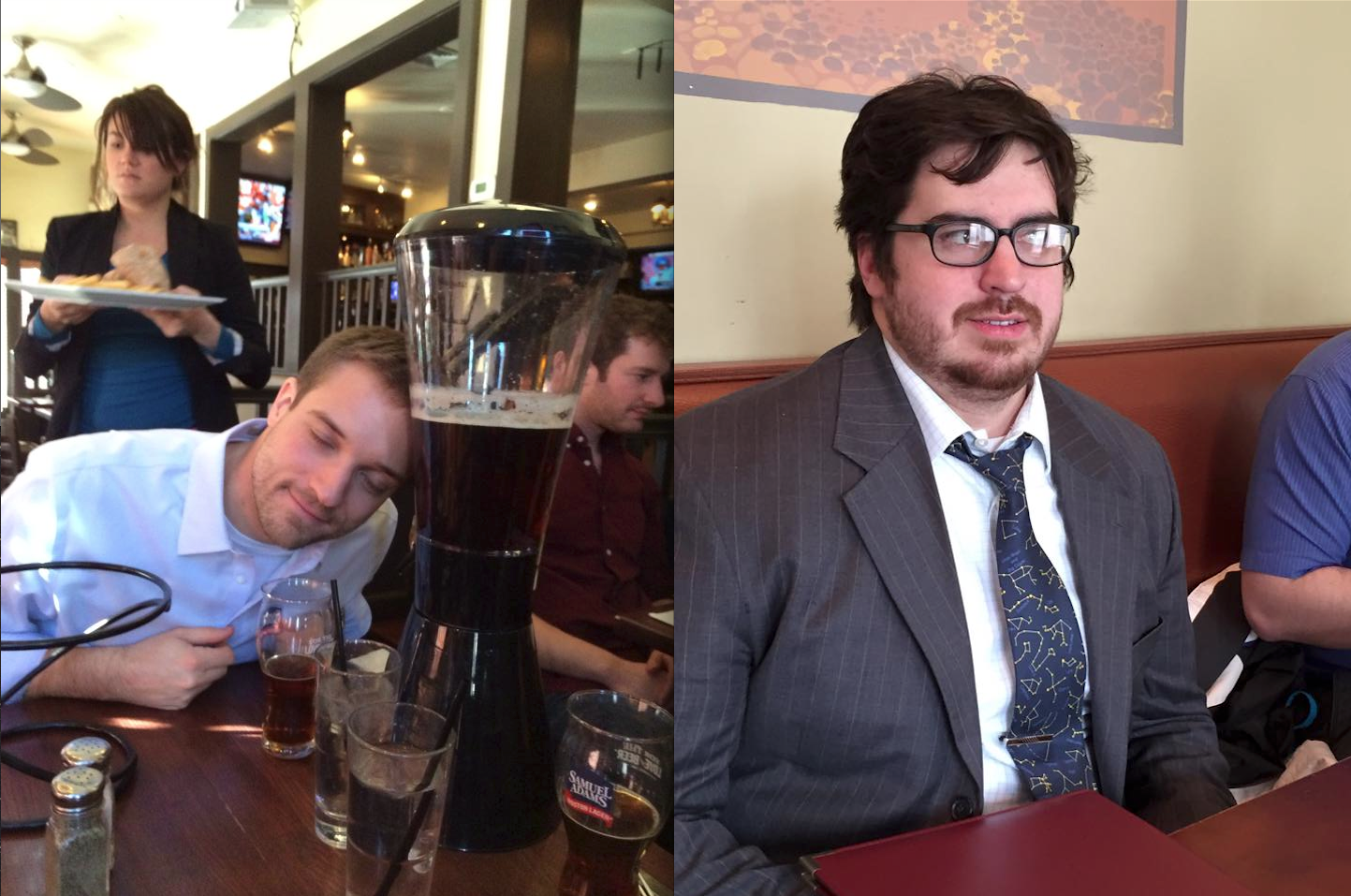
Pictures of David & Ryan, within hours of their defenses. The psychological toll is evident. Photo credit (left to right): Ryan, Dave. (Posted without Dave’s permission.)
As I bragged about in the post I wrote two days after my doctoral defense, one of the things that I was proudest of was slipping a bunch of jokes past my thesis committee. Sure, it was gratifying to receive the approval of other physicists on the culmination of 5 years of research and over a decade of scientific training. But sometimes, at a moment like that, what matters the most is getting some solid goofs preserved in perpetuity upon a dusty shelf in the corner of the esteemed library of my and Dave’s elite Rhode-Island-based university that Aitchbar refuses to mention by name for some reason.
Despite this, my dissertation, with the catchy name Quality-Selected Lensing Analysis of Galaxy Clusters in Subaru Telescope Fields hasn’t gotten the kind of internet heat I would have expected. So I felt like I ought to come up with a primer to point interested parties to the comedy gold. You, dear reader, can be assured that these things are funny, because they have been approved of by astrophysicists in terms of their scientific content. As much humor writing is.
We spent Thanksgiving in my wife’s home state of Minnesota this year. It was a really fun trip, between visiting her family in the snowy far north, photo-ops with giant Midwestern statues, and taking in some culture in the Twin Cities. The highlight of that culture part was definitely visiting the home of one of Minnesota’s brightest lights, the late Prince Rogers Nelson.
Paisley Park, his recording studio, base of operations, and home, opened to the public less than a month before we visited, on October 28th. It was only announced that it would become a public museum in August. It wasn’t clear how much preparation for turning it into a museum was done prior to his untimely death this April, but my wife observed that he was already basically living his life as a public performance, and there were already probably plenty of glass cases holding memorabilia around beforehand anyway, so it’s hard to know.
We went in the early evening on the Saturday after Thanksgiving. Currently, they give tours most days going until 11 pm or so. When we got there, a guard stopped us at the gate to ask whether we had tickets. We didn’t, and he informed us that they can only be bought online, so we were turned away, and proceeded to buy them on a phone while idling in a nearby CVS parking lot. We idly pondered whether Prince had ever stopped there to buy Vitamin Water.
Tickets acquired, we were ushered through the gates and parked in front of this blurry purple wall.
Purple wall, purple wall
Phones were not allowed on the tour, so I snapped the only other picture I was able to take:
Purple wife, purple wife
Ironically, although they are extremely paranoid about phones, the only way to get in was to show them the QR code for your ticket…on your phone. After you do, they put your phone in a little “locked” pouch that they unlock at the end of the tour. I strongly suspect that they were already in use back in the days when he would throw massive parties here as well. I entertained the thought that Madonna had once been forced to use my pouch to lock up her phone when she came to an impromptu party/performance in one of the party/concert events he held for celebrities and cool people.
To start with, in case you’re not familiar, Paisley Park looks more like an office complex than a house. It’s a big white boxy structure on the corner of a ordinary street in the suburbs outside Minneapolis, in a pretty sparsely populated sort of place with occasional strip malls and empty lots. Here’s a picture I found on the internet.
Unlike a normal house, it had the kind of glass double doors, HVAC, and other stuff that you usually see in commercial buildings. Which makes sense, I suppose, since lots of people work(ed) there in a professional sense, but it is still a little crazy that someone extremely famous lived here for nearly 30 years. Also, because there were multiple displays which looked like they were created for a museum, and yet, other things which we were told had been there for years but looked carefully presented, we frequently wondered how much had been changed for the public tours. Our assumption was “less than you would expect.”
Security was omnipresent. They were both gruff and jocular and I strongly suspected that they were mostly people who had already been working there and were now getting used to dealing with the public on a daily basis.
About half of the tour group was wearing at least some purple, and the makeup of us tourists was diverse in every sense—reflecting the fact that Prince was a rare artist who appealed to people from every background and walk of life. He really united people in a cool way.
While waiting for our guide, we were allowed to peruse the wall of gold and platinum records hanging up around the entryway. My brother-in-law noticed that a quote/drawing beside the doorway was clearly from a blown-up image, and you could see the sloppy pixelation (he asked about it later, it had been there for many years). My wife was especially happy to find the platinum record (with accompanying platinum tape cassette) for ‘Batdance’. Across from these in a small frame was a condolence letter from the President that he and Michelle had signed in purple ink. I can’t find an image from it online, and I wish I remembered it better, but it probably included something like “‘A strong spirit transcends rules,’ Prince once said — and nobody’s spirit was stronger, bolder, or more creative” which is from a quote Obama made publicly at the time. It was characteristically eloquent.
Our tour guide eventually arrived, wearing, as all the guides did, a loose Prince-ish, purple shirt with long loose sleeves. I noticed that he had a Prince symbol tattooed on his forearm and wondered whether the folks leading the tours were chosen from local super-fans. (This article seems to confirm that they were.)
He ushered us into a large room with a kitchen on one side and doors going in every direction. The second level ringed most of it, and on the upper level there was a birdcage holding two of Prince’s doves. We did not witness them crying.
Via this site the room was much like this, but the doors with Prince paintings have been replaced with memorabilia displays and a pedestal with a Paisley Park model and his remains now sits in the center of the photo.
We were told that this is where Prince spent a lot of his time, and it was where he had given a famous interview to Oprah in the 90s. The kitchen was frequently used when the musicians were in long recording sessions, and also held a couch and TV where he spent nights watching the Timberwolves. In recognition of that, the TV was playing a recording of an old game. Despite the seeming incongruousness of it, he was an avid supporter of Minnesota sports, as people in the area can attest.
On the opposite wall (where the photo above faces), there were several inlaid displays with guitars and hand-written lyrics (in place of those pictures of him), and several small rooms with the same kind of thing, and some of his bonkers outfits (these were in most displays and they were always quite small). Another room held his relatively normal-looking office. The phone on his desk was purple.
A small replica of the Paisley Park building sat in the middle of the large room (around the end point of the arrow on his symbol, as seen above), and contained a small black box holding his remains. (My brother-in-law, a funeral director, mentioned that the box would have been far too small to hold the entirety of a cremation, so the rest of His Purpleness must be somewhere else.)
We were led into a large wood-paneled recording studio. Prince had been recording a new collaboration jazz album there less than a month before his death in April. The guitar he was playing was still there, as was the lyric sheet in his own handwriting. The guide played an unmixed section of one of these tracks. It was extremely funky. In the mixing room, the original drum machine used on Purple Rain could be seen. The guide also egged someone on into asking about a little door about 10 feet off the ground…only to reveal that it was just for storage. We were baffled why he was so intent on telling us this.
We then passed through a room with memorabilia from and screens showing Under the Cherry Moon and Graffiti Bridge. It had previously held promotion offices and been set up for the museum. Half of the room was monochromatic in a nod to Cherry Moon, a black-and-white movie. Graffiti Bridge, apparently a spiritual sequel to Purple Rain, was mostly filmed in this building, something he asked us to keep in mind, as the scale of the production, from the film clips playing, was clearly made in a very large studio space. Where could this space be?
This led to a long hallway (I might be mis-remembering the sequence) with his various awards over the years in inset cases in the wall. We noticed that the Grammy award trophies apparently got larger at some point in the early 90’s and got to see an MTV moonman statue up close. It was a long hallway, and, unsurprisingly, there were many awards.
Next we saw another less ornate recording space where they had created a display which included one of his outfits, a motorcycle (seen on the covers of the “Purple Rain” and “Let’s Go Crazy” singles), and his Oscar from Purple Rain. Then an antechamber for a large concert space, where a strange piano sat among strange organic sculptures. They mentioned that it was one of only a dozen or so examples of this unusual pianos ever made, but not knowing the name for this unique instrument, I could only find this single photo online. From my angle, it was reminiscent of black sea creature.
This was the entryway into an enormous concert-space/airplane hanger. In about half of the room, outfits and instruments from various tours were arranged on platforms, as were some giant chairs. A concert video played on the distant movie-theater screen. This was where he threw private concerts. It was incredibly large, with a very high ceiling—it felt like they could have fit a space shuttle in here, and if Prince had wanted to, they probably would have. It was staggering to suddenly emerge into a gigantic mostly-empty room.
Our penultimate room was full of couches and large screens. Our guide told us that Prince would sit up on an upper-level walkway looking down over his parties from a chair–which was still present. The area below was full of intimate couch-tables that would belong in a small jazz club, and psychedelic patterns played on the walls.
Near the exit, a neglected wall held some of the offerings left by fans after his death. They seemingly scooped up what was left outside (signs, drawings, tickets) and arranged it in a tapestry of raw grief, with names and addresses still visible on printed-out tickets scrawled with messages of what he meant to them. The flowers, cast about loosely on the floor, though dry, were not yet completely withered.
In this final area, a large flat-screen TV played his virtuoso Superbowl performance. In 2007, the Superbowl in Miami was played under heavy rain. As halftime approached, the organizers, worried if the weather would effect the show, asked him if there was anything they could do to help. His response:
Providence actors Derek Smith and Victoria Ezikovich explore space hallucinations in The Final Voyage of X Minus One. Photo by Bert Silverberg.
My wife* has a pretty cool gig writing theater reviews for the website Broadway World. For doing this, she gets all sorts of free tickets to various productions around town and yours truly comes along to a good fraction of the performances. She’s gotten pretty good at it, and recently even joined the American Theater Critics Association and got to travel to New York to participate in their yearly event where she moderated a lunch talk with Susan from Friends, her new best friend!
Last weekend we went to The Final Voyage of X Minus One by Counter-Productions Theatre Company at AS220 in Providence and my lovely wife asked me to pinch-hit on the review, since the show was a sci-fi anthology and I’m a huge dork. It was easy to write since the play was really excellent and fun. It’s not a new Aitchbar post, per se, but it’s a thing I wrote on the internet, so check it out! (And if you’re in the area, go see it!)










 Aitch-Bar