


Yes, that’s a giant termite. It’s Christmas in Providence
As we gather around the roaring yule-log, sipping our rum laced with egg-nog, we too often fail to reflect on the true origins of our yearly holiday. And I certainly do not mean the Christ-y ones– I’m talking about the kind of origin that involves drunk rioters and talking farm animals. In times like these, I turn to my 1898 edition of Curiosities of Popular Customs, and of Rites, Ceremonies, Observances, and Miscellaneous Antiquities by William S. Walsh for the proper perspective. I bought my copy from the Tabor Academy library for $1, the reference librarian having concluded that it was too racist and outdated for a modern high school. It is an invaluable source of naïvely Anglo-centric information about holidays no one celebrates anymore, or celebrates widely now but which were new then, or stories about where pieces of saint’s bodies ended up. Or of the horrible blood-rites common in heathen lands.
As my X-Mas gift to you, people who read this, I will simply excerpt a large piece of the fascinating entry on Christmas. (It may be read starting on page 226). No where else can you see the history of Christmas explained using words like ‘pagan,’ ‘Govr‘ and ‘Popish’? Or outlandishly racist sentiment from the 1890’s. Or phrases such as “…citizens saluted his charred and mangled corpse, when it was last borne to the grave.” Enjoy!
Christmas. The reputed anniversary of the birth of Jesus Christ, December 25, and as such one of the greatest festivals of the Protestant, Catholic, and Greek Churches. It is essentially a day of thanksgiving and rejoicing,—a day of good cheer. Though Christians celebrate it as a Christian festival, though to them it is the anniversary of the most solemn event in all history, the meeting of heaven and earth in the birth of the God-Man, the festivities that mark the epoch are part of the universal history of the race. In pagan Rome and Greece, in the days of the Teutonic barbarians, in the remote times of ancient Egyptian civilization, in the infancy of the race East and West and North and South, the period of the winter solstice was ever a period of rejoicing and festivity.
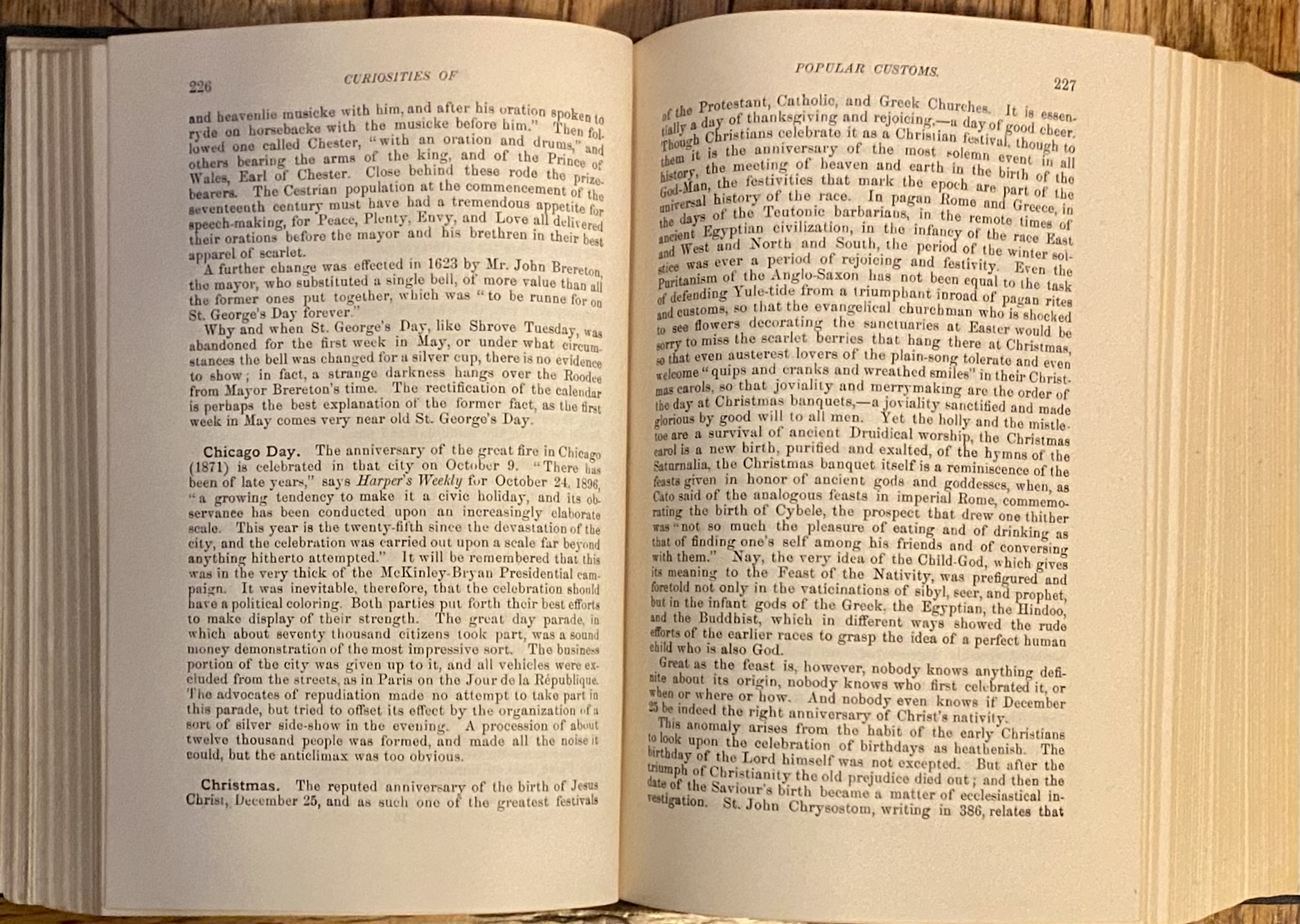
Even the Puritanism of the Anglo-Saxon has not been equal to the task of defending Yule-tide from a triumphant inroad of pagan rites and customs, so that the evangelical churchman who is shocked to see flowers decorating the sanctuaries at Easter would be sorry to miss the scarlet berries that hang there at Christmas, so that even austerest lovers of the plain-song tolerate and even weleome ” quips and cranks and wreathed smiles” in their Christmas carols, so that joviality and merrymaking are the order of the day at Christmas banquets,—a joviality sanctified and made glorious by good will to all men. Yet the holly and the mistletoe are a survival of ancient Druidical worship, the Christmas carol is a new birth, purified and exalted, of the hymns of the Saturnalia, the Christmas banquet itself is a reminiscence of the feasts given in honor of ancient gods and goddesses, when, as Cato said of the analogous feasts in imperial Rome, commemorating the birth of Cybele, the prospect that drew one thither was “not so much the pleasure of eating and of drinking as that of finding one’s self among his friends and of conversing with them.” Nay, the very idea of the Child-God, which gives its meaning to the Feast of the Nativity, was prefigured and foretold not only in the vaticinations of sibyl, seer, and prophet, but in the infant gods of the Greek, the Egyptian, the Hindoo, and the Buddhist, which in different ways showed the rude efforts of the earlier races to grasp the idea of a perfect human child who is also God.
Great as the feast is, however, nobody knows anything definite about its origin, nobody knows who first celebrated it, or when or where or how. And nobody even knows if December 25 be indeed the right anniversary of Christ’s nativity. Continue reading

 Aitch-Bar