Aitch-Bar

Writing About (Mostly) Not Astrophysics


Leave a comment

Cosmic Comic Warp Wrapup

Edited from a Crosspost to Adventures in Poor Taste

The AiPT crew asked if I could explain the weird physics in Fantastic Four #10, where an alien spaceship seems to struggle with its spacetime warping engines. I may not be a Fantastic Four expert, but I know the basics. All classic groups are foursomes, and the FF are no different. Ninja Turtles, A-Team, Beatles, Sex and the City, the four fundamental forces of nature, etc. The quadriad heroes tend to compliment each others’ skills, getting into lots of situations that are aided by a combination of invisible lady, stretchy guy, strong big guy, and fiery guy. Is one such situation a spacetime anomaly? We’re about to find out.

Ryan North and Leandro Fernández’s Fantastic Four #10 features a story told in five 100 year chunks, as the caretakers of an alien starship full of passengers in suspended animation ponder their vessel’s frozen state. The ship awakens them one by one to maintain the engines, but instead, they find that the starship is motionless in space. What’s more, they individually observe the Fantastic Four members (though they have no idea that’s what they are) moving within and outside the ship in extremely slow motion.

Someone familiar with special relativity might suspect this involves relativistic time dilation: the phenomena whereby something traveling near the speed of light experiences the passage of time more slowly than objects at rest. In fact, the ship is genuinely motionless. Or more specifically, frozen in a warped region of spacetime.
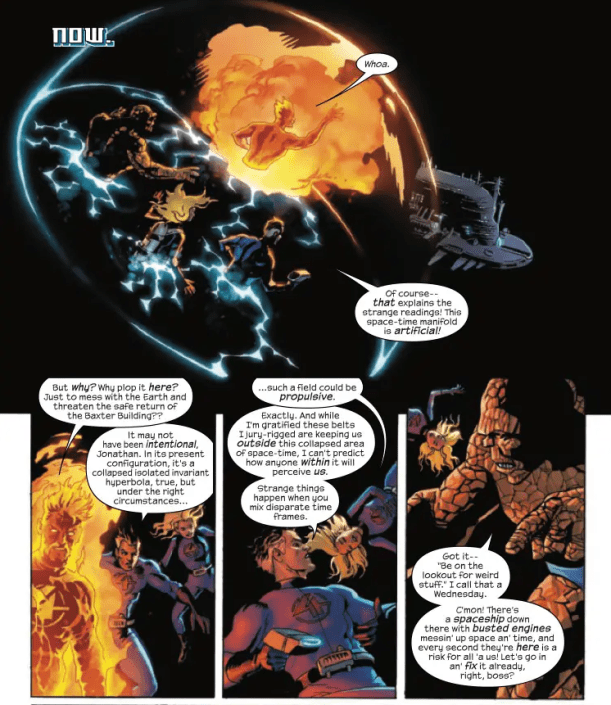
Fantastic Four #10–now with 50% more spacetime manifolds!

Of course–that explains the strange readings! This space-time manifold is artificial!

In its present configuration, it’s a collapsed isolated invariant hyperbola, true, but under the right circumstances…such a field could be propulsive.

Exactly. And while I’m gratified these belts I jury-rigged are keeping us outside this collapsed area of space-time, I can’t predict how anyone within it will perceive us. Strange things happen when you mix disparate time frames.

Fascinating. Their instantaneous appearance implies time is moving much faster for them than it is for us.

So to anyone on board, we look like–what, statues?

Given the temporal frame conflict, it’s likely we’re appearing at multiple and disparate times, locations and relative speeds. It would be quite challenging to predict.

It is interesting that the crew of a ship that operates through warping spacetime would be unfamiliar with the notion of different relativistic frames of reference. (It is implied that the shipbuilders were “ancient.” I guess their wisdom didn’t extend to the notion that they should make sure to pass down the basics of spaceflight.)

The description in the issue implies that the ship is designed to move by warping spacetime itself, without specifying how exactly. If that sounds like utter and complete gobbledegook, it may surprise you to learn that physicists merely consider it far-fetched-but-remotely-plausible gobbledegook. General relativity theorists have proposed spacetime geometries that would allow objects to circumvent light speed — the universe’s speed limit.

The best known of these is the Alcubierre drive, a hypothetical geometry first proposed in 1994 by Miguel Alcubierre, whereby space is contracted in front of an object, and expanded behind it. Superluminal travel is accomplished by moving space around the ship, which remains below light speed itself.

Easy enough, right? Wrong.

While dense matter or energy can contract spacetime, like a heavy object creating an indentation on a trampoline, there’s no known substance which can produce the opposite effect. Without a means of expanding space, like a source of negative energy, creating the spacetime geometry of a “warp bubble” is impossible.

Even if there were such a means, the amount of energy needed to distort space this way is implausibly enormous. Various proposals to operate an Alcubierre warp drive more efficiently have focused on methods that would reduce the amount of energy needed from that of the entire observable universe, to only that of several solar masses, or half a planet the size of Jupiter.

Other complications involve the fact that the warp bubble would violate relativistic causality – arriving at its destination before it would have seemed to have left. Light from the ship at its point of departure could reach the ship at its eventual end point, making it appear to exist in two places at once. The universe tends to have a problem with that sort of thing, as it implies a form of backwards time travel has occurred. Stephen Hawking’s chronology protection conjecture theorized that unspecified (maybe quantum) effects would intervene to prohibit the creation of time paradoxes. How or whether this would actually work, though, remains an open question.

Now if only we could get off this weird grid thing

Even if an Acubierre warp drive could work, it’s been calculated that a build-up of energetic particles caught up in the warp bubble over the trip would be released as the ship decelerated from superluminal velocity, and if a planet or object were along that direction of motion, this burst could destroy the destination itself.

Normally, an utter inability to accomplish something tends to dissuade people’s interest in it, but warp drive is a pretty tantalizing idea. As a result, nearly every article a theorist publishes relating to these models gets written up by pop-science sites. A sample of recent headlines include:

A warp drive is theoretically possible without breaking known physics

Alien ‘warp drives’ may leave telltale signals in the fabric of space-time, new paper claims

Warp Drives Might Be Real, and We’ll Find Them With Lasers: Study

Scientists Just Made a Breakthrough For Interstellar Travel

Faster-than-light ‘warp speed’ interstellar travel now thought to be possible

Scientists Get Serious in the Search for a Working Warp Drive

First-of-its-kind model makes warp drives feasible for space travel

Government-Funded Study Explores Warp Drives as Means of Faster-Than-Light Communication through “Hyperwaves”

If Warp Drives are Impossible, Maybe Faster Than Light Communication is Still on the Table?

I hate to be the bearer of bad news, but very little to increase the likelihood of warp travel within our lifetimes has actually transpired here. Rather, clickbait science sites are seizing on fairly hypothetical and insubstantial developments (like journal articles touching on minor refinements of theoretical work). Until humanity starts making big strides in folding spacetime around itself, we won’t be seeing anything like warp travel.

And it’s a shame! The universe is huge, and it would be exciting to be able to see more of it at close range. But without discovering some new physics, missions of interstellar exploration will require decades, if not centuries. We still have a lot to learn about gravity, so maybe 500 years stuck in one place would do it.

Leave a comment

The Final-ish Frontier

Crossposted from Adventures in Poor Taste

USS Enterprise

Pink galaxy at morning, starship take warning. Pink galaxy at night, starship’s delight.

Is Star Trek’s Galactic Barrier Real?

(No, but there’s some weird stuff out there)

Star Trek: Discovery comes to an end this year, after a run that successfully rescued the franchise from the clutches of J.J. Abrams’ two-dimensional alternate universe movies and brought it back to television, where it belongs. While views of the show are mixed, there’s no doubt that Discovery made brave choices and ultimately reignited the current era of boundless Trek. It brought an enthusiasm for science, with a litany of new concepts, a character named for a mushroom researcher, and an irrepressible ensign who’d say things like, “I f*cking love math!” For all its many invented technologies, Star Trek has been relatively faithful to scientific reality — in spirit, if not in details.

The science fictional elements are typically grounded in at least some speculative ideas about nature, or relate to a concept that scientists would recognize. This doesn’t mean that things like matter-transporting and faster than light travel are actually possible, but understanding they’re not, the creators of the shows typically build in explanations. The abrupt ship maneuvers that would flatten the crew as a starship accelerates? Inertial dampeners. Quantum indeterminacy impeding the ability of the transporter to precisely image an object? Heisenberg compensators. Someone to cook disgusting food, endanger the crew with pointless detours, and date a 2-year-old? Neelix.

One area where Star Trek series have tended to stumble is with actual astronomical phenomena. Many of the interest points in the shows have to do with fictitious yet frequent anomalies that could never do what they’re depicted doing. “Subspace temporal vortexes,” “quantum folds,” and  “warp bubbles” are fine and all, but astronomy has plenty of weird, speculative stuff already! Quark stars, cosmic strings, magnetic monopoles, several types of supernovae, black hole collisions. Admittedly, writers do have to come up with about 26 episodes a season, but it’s always felt as if they’ve never come close to exhausting the smorgasbord of real or near-real phenomena that astrophysics has to offer.

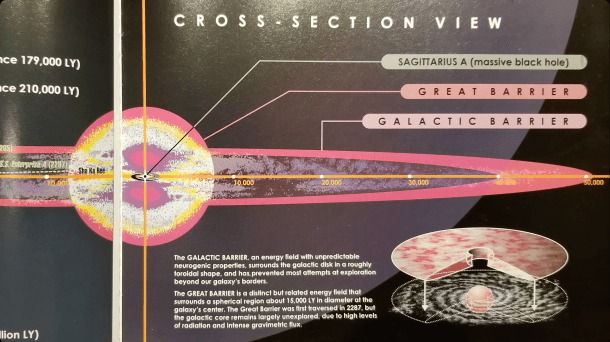
There is even one recurring structure which has been used repeatedly, despite being the opposite of a real astronomical feature — the Galactic Barrier.

Star Trek is set entirely within our galaxy, the Milky Way; a stage that gives the franchise at least 100 billion star systems to work with. For scale, Voyager, stranded on the far side, is 70 years from home at top speed. The fictional Galactic Barrier is a region enveloping either the rim or the entire exterior of the Milky Way. It may also dip down into the core to surround the disappointing God-planet in Star Trek V. It supposedly consists of “negative energy,” which can damage ships and has the counterintuitive property of being invisible from far away and bright purple as it’s approached.

As you might guess, there’s nothing like this in our galaxy. The Milky Way, shaped like a pancake of stars, gas, and dust 90,000 light years across, with a slight bulge in the center, has the rather pedestrian quality of petering out in density as you leave the disk in any direction. The edges get increasingly diffuse. (However empty and diffuse you think space is, it is far more empty and diffuse than we can possibly comprehend.)

But that’s not the whole story! Past the visible edge of our galaxy (and others) extends a halo of dark matter. We know this because the speed with which stars orbit the center of the galaxy does not decrease as you go outward in the disk. If only the visible matter of stars and gas were present, it would. In that gravitational discrepancy, invisible matter is hiding. Dark matter, as far as we currently know, is a type of massive particle which doesn’t interact electromagnetically. This is why it doesn’t emit light.

For that reason, dark matter doesn’t form bonds like those holding regular atoms and molecules together, nor does it undergo the friction-like breaking interactions that would make it shed energy and slow down enough to coalesce into stars or nebulae. Having not given up energy as luminous matter does, it distributes itself (approximately) within a spherical clump around the galaxy’s center of mass and extends out far beyond the stars, gas, and dust we see.

That is not how Star Trek‘s Galactic Barrier works. In the shows, the ship comes upon it suddenly, and it presents itself as sort of a glowy, purple cloud wall that only becomes visible within a light year or less. Spock’s analysis describes it as, “Density negative. Radiation negative. Energy negative.” Of course, neither density nor radiation can be “negative,” since they describe physical quantities, but I suppose that’s part of the mysteriousness. Ships trying to pass through this region suffer a widely inconsistent set of phenomena, belying its inconsistent amount of danger.

The barrier first appears in the Star Trek original series episode “Where No Man Has Gone Before (AKA “the Gary Mitchell episode”). After finding wreckage from a ship lost to the barrier 200 years previously, the crew resolves to fly the Enterprise into it out of curiosity, to see if anti-galactic barrier technology has improved. They expect damage, and after some consoles explode and it’s casually reported that nine crew members died, the real weirdness begins. The Galactic Barrier turns Mitchell into a psychokinetic spooky man. Needless to say, this is not astronomically accurate.

Discovery confronts the edge of the galaxy, after a color palate reboot

We next see the Galactic Barrier in “By Any Other Name,” in which Kelvans from Andromeda travel to our galaxy on generation ships. The barrier has wrecked their vessels, forcing them to escape on lifepods, and they hijack the Enterprise to return home. Despite the fact that the edge of our galaxy is clearly transparent, they claim that they can’t get a message through it, so flying back is their only chance. Though they never say whether they modified the Enterprise, everyone gets through without much fuss, and it seems odd that the Kelvans’ seemingly more-advanced technology had a problem with it in the first place.

The crew sees it once more in Is There in Truth No Beauty?” and they pass through it without any trouble, only to be “stranded” in the void outside the galaxy, without any reference points to navigate by. Considering that this thing is supposed to be invisible, that doesn’t make a lot of sense. Can’t they just look back over their shoulders at the galaxy behind them? By the final original series encounter with this force field, which is called the “Great Barrier around the center of the Milky Way” in Star Trek V: The Final Frontier, it barely attempts to live up to its reputation — the Enterprise passes through it easily.

This would have been a great point to leave this silly concept behind. Subsequent series don’t mention the barrier, and actually hint that people are exploring extragalactic space or traveling to the Small Magellanic Cloud (a dwarf galaxy near our own). But after a nearly 40 year absence, the crew of Star Trek: Discovery brings it back in season 4, with another overhyped journey through the barrier, to reach the homeland of the season’s adversary. Even this show’s earnest ethos of “science is great!” couldn’t resist the appeal of resurrecting a baffling impossibility.

Star Trek is “about” many things, but perhaps most essentially, roaming the galaxy gives the crew the chance to encounter a wide diversity of life and cultures, all new to them. The distances may technically be astronomical, but on Trek, the cosmos is teeming with life and activity. The diplomacy between the Federation, the planets within it, and the brave new worlds it forges relationships with often mirror conflicts seen in our present day, and analogize social issues that we 21st century Earthlings contend with. As often as the stories feature a point of alienness, they resolve through cooperation across those differences.

So maybe putting a wall around the galaxy – foreboding, but not impermeable – is a reminder that for all the differences across our worlds, these civilizations share a place. An area removed from their interstellar neighborhood exists, and some unknown force is reminding the crew not to stray too far from the light of home stars. Moving toward total isolation and setting yourself apart is an action that damages and changes you. But the appearance of the Galactic Barrier is an illusion that can be surmounted by strong desire. The frontier stops at the coast, even though there’s an ocean to cross beyond, and worlds anew on the other side.

Is Star Trek's 'Galactic Barrier' real?

Or maybe the creators of Star Trek had a swirling pink cloud effect on hand back in 1966, and they wanted to throw around a neat-o phrase like “galactic barrier,” and they’d fill in the details later.


Leave a comment

Max Planck & Having Only Bad Choices Under Fascism

If you were looking for a 32-minute video about the dilemmas that faced celebrated physicist Max Planck as the German science academe fell under the control of the Nazi party in the 1930’s, this is the one for you. Science historian Kathy Joseph expounds, rivetingly, on how Planck, a major leader in the development of quantum physics and beloved national figure, wrestled with how much public opposition he could wisely muster to the regime. Initially convinced that the buffoonish right-wingers who came to power in 1933 were a temporary blip, he did his best to preserve the continuity of the German physics community and protect Jewish scientists under his responsibility as president of the Kaiser Wilhelm Society (predecessor to the institution bearing his name). It is striking that while he miscalculated the course of the fascist movement in some ways, it seems unlikely that there is much he could have done differently to oppose their oppressive policies.


Leave a comment

It’s Only A Paper Moonfall

Screw the moon

You dumb moon! Don’t you know it’s day!?

Crossposted from Adventures in Poor Taste

Emmerich’s new spectacle involves a dubious premise that hits the planet in the face, but what do unlikely scientific theories look like when they end up being true?

Roland Emmerich’s newest disaster film Moonfall came out in theaters last week, and while I’m curious to see it, I’m also on paternity leave. My daughter’s as much explosive entertainment as I can take at the moment, so while I can’t evaluate the scientific reality of the movie, I’m not sure I’d even want to at this stage of the Emmerich oeuvre (especially not for a film that seems to involve the idea that the Moon is some kind of alien megastructure).

What I can do instead is pontificate a number of half-formed thoughts based on how the trailer looks! No longer content to merely destroy the surface of the Earth, Emmerich posits a baffling scenario in which Earth’s Moon gradually gets closer and closer to us, wreaking havoc, demolishing cities, and somehow culminating in shuttles scrawled with “Screw The Moon” flying up to fight … what seem to be robots? As custom dictates in such a film, one of the main characters appears to be a scrappy outsider whose hacking/amateur astronomy/conspiracy-theorizing skills bring them to the center of the elite governmental apparatus on a mission to confront the unfolding disaster.

Moonfall conspiracy theorist

John Bradley’s “Moonfall” character (probably) expounding on an imprecise array of questions, which, by sheer luck, happen to have merit in the universe of Roland Emmerich.

John Bradley (best known from his Game of Thrones role as Jon Snow’s guileless friend from the Night’s Watch, who exists to make Jon seem cooler by comparison) mugs his way through the trailer, implying that though he doesn’t work for the government, he knows more about the unfolding calamity than everyone else. This is a hacky archetype at this point, and one that’s gone some way toward convincing society that geniuses working in isolation, shunned by the establishment, are likely to be brave truth-tellers. (With vaccine hesitancy promoted by hucksters under that mantle having led to hundreds of thousands of unnecessary deaths in the past year, we can see what that notion has done for us.)

But what’s it actually like to be a scientific loner? What do you do when you think you’ve discovered something no one else accepts yet? Imagine you’re an amateur astronomer, unaffiliated with any institution, and you think you’ve discovered that the Moon’s orbit is decaying. How would you get anyone to listen to you?

Continue reading


Leave a comment

Kramschublade Clam Cram

Let's go get those deep clams

It’s time for a rustic assemblage of miscellany.

I wanted to use a clever name for a running series of miscellaneous hodgepodge so I thought “there’s probably some zany Germanic compound word for a collection of random artifacts. It’ll be a translation of a common thing that contains random items.” Well, as you may have guessed, it is kram schublade, literally, ‘stuff compartment’ in German. Despite the length and fun to say, it doesn’t appear to be a well-celebrated term. The Germans are very efficient when it comes to junk storage, one assumes, and people who store their junk this way are probably socially ostracized.

It seems like it’s supposed to be two words, really, but compound words are more fun. And now that summer is on the way and people are getting vaccinated, what better time to cram some clams? (Where by “clams” I mean “miscellaneous information,” that is.)


Ernst Thälmann Island

Bring me the head of Ernst Thälmann!

And speaking of German, East Germany! There is an oft-repeated geography curio that goes like this: a small uninhabited island off the coast of Cuba was ceded to East Germany back when there was an East Germany as a gift between allies. When East Germany ceased to exist, the reunification treaty didn’t specifically mention this island, so, by implication, the German Democratic Republic lives on there, a smoldering ember of a once mighty Eastern Bloc.

It’s an appealing sort of myth–that some geographic technicality undoes a basic fact about the world that most people think they know. In this case, the technicality itself isn’t true: the “gift” that Cuba made was only ever in spirit, never a formal thing. They just did a little renaming ceremony so that the diplomats could get a picture together for the newspaper. The Cubans renamed their uninhabited isle after Ernst Thälmann, a German communist who opposed (and was eventually murdered by) the Nazis, and “ceremonially” gave it to them and erected a bust of the man himself on the beach.

But it is worth observing that even if it were “true” it wouldn’t really be. Things like the existence or non-existence of countries isn’t based on deciphering obscure bits of information, they’re based on mutual understanding, which is sort of the opposite. Unlike a question like “how many atoms make up the moon?” which has a precise, real answer, there is no cosmic ledger that says which countries exist and which don’t. They’re based on whether you can get a sufficient number of people to treat them as valid, so even if the architects of German reunification had forgotten about this windswept isle, it wouldn’t mean anything, and the Stasi wouldn’t get to start prowling around the Caribbean, wiretapping coconuts and whatnot.


Cash rules everything around me. [Ed: this graph is technically extrapolated from low-wage worker statistics specific to several urban localities, but proportions ought to be broadly true.]

Wage theft is the most common form of stealing in the US. That is, companies underpaying workers what they are owed. And because of the obvious difficulty in bringing legal challenges against an employer, nearly impossible to redress.

An Epidemic of Wage Theft Is Costing Workers Hundreds of Millions of Dollars a Year


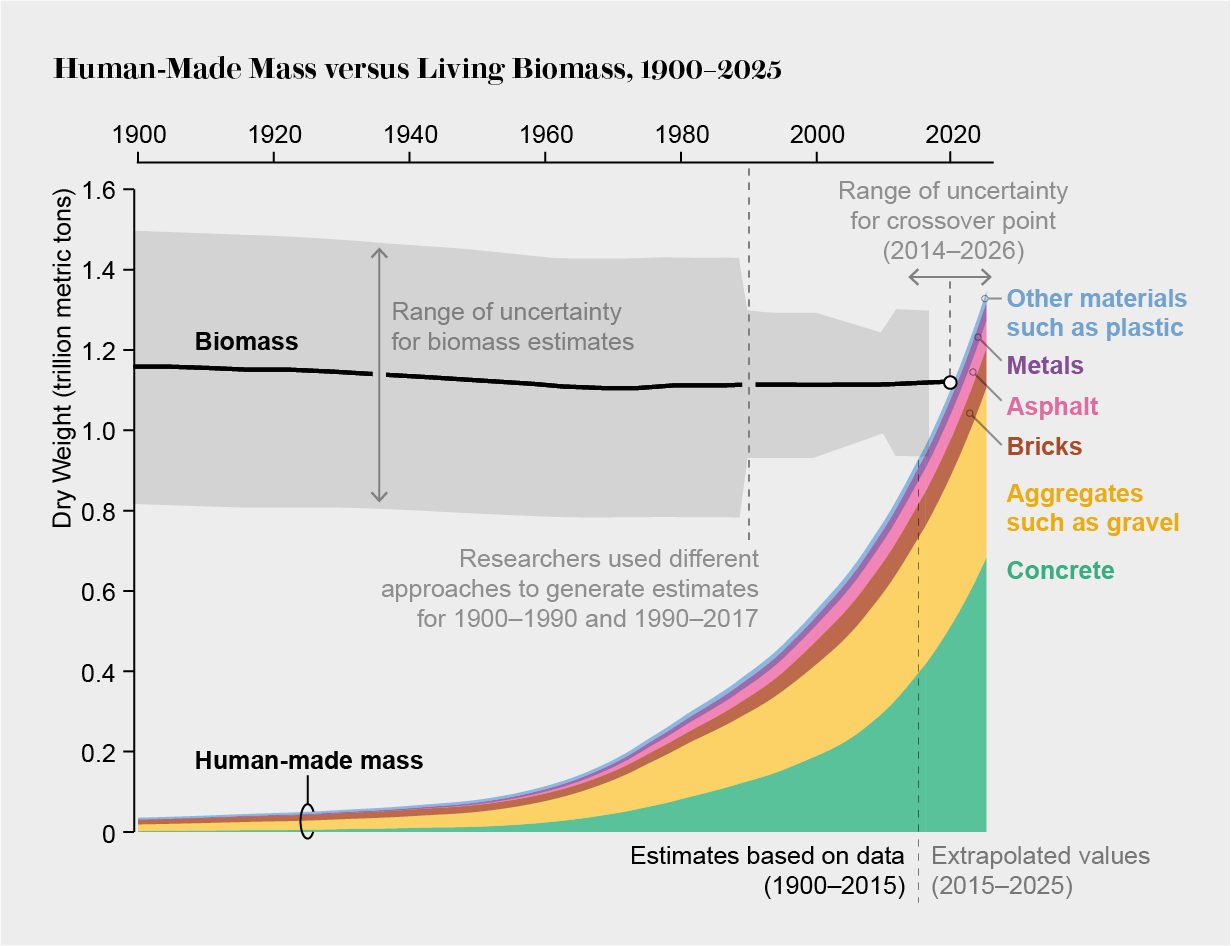
Human-Made Stuff Now Outweighs All Life on Earth — Scientific American

Change in estimated human-made mass versus living biomass from 1900 to 2025

Credit: Amanda Montañez; Source: “Global Human-Made Mass Exceeds All Living Biomass,” by Emily Elhacham et al., in Nature. Published online December 9, 2020

The implications of these findings, published on Wednesday in Nature, are staggering. The world’s plastics alone now weigh twice as much as the planet’s marine and terrestrial animals. Buildings and infrastructure outweigh trees and shrubs. “We cannot hide behind the feeling that we’re just a small species, one out of many,” says study co-author Ron Milo, who researches plant and environmental sciences at the Weizmann Institute of Science in Israel. […]

He and his team had previously published an estimate of the amount of biomass on Earth, which led to the question of how it compared with the mass of artificial objects. Emily Elhacham, then a graduate student at the Weizmann Institute, led the effort to pull together disparate data sets on the flow of materials around the world. The researchers found that human-made, or anthropogenic, mass has doubled every 20 years since 1900. Total biomass remained more stable in that time period, though plant biomass has declined by approximately half since the dawn of agriculture some 12,000 years ago. The team estimates that anthropogenic mass crossed over to exceed biomass this year, plus or minus six years. […]

Whatever the moment when humanity’s production eclipsed nature’s, the study points to a larger narrative in which humans are modifying the planet to such an extent that we have created a new geologic epoch called the Anthropocene, says Waters, who has been active in research seeking out geologic markers of this proposed division of time.


Leave a comment

On The Search For Planet X (the game)

Not actually from the game

“Greetings, Earthling. Would you like to play this game I bought?”

Occasionally, I write pieces for Adventures in Poor Taste, a cool site about all things pop culture, and even, sometimes, science! I recently reviewed the hit board game ‘The Search for Planet X‘ which falls squarely into the intersection of those two subjects. And after you check that out, have a look at my buddy Chris’s far more popular columns about X-Men comics.

‘Search for Planet X’ board game simulates real astronomy — by Ryan Michney


Leave a comment

What We Leave Behind

Dave-Ryan-post-defense.png

Pictures of David & Ryan, within hours of their defenses. The psychological toll is evident. Photo credit (left to right): Ryan, Dave. (Posted without Dave’s permission.)

As I bragged about in the post I wrote two days after my doctoral defense, one of the things that I was proudest of was slipping a bunch of jokes past my thesis committee. Sure, it was gratifying to receive the approval of other physicists on the culmination of 5 years of research and over a decade of scientific training. But sometimes, at a moment like that, what matters the most is getting some solid goofs preserved in perpetuity upon a dusty shelf in the corner of the esteemed library of my and Dave’s elite Rhode-Island-based university that Aitchbar refuses to mention by name for some reason.

Despite this, my dissertation, with the catchy name Quality-Selected Lensing Analysis of Galaxy Clusters in Subaru Telescope Fields hasn’t gotten the kind of internet heat I would have expected. So I felt like I ought to come up with a primer to point interested parties to the comedy gold. You, dear reader, can be assured that these things are funny, because they have been approved of by astrophysicists in terms of their scientific content. As much humor writing is.

So here’s a rundown for someone who might want to skip all the way more interesting astrophysics parts. This is the link to that dusty library’s online pdf. Here’s the rundown:

Continue reading


Leave a comment

I Wrote A Book

I can pour liquids

I can pour liquids

Like my co-blogger, I recently, finally, finished my physics thesis. Mine took 1.333(…) years more than his because: (a) I started with my research group in my 3rd year of grad school (instead of the summer before our 1st, like he did), (b)  I did all sorts of distracting/fulfilling outreach activities for funding over the course of my years at [Semi-Prestigious East Coast University You Can Find by Googling My Name Or Looking at My Mini-Bio and Remembering Which Famous Colleges Are in Rhode Island] which diverted my attention a bit, (c) Because I am a perfectionist who also realizes that he is lazy, and therefore made every bit of code I wrote idiot-proof for the idiot I knew I would be several months after I wrote it (which turned out to be time-consuming but useful, because I was right about that idiot thing), (d) My project ended up being nearly as large as things accomplished by groups composed of dozens of astronomers—but with just me working on it, (e) Dave is smarter than me.

This picture is me pouring champagne after the confirmation (which is always obvious to everyone other than the person presenting their PhD) that it’s all good, and you’re now a Doctor. I am, conveniently, standing in front of a case displaying former department heads. Other than the guy with the cool chemistry setup on the bottom, I’m the only one who got to know that the universe is much larger than the Milky Way and that the Big Bang happened. I mean, it wasn’t a thing I discovered myself, but it’s still weird.

With one day of distance from this experience I have two major observations. The first is that the passage of time has expanded drastically since the day, weeks ago, when I submitted my dissertation. My perception of time was strongly affected by how much I’d added to my thesis, and when I spent a few days getting something to work, but didn’t contribute pages to it, I felt like I was stuck in a moment and I couldn’t get out of it. Now that I’m done, time is again like it was when I was 8 and each new day was a new world of beautiful experiences to be savored. This whole PhD thing happened yesterday and it feels like years.

Secondly is the fact that my reviewers were fine with the several snide remarks and jokes that I sneaked in there. This, in itself, is ~50% as gratifying as the whole doctorate thing itself. I quoted Donald Rumsfeld and Stephen Colbert. I wrote snide footnotes about Albert Einstein and The Dress. And it will all be on a shelf on the [Semi-Prestigious East-Coast University] Library in perpetuity. That is the sweetest victory of all.

And yes, that is a tie with constellations on it. Because I’m a fucking astrophysicist.


Leave a comment

Eponymity in Physics

This is a re-post of a piece I wrote on my old blog, Topography of Ignorance, back in 2007. It’s a list I compiled of the types of things you could get named after you that come in the form [Name][Type of thing], as in the word “Law” from “Moore’s Law.” There are the obvious ones like “equation” but the unusual terms are more interesting because there might be only a single example. The title is itself an adaptation of an obscure word, eponym, which I loosely interpreted to mean “anything named after someone.” I don’t think it’s a real word, and using it probably confused readers (it also could have confused them that it’s basically just a massive list with very little prose). To preserve the classic 2007 “feel” of the original post, I’m keeping the poorly-chosen title and format.  Plus, lists are now back in a big way! (What with your Buzzfeeds et al.) So it seemed like an appropriate time to bring it back. Will animate with Jennifer Lawrence GIFs as soon as I’m able…

~~~~~

A physicist wanting to make an impact on the field most often imagines his or her name attached to an Equation, or a Theory. Or even, if they really want to move mountains, a Law. I have no idea what mathematicians think about, but I would assume that they are hoping to come up with Theorems and Conjectures. Of course, not everyone is an Einstein or a Kepler, able to remake a subject and declare a Law. But if you carve out a niche for yourself, or invent a novel way of dealing with a certain topic, you’re virtually assured of getting something. For an elegant discovery, you could have an Angle named after you, or a Number. Or in a more bizarre direction, a Sea or Paradox. de Sitter has an entire Universe! Me? If I could become the first person since Isaac Newton with an eponymous Bucket I would consider myself a success. There are so many strange things you could find named in your honor that I have compiled an extensive list of them with some examples namesakes on the right-hand side.

First, some of the most common:

Equation  
Formula
 
Law
 
Theorem
 
Theory
 
Hypothesis
 
[A Unit] Newton, Gauss, Joule
[A Constant] Planck, Boltzmann
Function Riemann-Zeta, Bessel
Effect Mössbauer, Stark, Bohr,
Gunn-Peterson, etc.

And then of course, there are rarer terms. These trend very roughly from less to more obscure.

Field Fermionic, Bosonic, Higgs
Matrix Kobayashi, Cabibbo
Relation Heisenberg, Tully-Fisher
Principle Copernican, Pauli Exclusion
Model Schwinger, Bohr
Method Schrödinger
Postulate Planck, Weyl
Approximation Born
Space
Minkowski, Fock, Hilbert
Metric Friedmann-Robertson-Walker,
Minkowski
Distribution Wigner, Bose-Einstein, Fermi-Dirac
___-on Fermi, Bose
___-ian Laplace, Hamilton, Riemann
Notation Dirac
Potential Coulomb, Yukawa
Action Stueckelberg, Proca
Inequality Minkowski, Bell
Limit Chandrasekhar
Tensor Riemann
Scalar Ricci
Gauge Newtonian
Diagram Feynman
Radiation Cherenkov, Hawking
Cycle Carnot, Born
Interpretation Bohm, Copenhagen
Paradox Einstein-Podolski-Rosen,
Olber, Fermi
Problem Rabi, Fermi
Experiment Milikan Oil Drop
Spectrum Mössbauer
Conjecture Witten
Interaction Yakawa
Amplitude Feynman
Operator d’Alembert
Particle Higgs, Planck
Neutrino Majorana, Dirac
Motion Brownian
Length Jeans
Number Avogadro, Chandrasekhar, Euler
Surface Fermi
Condensate Bose-Einstein
Radius Schwartzschild, Bohr
Convention Einstein Summation
Transform Forier, Laplace
Series Balmer, Lyman
Line Lyman, Balmer
Rules Slater
Scattering Compton, Rayleigh, Thompson
Variable Cepheid, RR Lyrae
Diffusion Bohm
Diffraction
Bragg
Junction Josephson
Expansion Taylor
Manifold Riemann
Topology Picard
Mechanism Higgs
Peak Wein
Test Tolman surface brightness
Repulsion Coulomb
Epoch Planck
Parameter Hubble
[An Element]
Einstein, Fermi, Curie, Mendeleev, Lawrence, Nobel
Time/Mass/Energy/Temperature
/Density
/Power/Current/Length
Planck
Energy/Level/Hole/Velocity
/Temperature
Fermi
Wavelength de Broglie
Boson Higgs
Profile Hernquist
Criterion Landau
Rigidity Born
Cross-section Thompson
Zone Brillouin, (also see, List of Zones)
State Hartle-Hawking
Angle Weinberg
Universe de Sitter, Lemaître
Sea Dirac, Fermi
Magneton
Bohr
Splitting Zeeman
Forest Lyman-alpha
Blob Lyman-alpha
Swindle Jeans
Trough Gunn-Peterson
Window Gamow
Cage Faraday
Engine Carnot
Bucket Newton
Tuning Fork
Hubble
Golden Rule Fermi
Pancake Zel’dovich
Brain Boltzmann
Demon Maxwell
Cat
Schrödinger


If anyone else is able to repeat that last one, I will be highly impressed. I would also like to point out that the Higgs boson may be the only phenomenon or concept that has two namesakes, since the term boson originally comes from Satyendra Bose! If you can think of anything else let me know and I’ll add it.


Update:

Pairs       . . . . . . . . . . . . . . . . . .  Cooper

Focus      . . . . . . . . . . . . . . . . . .  Cassegrain, Nasmyth


Leave a comment

In which I answer the evolution questions of hopeless people living without access to the internet

Buzzfeed has a collection of “questions”/smirking ignorance from people who consider themselves creationists. Since these are all such pat, easily-answerable questions I can’t resist taking a break between doing science, and helping teach science to people who are interested in learning it, to throw up a few answers to the questions of people who aren’t. None of the actual science ones ought to take a minimally interested person more than 30 seconds to find online, but since I can do each in 5 sec or less, let’s all save some time together! (Spelling mistakes faithfully transcribed!) (Smirkiness levels matched!)

1. “Bill Nye, are you influencing the minds of children in a positive way?”
I’m not him, but yes he is.

2. “Are you scared of a Divine Creator?”
No

3. “Is it completely illogical that the earth was created mature? I.e. trees created with rings… Adam created as an adult…”
Yes.

4. “Does not the second law of thermodynamics disprove Evolution?”
No.

5. “How do you explain a sunset if their is no God?”
Earth’s rotation.

6. If the Big Bang Theory is true and taught as science along with evolution, why do the laws of thermodynamics debunk said theories?”
They don’t.

7. “WHAT ABOUT NOETICS?”
I’ll try anything once.

8. “Where do you derive objective meaning in life?”
From being right about science.

9. “If God did not create everything, how did the first single-celled organism originate? By Chance?”
By natural processes. Also, ‘chance’, given millions of years and the right conditions, guarantees such a thing occurring. Also also, not fully understanding an event doesn’t imply that God did it.

10. “I believe in the Big Bang Theory… God said it and BANG it happened!”
OK

11. “Why do evolutionists/secularists/huminists/non-God believing people reject the idea of their being a creator Gob but embrace the concept of intelligent design from aliens of other extra-terestrial sources?”
They don’t, you’re thinking of the film Prometheus.

12. “There is no in between… the only one found has been Lucy and there are only a few pieces of the hundreds neccessary for an ‘official proof’.”
The non-existence of “transitional” fossils is a myth. There are thousands of pre-human fossils. I will forward your objection to the Official Proof Commission.

13. “Does metamorphosis help support evolution?”
The Metamorphosis is a surrealistic short-story by Franz Kafka. Published in 1915, this German novella depicts the unexplained transformation of salesman Gregor Samsa into a horrific cockroach-like insect and his efforts to deal with his mysterious and terrifying condition.

14. “If Evolution is a Theory (like creationism or the Bible) why is Evolution taught as fact.”
‘Theory’ and ‘fact’ are not mutually incompatible concepts. Also, the Bible is a book, not a theory.

15. “Because science by definition is a ‘theory’— not testable, observable, nor repeatable’ why do you object to creationism or intelligent design being taught in school?”
See #14. Theories are all of those things and evolution has been tested and observed in a myriad of ways.

16. “What mechanism has science discovered that evidences an increase of genetic information seen in any genetic mutation or evolutionary process?”
Not an expert here but I’d venture the existence of forms of life with less complex genetic code. Also, if this is a reference to entropy, it only has to increase overall within an environment, not within every organism.

17. “What purpose do you think you are for if you do not believe in salvation?”
I’m pretty decent at parallel parking.

18. “Why have we found only 1 ‘Lucy’, when we have found more than 1 of everything else?”
There are literally thousands of other hominid fossils.

19. “Can you believe in ‘the big bang’ without ‘faith’?”
I do. But I ‘believe’ in it because there is evidence that it happened. If new evidence showed that it didn’t, I would change my mind.

20. “How can you look at the world and not believe Someone Created/thought of it? It’s Amazing!!!”
Cool story.

21. “Relating to the big bang theory…. Where did the exploding star come from?”
The big bang was a star exploding? I don’t even…

OK, these have been rough. Just one more left. Hopefully it’s not a super-dumb misunderstanding of one of science’s most important and beautiful theories that anyone can understand if they bother to take a couple seconds on the internet or ask a grown-up.

22. “If we come from monkeys then why are there still monkeys?”
Gosh, that’s a good one. That really sounds like a thoughtful new angle on this whole issue that biologists surely haven’t considered. I haven’t lost patience with this exercise or anything.
Cactus
You know what? This cactus here is like, really old and wise and stuff. He says he’s been around hundreds of millions of years and he’s seen pretty much all of human history so why don’t you just get really close to his knowledge port and he can whisper it to you. Don’t be shy. Yeah, right in there…