
Aitch-Bar

Writing About (Mostly) Not Astrophysics


Leave a comment

The Final-ish Frontier

Crossposted from Adventures in Poor Taste

USS Enterprise

Pink galaxy at morning, starship take warning. Pink galaxy at night, starship’s delight.

Is Star Trek’s Galactic Barrier Real?

(No, but there’s some weird stuff out there)

Star Trek: Discovery comes to an end this year, after a run that successfully rescued the franchise from the clutches of J.J. Abrams’ two-dimensional alternate universe movies and brought it back to television, where it belongs. While views of the show are mixed, there’s no doubt that Discovery made brave choices and ultimately reignited the current era of boundless Trek. It brought an enthusiasm for science, with a litany of new concepts, a character named for a mushroom researcher, and an irrepressible ensign who’d say things like, “I f*cking love math!” For all its many invented technologies, Star Trek has been relatively faithful to scientific reality — in spirit, if not in details.

The science fictional elements are typically grounded in at least some speculative ideas about nature, or relate to a concept that scientists would recognize. This doesn’t mean that things like matter-transporting and faster than light travel are actually possible, but understanding they’re not, the creators of the shows typically build in explanations. The abrupt ship maneuvers that would flatten the crew as a starship accelerates? Inertial dampeners. Quantum indeterminacy impeding the ability of the transporter to precisely image an object? Heisenberg compensators. Someone to cook disgusting food, endanger the crew with pointless detours, and date a 2-year-old? Neelix.

One area where Star Trek series have tended to stumble is with actual astronomical phenomena. Many of the interest points in the shows have to do with fictitious yet frequent anomalies that could never do what they’re depicted doing. “Subspace temporal vortexes,” “quantum folds,” and  “warp bubbles” are fine and all, but astronomy has plenty of weird, speculative stuff already! Quark stars, cosmic strings, magnetic monopoles, several types of supernovae, black hole collisions. Admittedly, writers do have to come up with about 26 episodes a season, but it’s always felt as if they’ve never come close to exhausting the smorgasbord of real or near-real phenomena that astrophysics has to offer.

There is even one recurring structure which has been used repeatedly, despite being the opposite of a real astronomical feature — the Galactic Barrier.
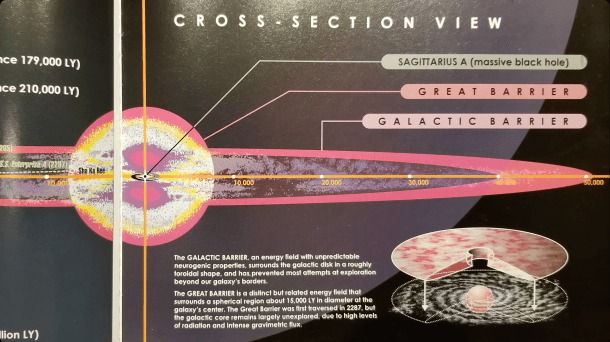
Star Trek is set entirely within our galaxy, the Milky Way; a stage that gives the franchise at least 100 billion star systems to work with. For scale, Voyager, stranded on the far side, is 70 years from home at top speed. The fictional Galactic Barrier is a region enveloping either the rim or the entire exterior of the Milky Way. It may also dip down into the core to surround the disappointing God-planet in Star Trek V. It supposedly consists of “negative energy,” which can damage ships and has the counterintuitive property of being invisible from far away and bright purple as it’s approached.

As you might guess, there’s nothing like this in our galaxy. The Milky Way, shaped like a pancake of stars, gas, and dust 90,000 light years across, with a slight bulge in the center, has the rather pedestrian quality of petering out in density as you leave the disk in any direction. The edges get increasingly diffuse. (However empty and diffuse you think space is, it is far more empty and diffuse than we can possibly comprehend.)

But that’s not the whole story! Past the visible edge of our galaxy (and others) extends a halo of dark matter. We know this because the speed with which stars orbit the center of the galaxy does not decrease as you go outward in the disk. If only the visible matter of stars and gas were present, it would. In that gravitational discrepancy, invisible matter is hiding. Dark matter, as far as we currently know, is a type of massive particle which doesn’t interact electromagnetically. This is why it doesn’t emit light.

For that reason, dark matter doesn’t form bonds like those holding regular atoms and molecules together, nor does it undergo the friction-like breaking interactions that would make it shed energy and slow down enough to coalesce into stars or nebulae. Having not given up energy as luminous matter does, it distributes itself (approximately) within a spherical clump around the galaxy’s center of mass and extends out far beyond the stars, gas, and dust we see.

That is not how Star Trek‘s Galactic Barrier works. In the shows, the ship comes upon it suddenly, and it presents itself as sort of a glowy, purple cloud wall that only becomes visible within a light year or less. Spock’s analysis describes it as, “Density negative. Radiation negative. Energy negative.” Of course, neither density nor radiation can be “negative,” since they describe physical quantities, but I suppose that’s part of the mysteriousness. Ships trying to pass through this region suffer a widely inconsistent set of phenomena, belying its inconsistent amount of danger.

The barrier first appears in the Star Trek original series episode “Where No Man Has Gone Before (AKA “the Gary Mitchell episode”). After finding wreckage from a ship lost to the barrier 200 years previously, the crew resolves to fly the Enterprise into it out of curiosity, to see if anti-galactic barrier technology has improved. They expect damage, and after some consoles explode and it’s casually reported that nine crew members died, the real weirdness begins. The Galactic Barrier turns Mitchell into a psychokinetic spooky man. Needless to say, this is not astronomically accurate.

Discovery confronts the edge of the galaxy, after a color palate reboot

We next see the Galactic Barrier in “By Any Other Name,” in which Kelvans from Andromeda travel to our galaxy on generation ships. The barrier has wrecked their vessels, forcing them to escape on lifepods, and they hijack the Enterprise to return home. Despite the fact that the edge of our galaxy is clearly transparent, they claim that they can’t get a message through it, so flying back is their only chance. Though they never say whether they modified the Enterprise, everyone gets through without much fuss, and it seems odd that the Kelvans’ seemingly more-advanced technology had a problem with it in the first place.

The crew sees it once more in Is There in Truth No Beauty?” and they pass through it without any trouble, only to be “stranded” in the void outside the galaxy, without any reference points to navigate by. Considering that this thing is supposed to be invisible, that doesn’t make a lot of sense. Can’t they just look back over their shoulders at the galaxy behind them? By the final original series encounter with this force field, which is called the “Great Barrier around the center of the Milky Way” in Star Trek V: The Final Frontier, it barely attempts to live up to its reputation — the Enterprise passes through it easily.

This would have been a great point to leave this silly concept behind. Subsequent series don’t mention the barrier, and actually hint that people are exploring extragalactic space or traveling to the Small Magellanic Cloud (a dwarf galaxy near our own). But after a nearly 40 year absence, the crew of Star Trek: Discovery brings it back in season 4, with another overhyped journey through the barrier, to reach the homeland of the season’s adversary. Even this show’s earnest ethos of “science is great!” couldn’t resist the appeal of resurrecting a baffling impossibility.

Star Trek is “about” many things, but perhaps most essentially, roaming the galaxy gives the crew the chance to encounter a wide diversity of life and cultures, all new to them. The distances may technically be astronomical, but on Trek, the cosmos is teeming with life and activity. The diplomacy between the Federation, the planets within it, and the brave new worlds it forges relationships with often mirror conflicts seen in our present day, and analogize social issues that we 21st century Earthlings contend with. As often as the stories feature a point of alienness, they resolve through cooperation across those differences.

So maybe putting a wall around the galaxy – foreboding, but not impermeable – is a reminder that for all the differences across our worlds, these civilizations share a place. An area removed from their interstellar neighborhood exists, and some unknown force is reminding the crew not to stray too far from the light of home stars. Moving toward total isolation and setting yourself apart is an action that damages and changes you. But the appearance of the Galactic Barrier is an illusion that can be surmounted by strong desire. The frontier stops at the coast, even though there’s an ocean to cross beyond, and worlds anew on the other side.

Is Star Trek's 'Galactic Barrier' real?

Or maybe the creators of Star Trek had a swirling pink cloud effect on hand back in 1966, and they wanted to throw around a neat-o phrase like “galactic barrier,” and they’d fill in the details later.


Leave a comment

It’s Only A Paper Moonfall

Screw the moon

You dumb moon! Don’t you know it’s day!?

Crossposted from Adventures in Poor Taste

Emmerich’s new spectacle involves a dubious premise that hits the planet in the face, but what do unlikely scientific theories look like when they end up being true?

Roland Emmerich’s newest disaster film Moonfall came out in theaters last week, and while I’m curious to see it, I’m also on paternity leave. My daughter’s as much explosive entertainment as I can take at the moment, so while I can’t evaluate the scientific reality of the movie, I’m not sure I’d even want to at this stage of the Emmerich oeuvre (especially not for a film that seems to involve the idea that the Moon is some kind of alien megastructure).

What I can do instead is pontificate a number of half-formed thoughts based on how the trailer looks! No longer content to merely destroy the surface of the Earth, Emmerich posits a baffling scenario in which Earth’s Moon gradually gets closer and closer to us, wreaking havoc, demolishing cities, and somehow culminating in shuttles scrawled with “Screw The Moon” flying up to fight … what seem to be robots? As custom dictates in such a film, one of the main characters appears to be a scrappy outsider whose hacking/amateur astronomy/conspiracy-theorizing skills bring them to the center of the elite governmental apparatus on a mission to confront the unfolding disaster.

Moonfall conspiracy theorist

John Bradley’s “Moonfall” character (probably) expounding on an imprecise array of questions, which, by sheer luck, happen to have merit in the universe of Roland Emmerich.

John Bradley (best known from his Game of Thrones role as Jon Snow’s guileless friend from the Night’s Watch, who exists to make Jon seem cooler by comparison) mugs his way through the trailer, implying that though he doesn’t work for the government, he knows more about the unfolding calamity than everyone else. This is a hacky archetype at this point, and one that’s gone some way toward convincing society that geniuses working in isolation, shunned by the establishment, are likely to be brave truth-tellers. (With vaccine hesitancy promoted by hucksters under that mantle having led to hundreds of thousands of unnecessary deaths in the past year, we can see what that notion has done for us.)

But what’s it actually like to be a scientific loner? What do you do when you think you’ve discovered something no one else accepts yet? Imagine you’re an amateur astronomer, unaffiliated with any institution, and you think you’ve discovered that the Moon’s orbit is decaying. How would you get anyone to listen to you?

Continue reading


Leave a comment

On The Search For Planet X (the game)

Not actually from the game

“Greetings, Earthling. Would you like to play this game I bought?”

Occasionally, I write pieces for Adventures in Poor Taste, a cool site about all things pop culture, and even, sometimes, science! I recently reviewed the hit board game ‘The Search for Planet X‘ which falls squarely into the intersection of those two subjects. And after you check that out, have a look at my buddy Chris’s far more popular columns about X-Men comics.

‘Search for Planet X’ board game simulates real astronomy — by Ryan Michney


Leave a comment

What We Leave Behind

Dave-Ryan-post-defense.png

Pictures of David & Ryan, within hours of their defenses. The psychological toll is evident. Photo credit (left to right): Ryan, Dave. (Posted without Dave’s permission.)

As I bragged about in the post I wrote two days after my doctoral defense, one of the things that I was proudest of was slipping a bunch of jokes past my thesis committee. Sure, it was gratifying to receive the approval of other physicists on the culmination of 5 years of research and over a decade of scientific training. But sometimes, at a moment like that, what matters the most is getting some solid goofs preserved in perpetuity upon a dusty shelf in the corner of the esteemed library of my and Dave’s elite Rhode-Island-based university that Aitchbar refuses to mention by name for some reason.

Despite this, my dissertation, with the catchy name Quality-Selected Lensing Analysis of Galaxy Clusters in Subaru Telescope Fields hasn’t gotten the kind of internet heat I would have expected. So I felt like I ought to come up with a primer to point interested parties to the comedy gold. You, dear reader, can be assured that these things are funny, because they have been approved of by astrophysicists in terms of their scientific content. As much humor writing is.

So here’s a rundown for someone who might want to skip all the way more interesting astrophysics parts. This is the link to that dusty library’s online pdf. Here’s the rundown:

Continue reading


Leave a comment

I Wrote A Book

I can pour liquids

I can pour liquids

Like my co-blogger, I recently, finally, finished my physics thesis. Mine took 1.333(…) years more than his because: (a) I started with my research group in my 3rd year of grad school (instead of the summer before our 1st, like he did), (b)  I did all sorts of distracting/fulfilling outreach activities for funding over the course of my years at [Semi-Prestigious East Coast University You Can Find by Googling My Name Or Looking at My Mini-Bio and Remembering Which Famous Colleges Are in Rhode Island] which diverted my attention a bit, (c) Because I am a perfectionist who also realizes that he is lazy, and therefore made every bit of code I wrote idiot-proof for the idiot I knew I would be several months after I wrote it (which turned out to be time-consuming but useful, because I was right about that idiot thing), (d) My project ended up being nearly as large as things accomplished by groups composed of dozens of astronomers—but with just me working on it, (e) Dave is smarter than me.

This picture is me pouring champagne after the confirmation (which is always obvious to everyone other than the person presenting their PhD) that it’s all good, and you’re now a Doctor. I am, conveniently, standing in front of a case displaying former department heads. Other than the guy with the cool chemistry setup on the bottom, I’m the only one who got to know that the universe is much larger than the Milky Way and that the Big Bang happened. I mean, it wasn’t a thing I discovered myself, but it’s still weird.

With one day of distance from this experience I have two major observations. The first is that the passage of time has expanded drastically since the day, weeks ago, when I submitted my dissertation. My perception of time was strongly affected by how much I’d added to my thesis, and when I spent a few days getting something to work, but didn’t contribute pages to it, I felt like I was stuck in a moment and I couldn’t get out of it. Now that I’m done, time is again like it was when I was 8 and each new day was a new world of beautiful experiences to be savored. This whole PhD thing happened yesterday and it feels like years.

Secondly is the fact that my reviewers were fine with the several snide remarks and jokes that I sneaked in there. This, in itself, is ~50% as gratifying as the whole doctorate thing itself. I quoted Donald Rumsfeld and Stephen Colbert. I wrote snide footnotes about Albert Einstein and The Dress. And it will all be on a shelf on the [Semi-Prestigious East-Coast University] Library in perpetuity. That is the sweetest victory of all.

And yes, that is a tie with constellations on it. Because I’m a fucking astrophysicist.


Leave a comment

Eponymity in Physics

This is a re-post of a piece I wrote on my old blog, Topography of Ignorance, back in 2007. It’s a list I compiled of the types of things you could get named after you that come in the form [Name][Type of thing], as in the word “Law” from “Moore’s Law.” There are the obvious ones like “equation” but the unusual terms are more interesting because there might be only a single example. The title is itself an adaptation of an obscure word, eponym, which I loosely interpreted to mean “anything named after someone.” I don’t think it’s a real word, and using it probably confused readers (it also could have confused them that it’s basically just a massive list with very little prose). To preserve the classic 2007 “feel” of the original post, I’m keeping the poorly-chosen title and format.  Plus, lists are now back in a big way! (What with your Buzzfeeds et al.) So it seemed like an appropriate time to bring it back. Will animate with Jennifer Lawrence GIFs as soon as I’m able…

~~~~~

A physicist wanting to make an impact on the field most often imagines his or her name attached to an Equation, or a Theory. Or even, if they really want to move mountains, a Law. I have no idea what mathematicians think about, but I would assume that they are hoping to come up with Theorems and Conjectures. Of course, not everyone is an Einstein or a Kepler, able to remake a subject and declare a Law. But if you carve out a niche for yourself, or invent a novel way of dealing with a certain topic, you’re virtually assured of getting something. For an elegant discovery, you could have an Angle named after you, or a Number. Or in a more bizarre direction, a Sea or Paradox. de Sitter has an entire Universe! Me? If I could become the first person since Isaac Newton with an eponymous Bucket I would consider myself a success. There are so many strange things you could find named in your honor that I have compiled an extensive list of them with some examples namesakes on the right-hand side.

First, some of the most common:

Equation  
Formula
 
Law
 
Theorem
 
Theory
 
Hypothesis
 
[A Unit] Newton, Gauss, Joule
[A Constant] Planck, Boltzmann
Function Riemann-Zeta, Bessel
Effect Mössbauer, Stark, Bohr,
Gunn-Peterson, etc.

And then of course, there are rarer terms. These trend very roughly from less to more obscure.

Field Fermionic, Bosonic, Higgs
Matrix Kobayashi, Cabibbo
Relation Heisenberg, Tully-Fisher
Principle Copernican, Pauli Exclusion
Model Schwinger, Bohr
Method Schrödinger
Postulate Planck, Weyl
Approximation Born
Space
Minkowski, Fock, Hilbert
Metric Friedmann-Robertson-Walker,
Minkowski
Distribution Wigner, Bose-Einstein, Fermi-Dirac
___-on Fermi, Bose
___-ian Laplace, Hamilton, Riemann
Notation Dirac
Potential Coulomb, Yukawa
Action Stueckelberg, Proca
Inequality Minkowski, Bell
Limit Chandrasekhar
Tensor Riemann
Scalar Ricci
Gauge Newtonian
Diagram Feynman
Radiation Cherenkov, Hawking
Cycle Carnot, Born
Interpretation Bohm, Copenhagen
Paradox Einstein-Podolski-Rosen,
Olber, Fermi
Problem Rabi, Fermi
Experiment Milikan Oil Drop
Spectrum Mössbauer
Conjecture Witten
Interaction Yakawa
Amplitude Feynman
Operator d’Alembert
Particle Higgs, Planck
Neutrino Majorana, Dirac
Motion Brownian
Length Jeans
Number Avogadro, Chandrasekhar, Euler
Surface Fermi
Condensate Bose-Einstein
Radius Schwartzschild, Bohr
Convention Einstein Summation
Transform Forier, Laplace
Series Balmer, Lyman
Line Lyman, Balmer
Rules Slater
Scattering Compton, Rayleigh, Thompson
Variable Cepheid, RR Lyrae
Diffusion Bohm
Diffraction
Bragg
Junction Josephson
Expansion Taylor
Manifold Riemann
Topology Picard
Mechanism Higgs
Peak Wein
Test Tolman surface brightness
Repulsion Coulomb
Epoch Planck
Parameter Hubble
[An Element]
Einstein, Fermi, Curie, Mendeleev, Lawrence, Nobel
Time/Mass/Energy/Temperature
/Density
/Power/Current/Length
Planck
Energy/Level/Hole/Velocity
/Temperature
Fermi
Wavelength de Broglie
Boson Higgs
Profile Hernquist
Criterion Landau
Rigidity Born
Cross-section Thompson
Zone Brillouin, (also see, List of Zones)
State Hartle-Hawking
Angle Weinberg
Universe de Sitter, Lemaître
Sea Dirac, Fermi
Magneton
Bohr
Splitting Zeeman
Forest Lyman-alpha
Blob Lyman-alpha
Swindle Jeans
Trough Gunn-Peterson
Window Gamow
Cage Faraday
Engine Carnot
Bucket Newton
Tuning Fork
Hubble
Golden Rule Fermi
Pancake Zel’dovich
Brain Boltzmann
Demon Maxwell
Cat
Schrödinger


If anyone else is able to repeat that last one, I will be highly impressed. I would also like to point out that the Higgs boson may be the only phenomenon or concept that has two namesakes, since the term boson originally comes from Satyendra Bose! If you can think of anything else let me know and I’ll add it.


Update:

Pairs       . . . . . . . . . . . . . . . . . .  Cooper

Focus      . . . . . . . . . . . . . . . . . .  Cassegrain, Nasmyth


1 Comment

Where’s my Planck Beach Ball?

ComparisonSome years ago, on my old blog, I wrote about a promotional beach ball with the WMAP Cosmic Microwave Background measurements printed on it that was distributed mysteriously to cosmologists. It was a kind of puzzling move since it was given, seemingly at random, to astrophysicists who were certain to know about WMAP anyway, and was not actually purchasable by members of the public. My undergraduate advisor, for instance, received one in a plain manilla envelope shortly after the results were published, and like everyone else who got one, blew it up and put it in his office. It didn’t make him rely on WMAP more or less, he already knew all about the experiment (just like everyone else who cares about the contents of the universe), and it’s primary function seemed to be sitting in the background of pictures taken for faculty webpages. It became so ubiquitous among cosmologists that it’s been featured in shows like, appropriately, The Big Bang Theory. There’s even an interview with the ball’s creator on the Goddard site.

Despite being the kind of thing that would help promote the mission, NASA didn’t sell them, but did devote a website to it for some effing reason. I was jealous, and liberated one from captivity, as I wrote about here:

I am now free to disclose that I have triumphed over the forces allied against me– the beach ball website that mysteriously refuses to sell it, the people who said I would never amount to anything, the journals that keep rejecting my groundbreaking work on the anisotropy of CMB beach ball distribution, everyone. I have, indeed, obtained the ball:

I can’t go into the specifics of where it came from, but let’s just say that a certain physics department who could never appreciate it as much as I do had a habit of carelessly leaving it in a usually unlocked room full of other neglected items, which I thoughtfully did them the favor of not stealing

Despite bragging about my larceny online, I had effed the eff off down to Providence by then, and the beach ball authorities never caught up to me.

Now, years later, the long awaited Planck results have been released; a refinement of the anisotropy measurements done by WMAP with higher resolution, a slightly lower Hubble Constant, and an older universe with more matter. But there’s something missing: a beach ball with the radiation from the early universe printed on it. Well, that and the polarization results that aren’t coming out until next year. Sure, Planck is an improvement on the accomplishments of the WMAP probe, but it’s a little hard to take them seriously when they aren’t willing to put their data on the surface of an inflatable ball.

It was NASA that came up with the WMAP ball, while this time it’s the European Space Agency running Planck— though NASA does have some involvement. If NASA’s outreach division hadn’t just been decimated by the sequester, this could be their contribution. Instead it’s up to the Europeans. Get it done ESA/Planck!