Aitch-Bar

Writing About (Mostly) Not Astrophysics


1 Comment

Doctor Who Theme for Ukulele

This is the tablature for the Doctor Who Theme as played by YouTuber WS64 in his brilliant video:

He prefers to spend his time coming up with excellent arrangements like this one, rather than tabbing them up (but doesn’t mind if others do). It’s a great adaptation so I figured out how to play it and thought I’d share it for the other Whovians, Ukulelers, TARDashians, Time Signature Lords, Whokulelians? (I also put it on a uke forum a while ago, but it looks like it doesn’t come up very high in Google searches, so perhaps this will make it easier for the Sonic Screwdriver & 4-string crowd to find).

First order of business? Let's get inside that sonic screwdriver.

As of April 1st, Fermilab’s new director.

All credit obviously has to go to WS64 for his awesome videos, and for giving permission to share his work.

I haven’t tabbed out ever instance of every note— rather you have to watch the video to understand exactly how the repeated parts and strumming works. Chords marked as {} are strummed several times, usually with the rhythm of: ↓ – ↓↑↓↑ – ↓↑↓↑ – ↓↑↓ [then up to the high chord!] ↓↑↓↑↓↑. So I think you could say this tab is bigger on the inside.

As ukulele tabs go, I’d rate it slightly more difficult than average, since it has a lot of jumping up and down the neck, and frequent changes between picking and strumming. However my experience has been that learning things around this level is definitely possible (and great practice) once you’ve gotten the basics down, and there are ways to simplify it a bit if you find it too tricky. Enjoy!


```{Gm}`REPEAT```````````````````````````````````{ Gm}```{Dm} REPEAT
 |--{1}--{4}--|---------6---{5}---{5}---8-------|-{1}----{0}-----|
 |--{3}--{6}--|-------------{6}---{5}-----------|-{3}----{1}-----|
 |--{2}--{5}--|---2-3-------{7}---{5}------3-2--|-{2}----{2}-----|
 |--{0}--{0}--|-------------{5}---{7}-----------|-{0}----{2}-----|

 ````Bb```````````````````````Gm`````{Gm}```{Dm}``` {}```{Dm}
 |---5-------(1)--1-----1-----1--||--{1}----{0}----{x}---{0}--------|
 |---6----6--(3)--1-----1-----3--||--{3}----{1}----{4}---{1}--------|
 |---5--------2---2--3--2--0--2--||--{2}----{2}----{5}---{2}--------|
 |--(5)------(0)--3-----------0--||--{0}----{2}----{5}---{2}--------|

 ```````````{Bb}`````````F```````{Bb} 
 |------6---{5}------5---3---0---{1}-|
 |----------{6}----6-----1-------{1}-|
 |-2-3------{5}----------0-------{2}-|
 |----------{7}----------2-------{3}-|

 ```````Eb``````````````Bb````````Eb```````````Bb
 |--8---10--------------8---------10-----------8----------|
 |------11--------11----10--------11-------11--10-----10--|
 |------10--------------10----10--10-----------10---10----|
 |-----(0/10)---10----------------10----10----------------|

 ````{F}````````````````````{Gm}```{Dm}```{Gm}```{D m}
 |---{3}---0--------------|--{1}----{0}----{1}----{0}--|
 |---{1}---------3----2---|--{3}----{1}----{3}----{1}--|
 |---{0}------------------|--{2}----{2}----{2}----{2}--|
 |---{2}------3-----2-----|--{0}----{2}----{0}----{2}--|

 ````Bb```````````````````````Gm`````{Gm}```{Dm}``` {}```{Dm}
 |---5-------(1)--1-----1-----1--||--{1}----{0}----{x}---{0}--------|
 |---6----6--(3)--1-----1-----3--||--{3}----{1}----{4}---{1}--------|
 |---5--------2---2--3--2--0--2--||--{2}----{2}----{5}---{2}--------|
 |--(5)------(0)--3-----------0--||--{0}----{2}----{5}---{2}--------|

 REPEAT ONCE:
 ````````````````````````````````````{Gm}```{Dm}``` `
 |---------6---{5}---{5}---8-------|-{1}----{0}-----|
 |-------------{6}---{5}-----------|-{3}----{1}-----|
 |---2-3-------{7}---{5}------3-2--|-{2}----{2}-----|
 |-------------{5}---{7}-----------|-{0}----{2}-----|

 Then:
 ```{Gm}`REPEAT`X3|``````````Gm
 |--{1}--{4}------|-----------1-----|
 |--{3}--{6}------|-----------3-----|
 |--{2}--{5}------|-----------2-----|
 |--{0}--{0}------|-----------0-----|


Leave a comment

Observations on Observing

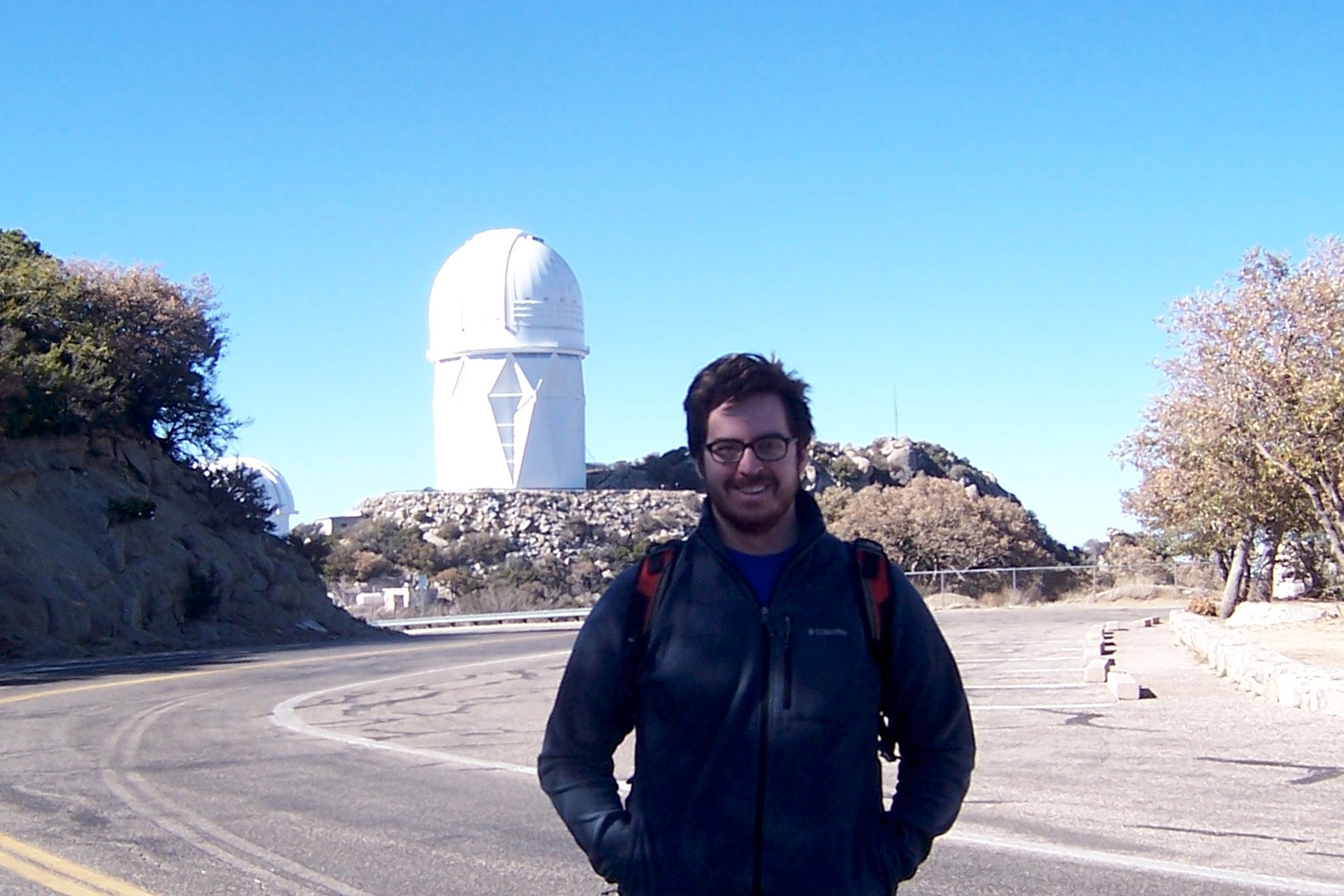
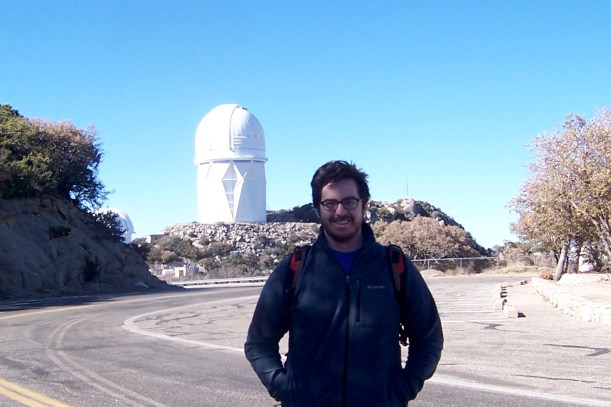
For once, something larger than my head in a photograph with my head.

For once, something larger than my head in a photograph with my head.

Two weeks ago I went down to Kitt Peak National Observatory in Arizona with my advisor to do some observing. Physics as a discipline isn’t really prone to sending students on trips (other than to conferences or to work with collaborators on a multi-university project), and astronomy only for observing trips like the one I just did, and consequently it was only the second time I’d gotten to travel for school/work/whatever grad school is. I did more theoretical stuff when I was an undergrad and I’ve been using archival data since I began in observational astronomy so going anywhere just hadn’t happened yet. This semester though there has been a lot of observing activity in our group, so even though it isn’t specifically connected to my thesis work, we’ve needed people to help out. In this case for a project involving star formation rates within galaxy clusters.

The 4-meter and some other 'scopes

Kitt Peak’s 4-meter and some other ‘scopes

The local environment within clusters of galaxies (presumably some aspect of its density at the point in question) has an effect on the star formation rate within the galaxies. Since there haven’t been a ton of observations of the lower rate, fainter, galaxies in clusters the idea was to come up with a method of imaging them so we could gain some insight into how many stars are forming there and why. We chose a few known galaxy clusters that are at a specific distance such that the primary emission wavelength is redshifted to be just within a narrow-band filter on the MOSAIC imager of the telescope we used (the Mayall 4-meter). Then, by comparing the difference between the narrow and wide band filters, we could pick the galaxies that were at this distance out from the background, and figure out their rate of star formation.

So that’s basically the science justification for what we were up to. Like I said, it isn’t specifically what I’ve been working on myself (though I do study galaxy clusters) so when I say “we” I really meant “the PI and my advisor” (at least in the last paragraph).

So back to focusing on me.
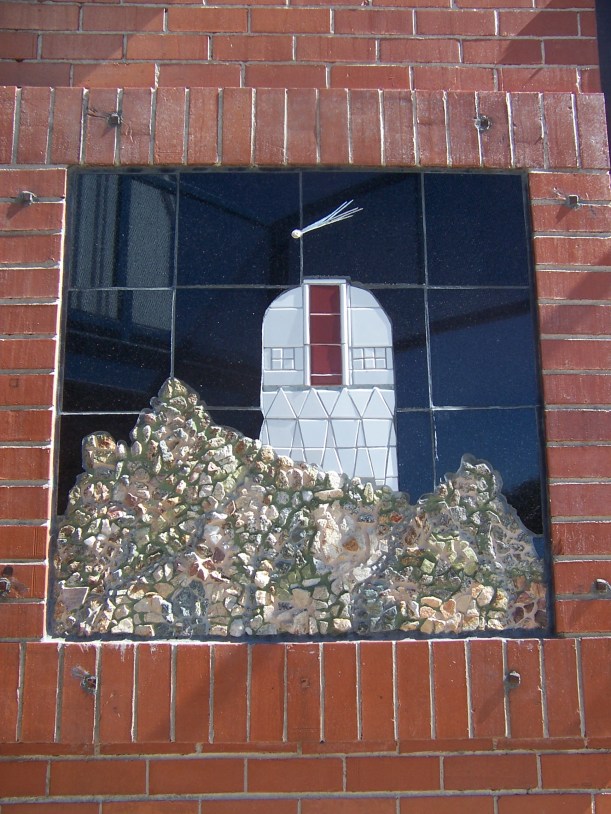
Kitt Peak National Observatory: Failing to detect Earth-destroying comets since 1958.

Kitt Peak National Observatory: Failing to detect Earth-destroying comets since 1958.

I had to leave from Boston at like 9am, so even though I knew I’d be up all night observing, I had to get up at like 6 am and spend most of the day in seats that weren’t designed for 6’1”, leggy brunettes like myself. We basically had to rush to get there in a timely manner, the observatory is about an hour outside Tucson, and my flight didn’t get in there until about 90 minutes before we had to get down to business
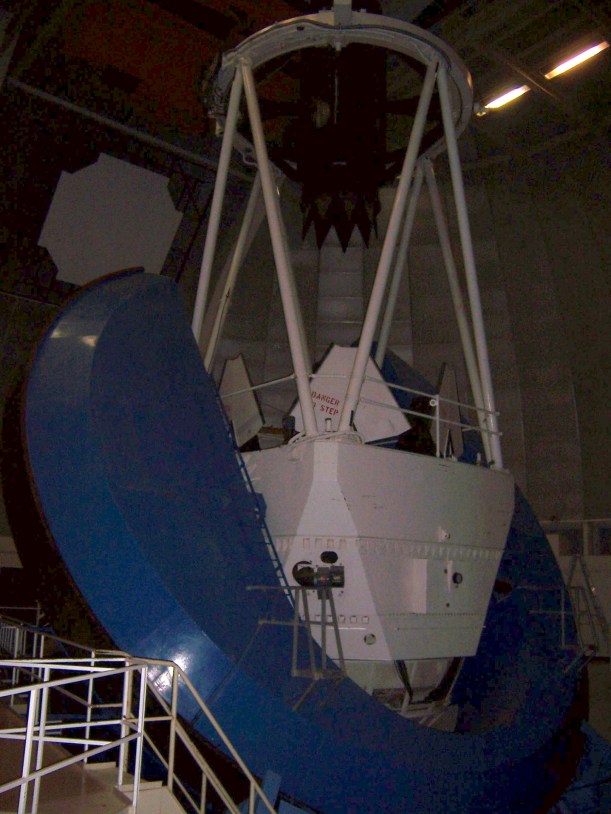
For scale, think of each letter as being the height of an average human. I would be incorrect, but think about it anyway.
For scale, think of each letter as being the height of an average human. It would be incorrect, but think about it anyway.

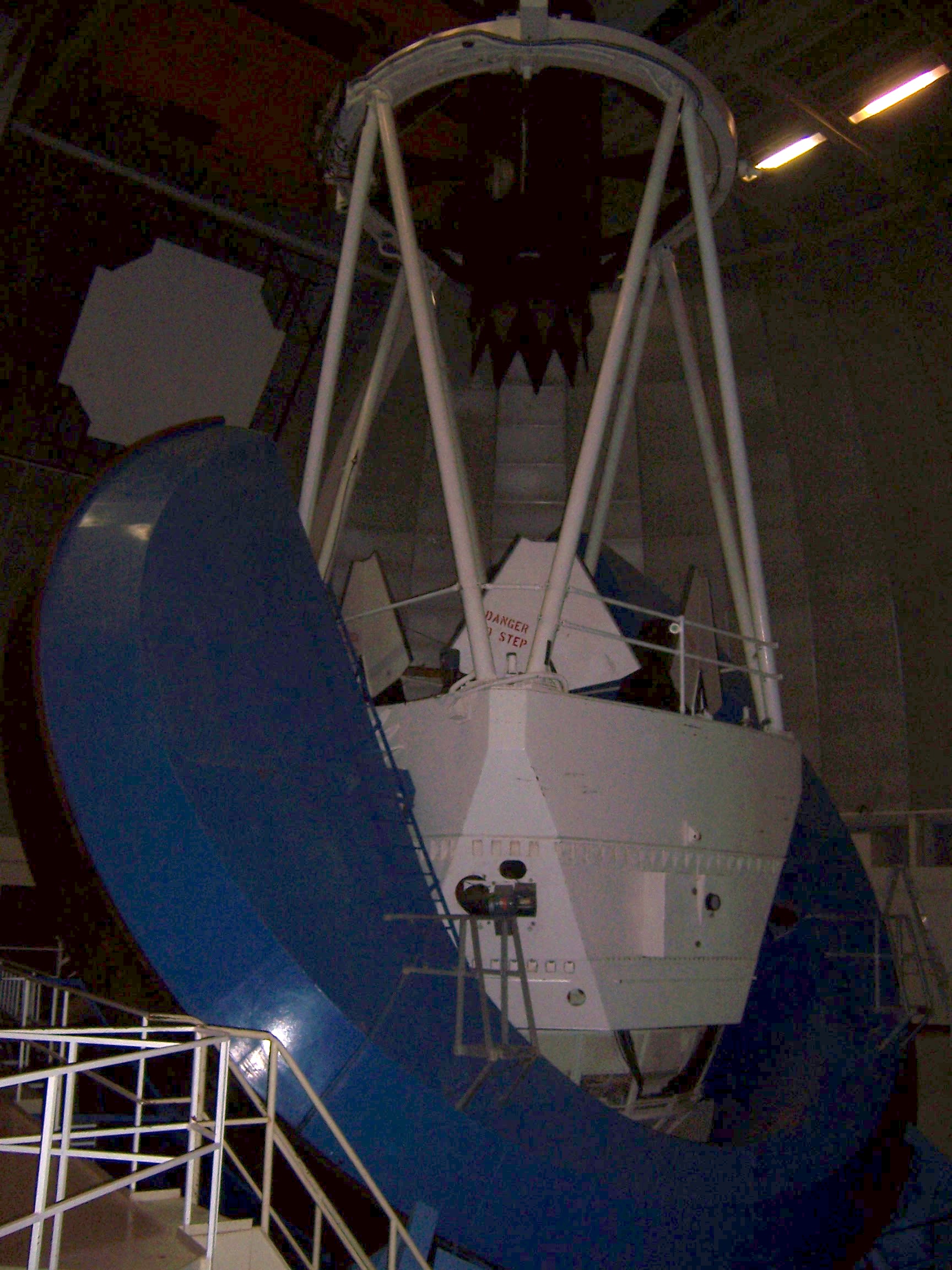
The telescope we were using for this project was the Mayall 4-meter at Kitt Peak. It’s a beast of an observatory— the telescope, the dome it’s in, and the structure itself, are all enormous. At least, they feel that way considering that it’s about 15 stories high and there are usually only 3 people working in there. It was built in the early 70s when the thinking was that getting any height above the ground was an improvement in seeing (the clarity of images), and so even though it was already on top of a mountain, they deliberately made it wicked tall. And to accommodate the the size of the telescope’s focal length (as you can see above) the inside of the dome, and therefore the footprint of the building had to be large as well. As it turned out, it really didn’t matter how tall it was, and in fact, giving it this massive structure caused wind coming up the side to shake the telescope a bit, which is obviously bad. Nonetheless, it’s a great instrument, and powerful enough to accurately resolve some faint galaxies.

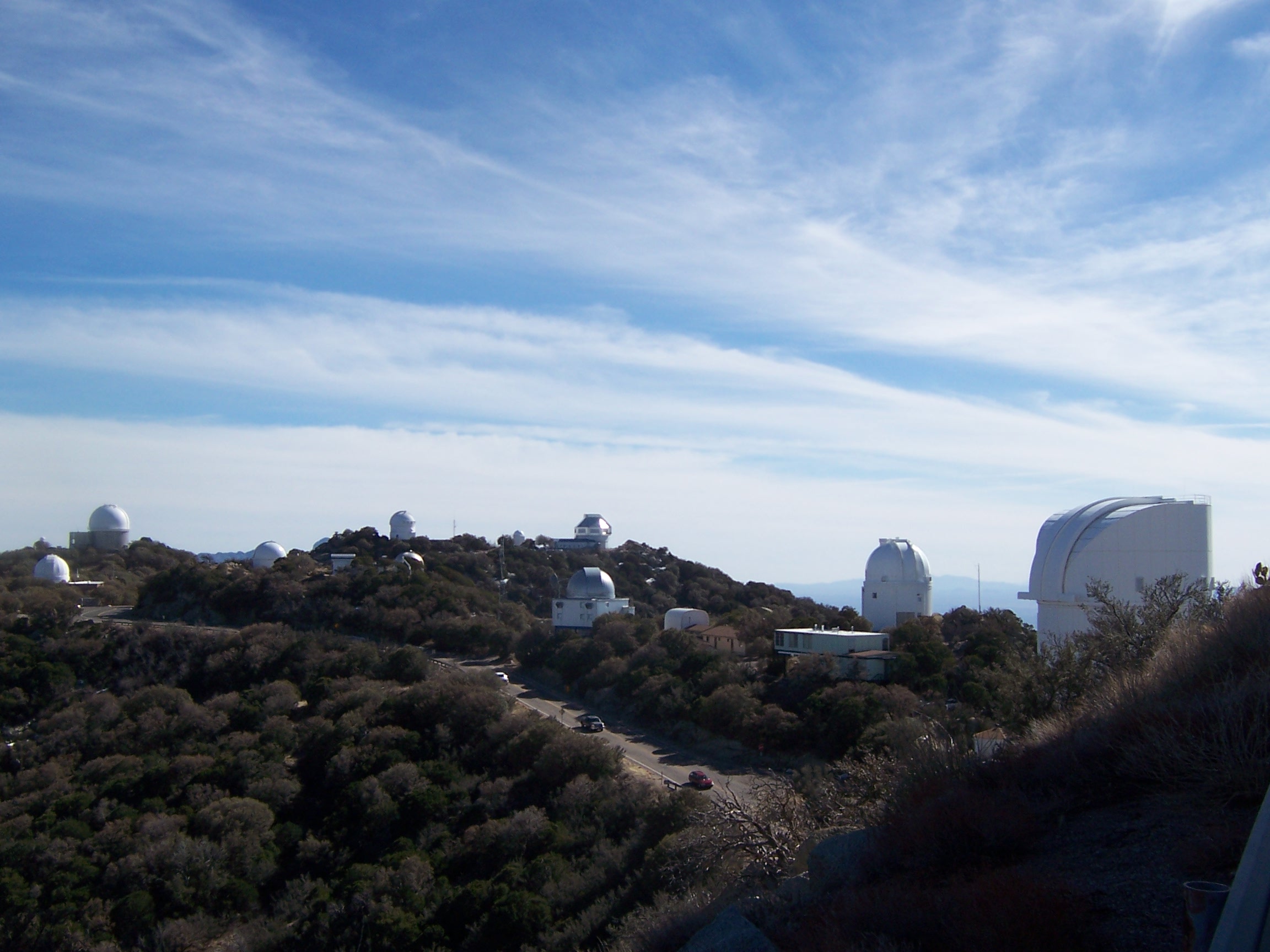
View from the 4-meter

Reverse view from the 4-meter. You can see WIYN (the shiny metal one), the 2-meter, and a surprising amount of traffic for a mountaintop.

The first night was really painful. After having been up for about 30 hours in a row, (especially when a lot of that time consists of traveling-while-tall) everything in my body hurt, and for about an hour around 4 am my consciousness was flipping on and off like a light switch. So good job there, self. And coming out at about 6:30 am onto a freezing, surprisingly windy mountaintop was fairly painful as well. Fortunately, it was worth it since we got so much data that night. My advisor, despite working around the clock and having a couple kids, has that Margret Thatcher superpower where he only needs a few hours of sleep every day (his approval numbers are better among Scottish miners too). So luckily for us, he breezed through the all-nighter. If it had just been me, I probably would have collapsed on the controls around 4:30 and caused some kind of comical mishap.

As I said in the little science part, in addition to two common filters, we were taking images in two narrow-band filters which required us to have the shutter open for 10 or 20 minutes at a time. Once you’ve gotten set up and conditions are basically constant, and you are doing a 5-image pattern of 20 minute exposures, it definitely gives you some time to think. So I thought about how to write a python script sorting data based on header information in the files I’m using, and since I was so tired and achy, it took about 5 times as long as it should have, and involved deep thoughts about how quotation marks in certain contexts cause syntax errors.

Usually when you go from New England to Arizona in the winter, it means you don't have to look at dirty snow.

Usually when you go from New England to Arizona in the winter, it means you don’t have to look at dirty snow.

One of the cool things though about the ultra-long exposures is that they are actually long enough to detect asteroids. You see all the usual stars and galaxies, and since the exposure is so long, a higher than average number of cosmic rays, but if you look closely, there are numerous little streaks, all going in the same direction. The Earth’s motion relative to the asteroids is such that over the course of 20 min we have moved far enough relative to them that they’ve steadily moved through the background. On the third night we accidentally set the telescope to track on an asteroid, and got the reverse effect. You pick a bright guide star on each exposure and it helps the instrument to follow the field through the Earth’s rotation. It was a 13th magnitude asteroid, and the operator understandably mistook it for a star, so after 10 minutes when we saw the image, everything was streaked out, with the asteroid (and presumably all the other asteroids) looking like stars. Needless to say, there isn’t much you can do with that image.

The view up through the dome. Fortunately, there was no reason  to go up that terrifying staircase.

The view up through the dome. Fortunately, there was no reason to go up that terrifying staircase.

We were there for 4 nights and semi-fortunately, only got good data on 2.25 of them. The first was clear, the second was cloudy and we packed it in around 1am. The third it was beautiful again and we finished up two of our three clusters, and on the last night, we got just enough to deepen our exposures of one cluster. Of the clusters we wanted to see, the first was up by sunset at ~7pm, while the second only came up at 1am or so and the third a little after that. We just barely got enough for the first two. The first night we got some images of the 3rd cluster (I think) but not in enough different bands to be useful for this project.

A metaphor? For the current state of investment in basic research? Or something, I guess.

A metaphor? For the current state of investment in basic research? Or something. It looks artistic though doesn’t it?

Since I mostly work with lots of raw data, as I said, this was my first time literally operating a world-class instrument. If you don’t count outreach activities (I can put together our portable hydrogen-alpha solar telescope blindfolded like the guy in Full Metal Jacket), or TA-ing (using some kind of 1843 brick observatory full of leaves and ghosts to show undergrads that Saturn actually has rings), my experience with these kinds of telescopes was on the back-end, dealing with the imagery itself. It was somehow surprising that to take images you simply type a command into a little unix terminal window and hit “enter.” The first few times you do it you think “that’s it?” It doesn’t seem possible that this is all it takes to photograph these enormous galaxies billions of lightyears away from Earth (and simply odd to have a typed command control a physical object), but of course, years of work went into designing everything and writing the software and wiring the control system… it’s just a thing that is easy to forget in the moment.

The control room, from which, as you may guess, the telescope is controlled. And screens are looked at.
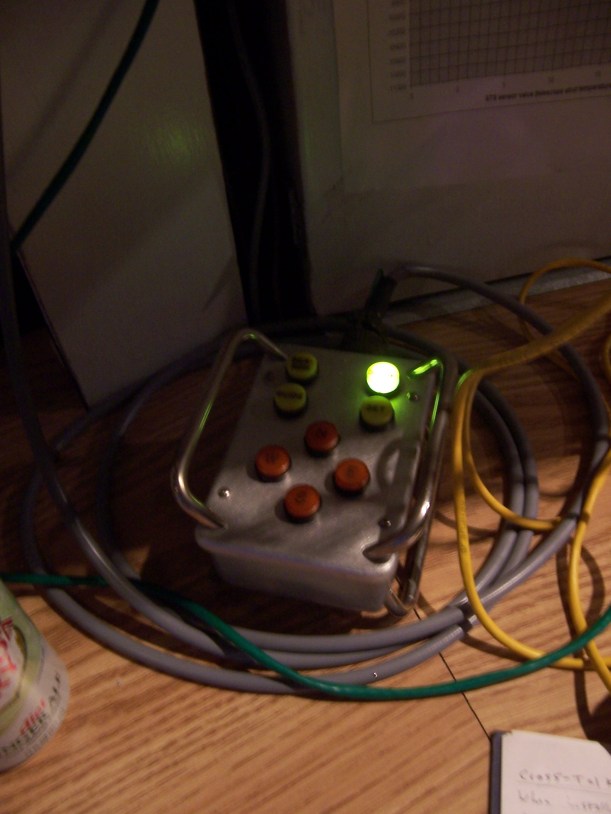
I drink a lot of ginger ale. This is a fact that's only available to H-bar Premium readers, i.e. people who read the alt-text..

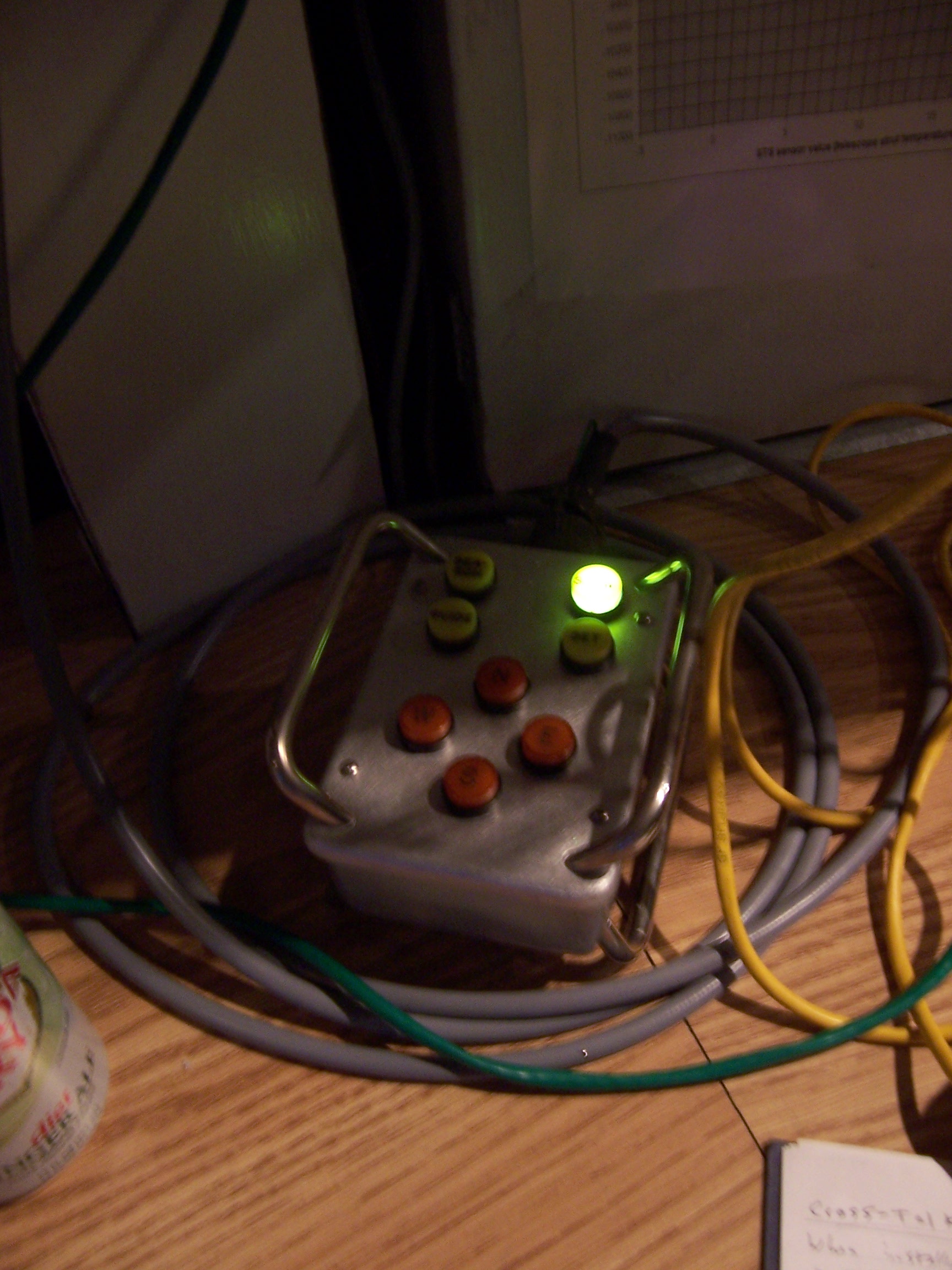
This paddle that can move the telescope was next to me most of the time we were observing. Even though it is almost never used, they like to leave it plugged in and in the middle of the observer’s workspace. What could possibly go wrong?

Although the operator controls the telescope pointing, this paddle could just move the telescope over a few inches at any moment if I hit it. Good to know it was powered up and plugged in. Other than the possibility of ruining an exposure by accident, the work area was actually pretty nice. Non-astronomers who I mentioned the trip to all assumed that we were exposed to the elements somehow—that we were actually inside the open dome structure. I’m glad that we weren’t, since other than stray light getting near the mirror, it was probably about 30 degrees up there, with extremely forceful wind. Astronomy would be brutal if we had to work that way. Instead, we get to stay in a nice, warm, protected control room. Bonus points for the controls on the operator’s side of the room looking like they could have come out of a 1950’s sci-fi movie with gauges and backlit buttons.

This mirror probably has mirror envy

This mirror probably has mirror envy

After getting enough rest following the first night I set out to wander and look at all the other instruments. There was some slight awkwardness based on the fact that Kitt Peak is enough of a tourist attraction to draw people during the daytime, and though I was there as an astronomer, it isn’t like I’m carrying some “I’m supposed to be here” card that would make me feel less odd about crossing “Staff Only” signs. I mean, I did do that, but I felt weird about it.

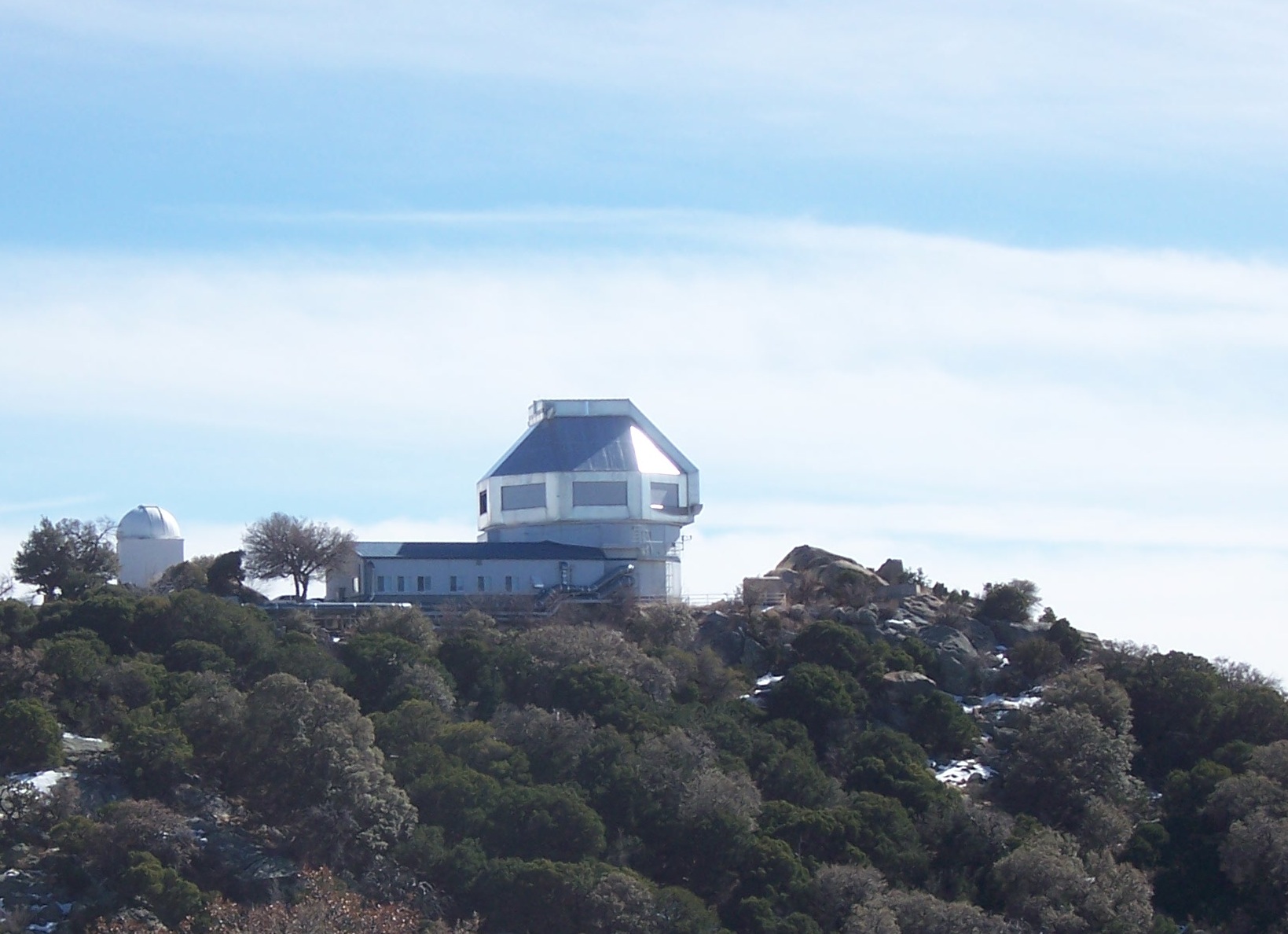
WIYN. Shiny domes are all the rage these days.

WIYN. Shiny domes are all the rage these days.

We have a strong involvement in the One Degree Imager (ODI) at the WIYN telescope so I headed over to give it a look. Gravitational lensing studies are all about trying to get accurate, resolved, shapes of galaxies, and seeing is often the most important part of doing that. Seeing is defined as the size of stars in the image—stars are so far away that they should be points of light, but the atmosphere spreads them out, and the larger they are, the worse the image is. The adaptive optics in WIYN’s mirror, and the further corrections made by ODI, (which was only installed in the past year), takes those star images in real time and predicatively corrects the atmospheric distortions. So even though it’s not located on top of a giant windy pedestal, it’s a pretty good tool for resolving galaxy shapes. Even though it isn’t a tourist area, I figured that since I’ve been hearing about it for years and helping to write proposals involving it, I was within my rights to barge in and look around. The operator was kind enough to show me around, and despite the fact that it is a comparable instrument to the behemoth I was working in, the entire building was about the size of a large house. Here’s a picture of the adaptive optics behind the mirror that shape it to improve the focus.

WIYN100_2273

And ODI is this stuff:

The One Degree Imager, an orthogonal transfer array that stabilizes the image in real-time within the CCD. Taking a blurry photo of it is deeply ironic.

The One Degree Imager, an orthogonal transfer array that stabilizes the image in real-time within the CCD. Taking a blurry photo of it is deeply ironic.

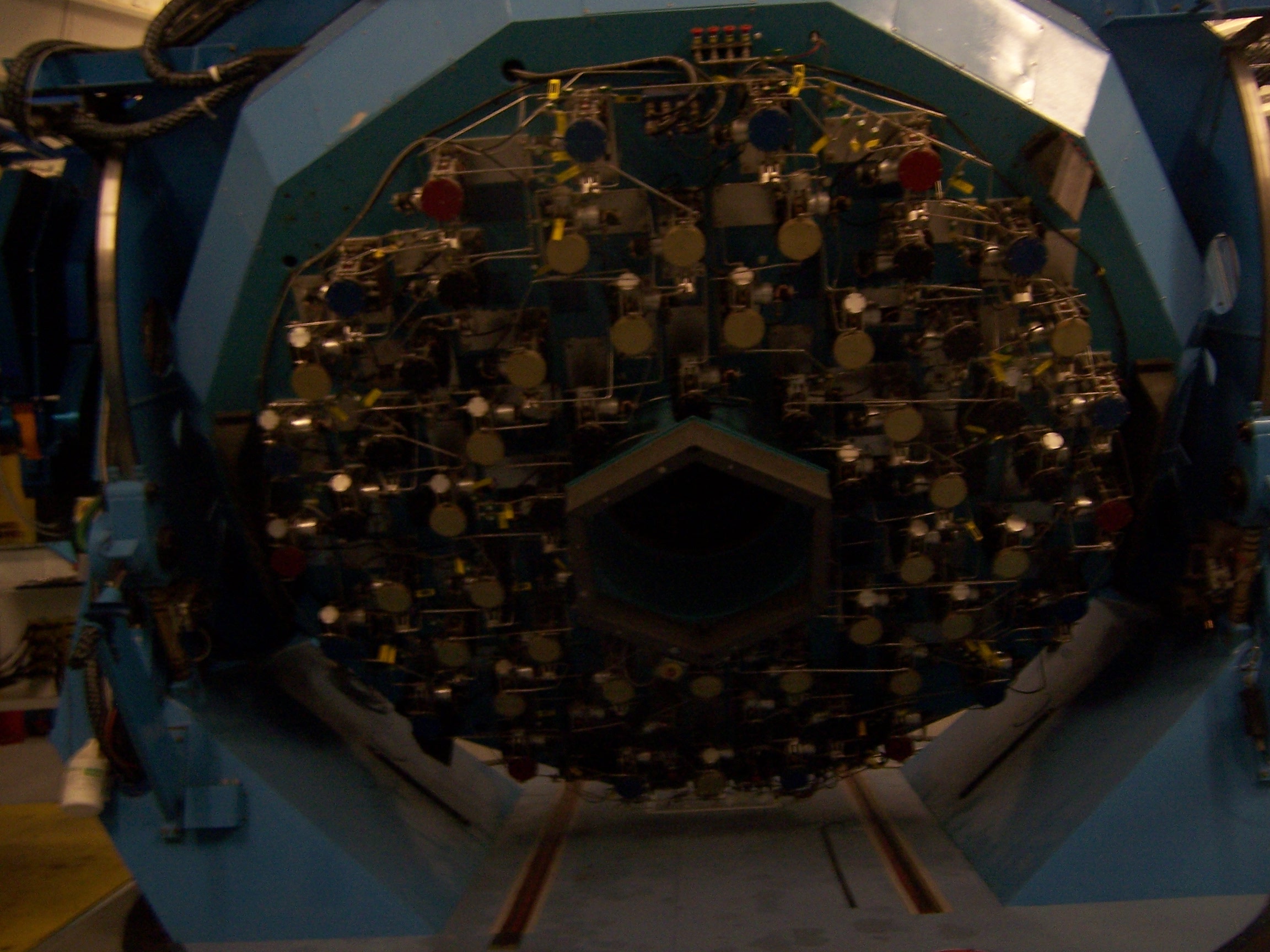
Apparently the instrument is so quiet when it’s moving that they actually put a cowbell on it so the operators could be sure that it was actually changing position. It was over where the ODI equipment is located, but so essential that they evidentally built the new instruments around it, so you can’t actually see it anymore. (I assume that it just happens that they were able to put all the new stuff around it, but I prefer the idea that they considered it so indispensable that some planning went into keeping it there). Oddly, almost all the pictures I tried taking of it came out blurry.
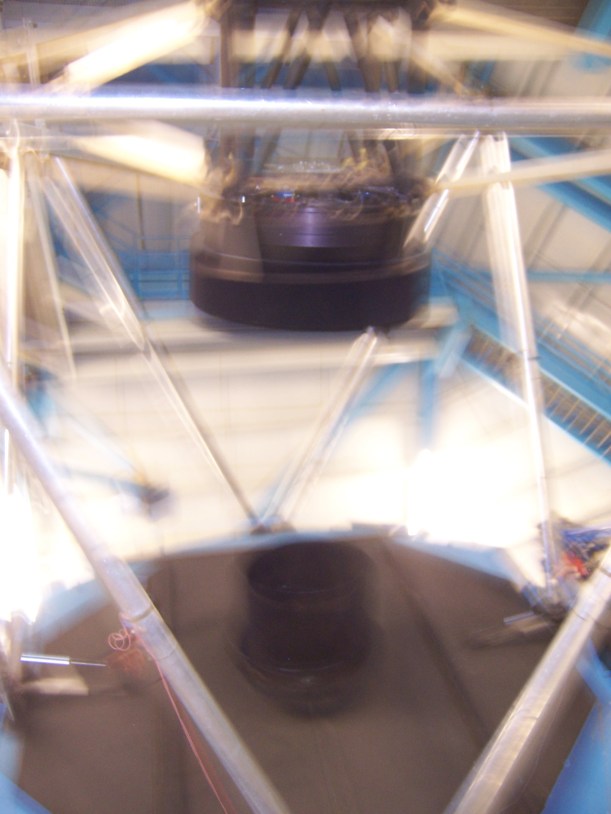
WIYN's (covered) mirror, and focus

WIYN’s (covered) mirror, and focus

As you can see WIYN clearly creates some special zone of optical clarity for itself that transfers blurriness to all nearby imaging devices.
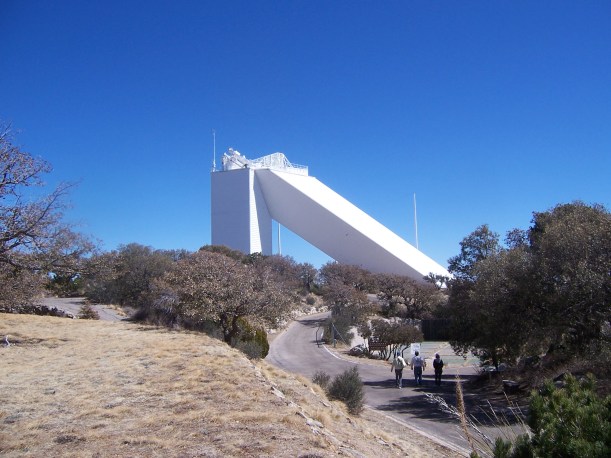
McMath-Pierce Solar Telescope.
McMath-Pierce Solar Telescope.

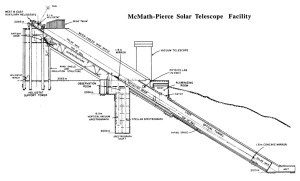
Schematic of the Solar Telescope. Like a potato, most of it is actually underground.

Schematic of the Solar Telescope. Like a potato, most of it is actually underground.

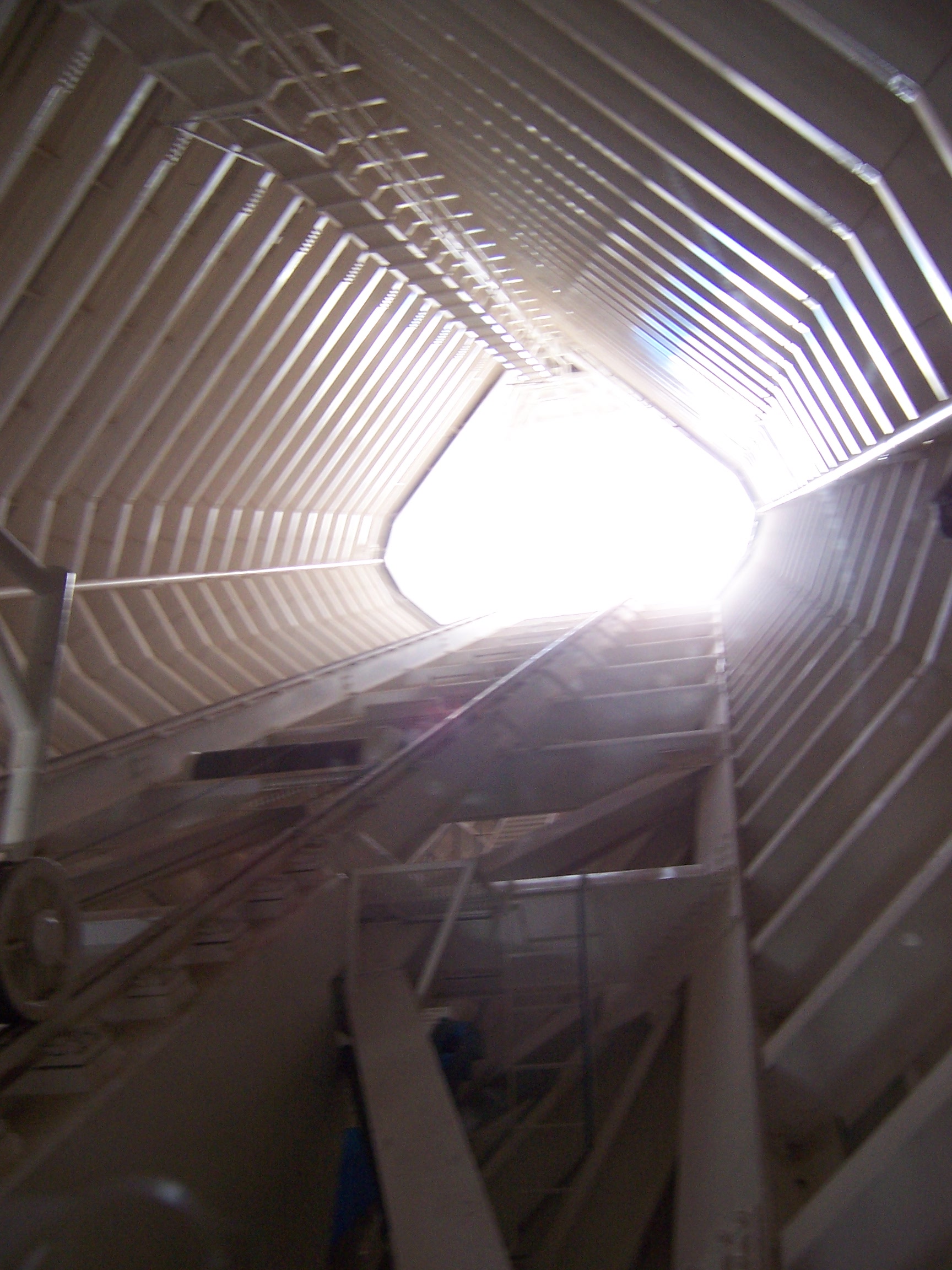
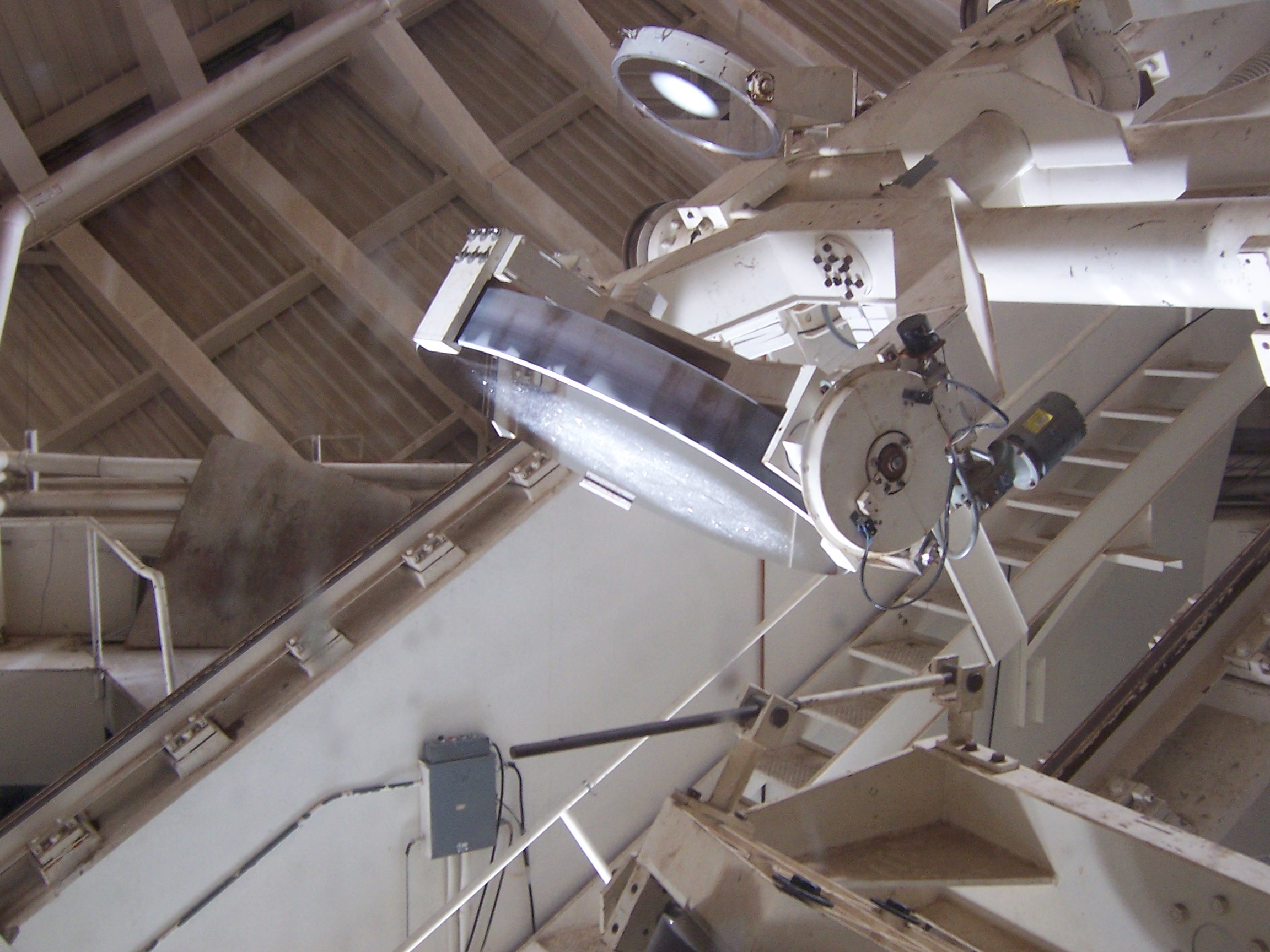
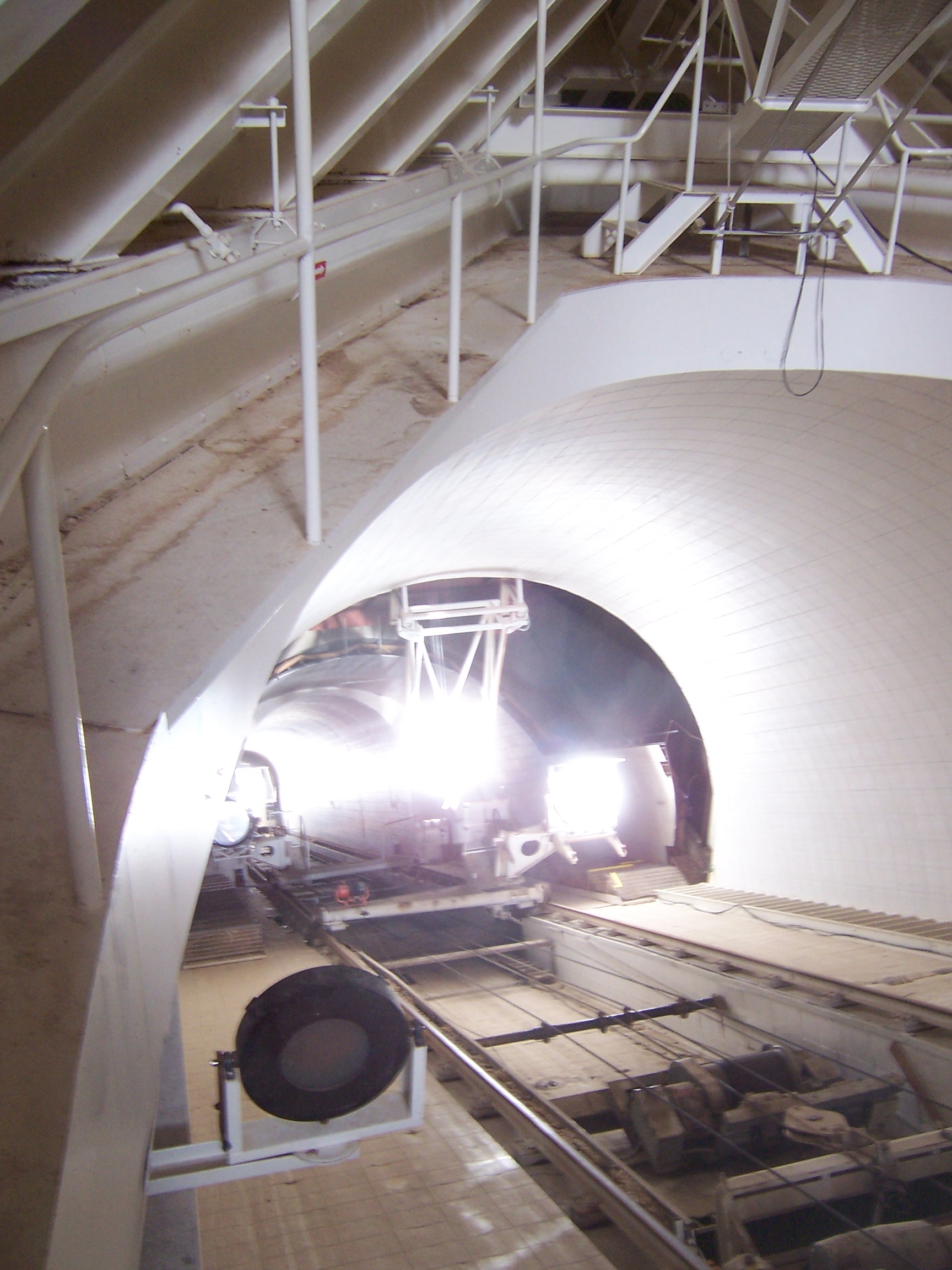
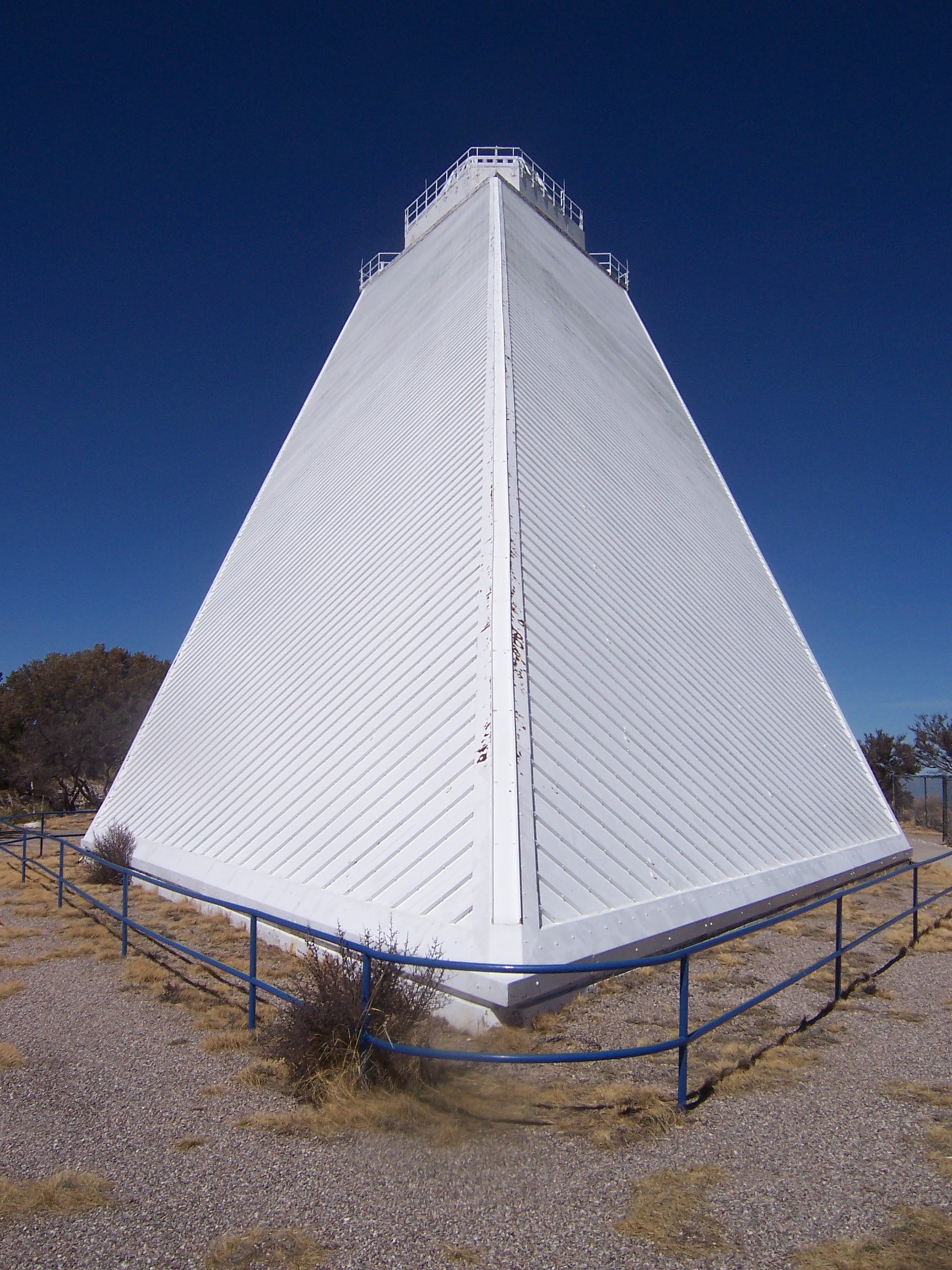
One of the most visually striking things up on Kitt Peak is the unusually shaped McMath-Pierce Solar Observatory. In terms of astronomical instruments it’s certainly unique. Like an iceberg or the hostility among players on a high school lacrosse team most of it is hidden below the surface. It sends light from the sun far down a long tunnel burrowed into the mountain, then reflects it back and finally sideways into an underground control room. At the time it was built this was the best way of getting magnified images and detailed spectra from the sun. Here’s a schematic:

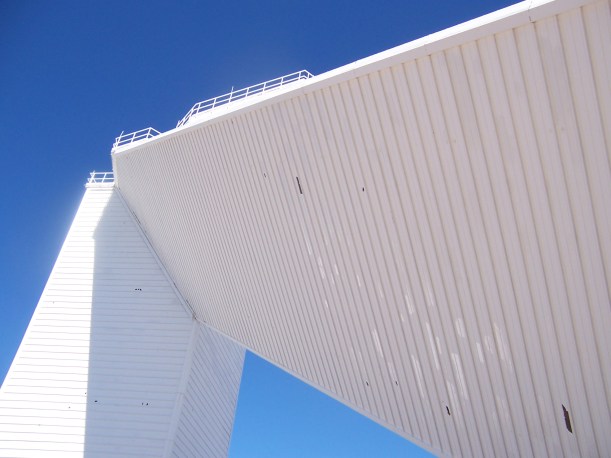
Not knowing anyone in this field, I resisted the urge to actually go in and see the science area, but I did check out the little tourist booth where you can see the shaft and mirrors and took a ton of artsy photos of this futuristic dystopian setpiece.
Solar2

Inside the solar observatory. It's bright up there, I think I see why they put that hole in the top.

Inside the solar observatory. It’s bright up there, I think I see why they put that hole in the top.
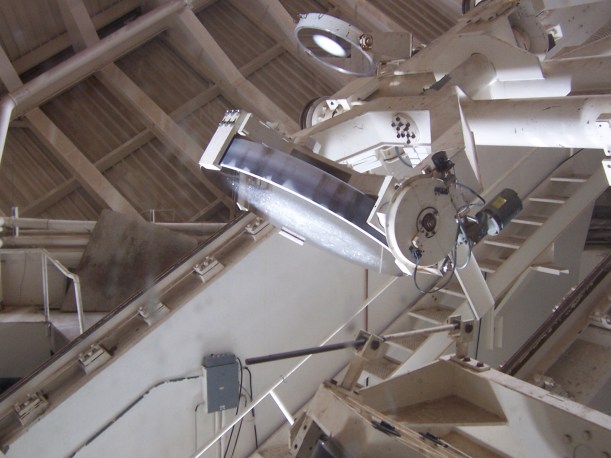
The mirror focusing the sun's light

The mirror focusing the sun’s light

Looking down into the mountain

Looking down into the mountain

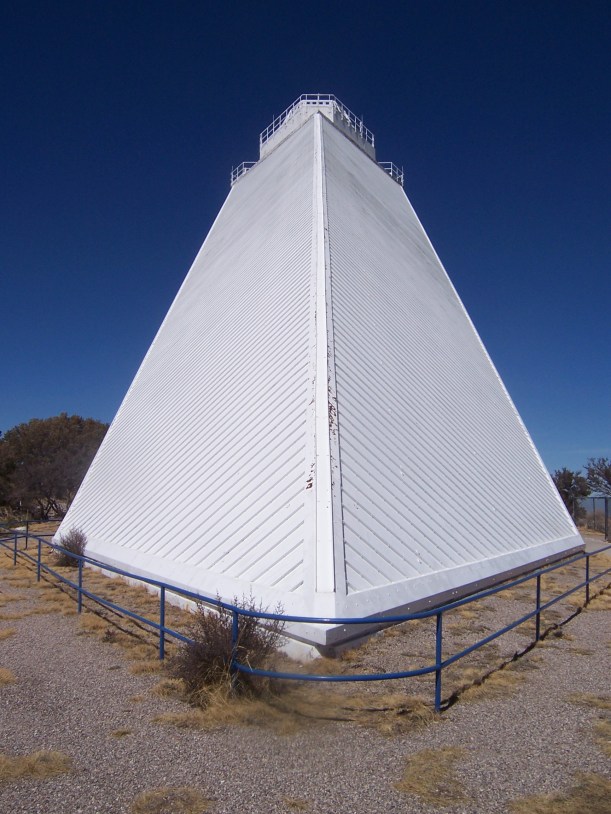
From a cool angle—it's like a giant doorstop.

From a cool angle—it’s like a giant doorstop.
100_2262

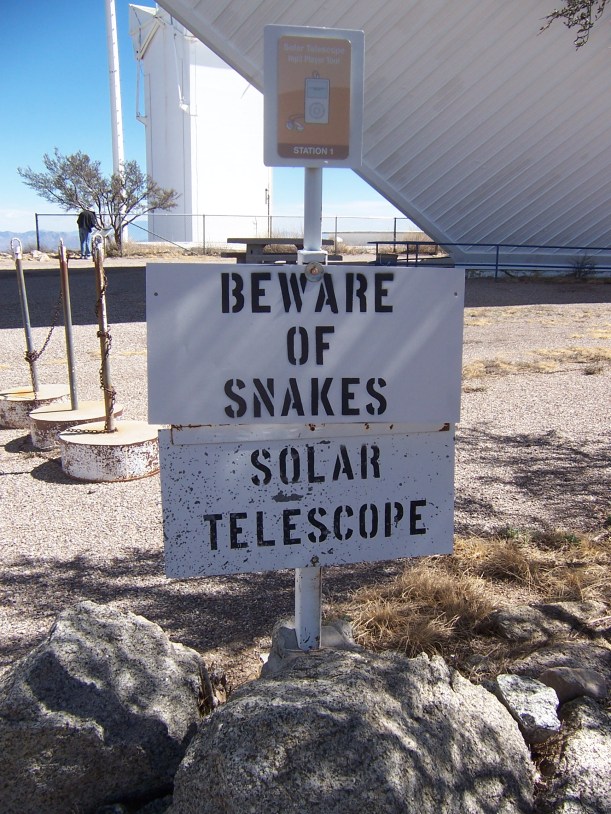
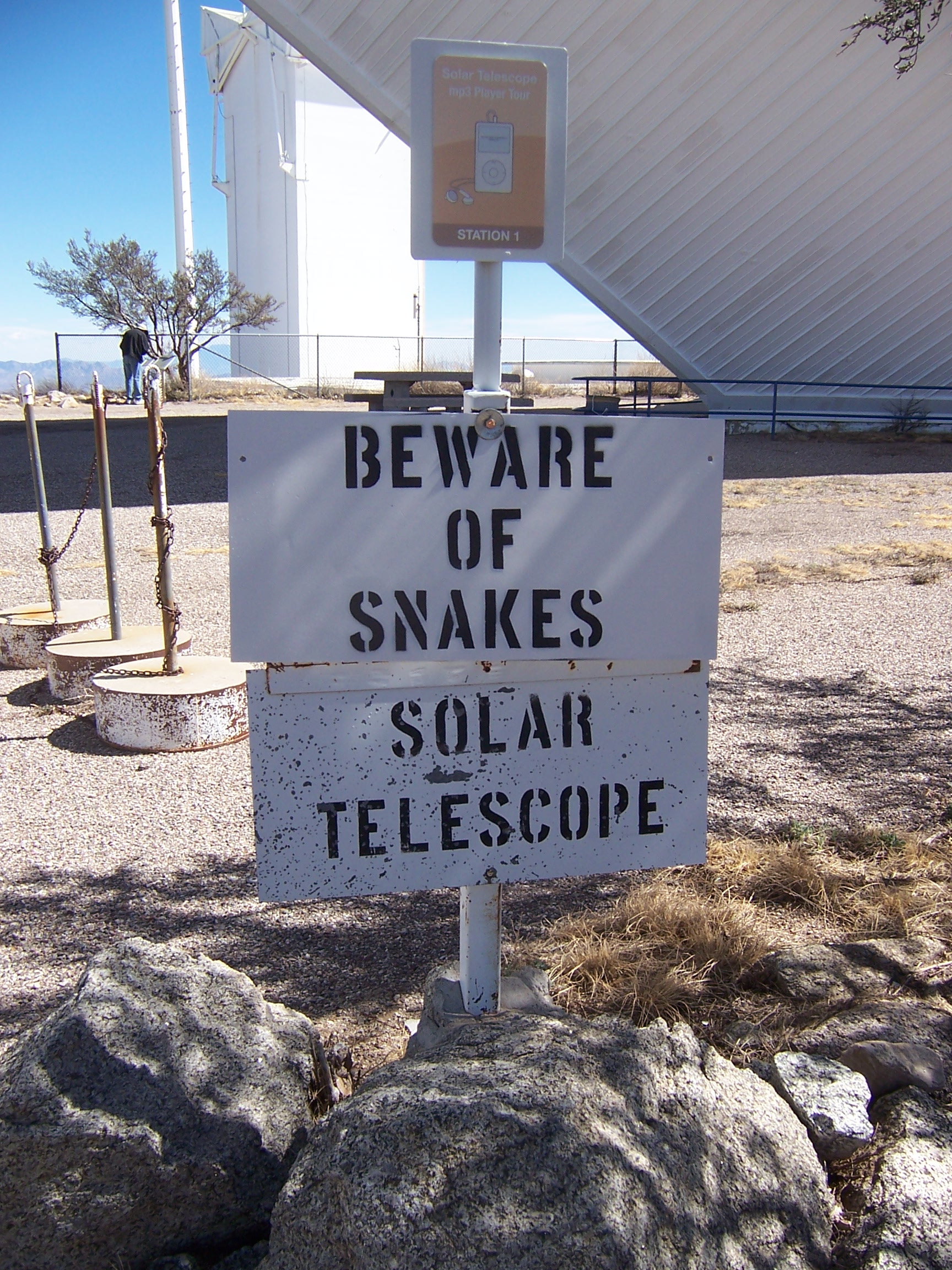
Snake times

This isn’t specific to Arizona, snakes everywhere are attracted to solar telescopes.
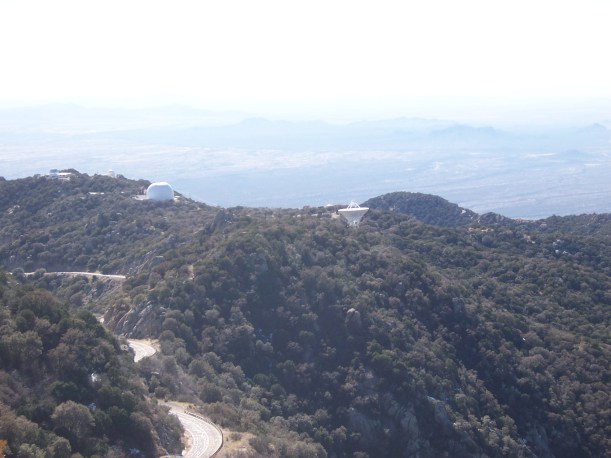
The radio telescope. It's some distance away from the main area, and operated remotely, so as to accommodate Jodie Foster's busy schedule.

The radio telescope. It’s some distance away from the main area, and operated remotely, so as to accommodate Jodie Foster’s busy schedule.
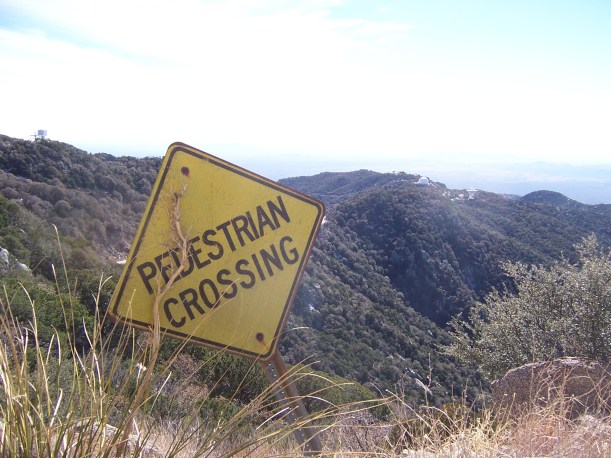
When I took this I though there was some kind of irony or artistic value in this photo. In retrospect, it is obviously meaningless.

When I took this I thought there was some kind of irony or artistic value in this photo. In retrospect, it is obviously meaningless.

Having done my share of aimless wandering and rested up, the rest of the trip was pretty fun. Unfortunately, the nights when we were able to get data alternated, so the second night we got nothing, the third we got a lot and on the last a storm was approaching so we only got a few hours done. There were points where we just watched the monitor as clouds were passing in front of the guide star, pausing it when it was covered, opening the shutter again when it cleared up, like the world’s most mundane video game.

One of the nights it was cloudy I went wandering around the building to check out the old equipment and aging rooms. It seems as though when it was designed, they envisioned using the building for everything, and since it’s so enormous they have all kinds of spaces there. People kept mentioning that there are creepy dorm rooms somewhere, in a way that implied that although they worked in this building, they weren’t clear on exactly where they were. Since there aren’t any windows, these terror rooms were basically small prison cells—unfortunately I didn’t find them. This is the exercise room, you can see the angular outside wall behind the state of the art exercise stuff:
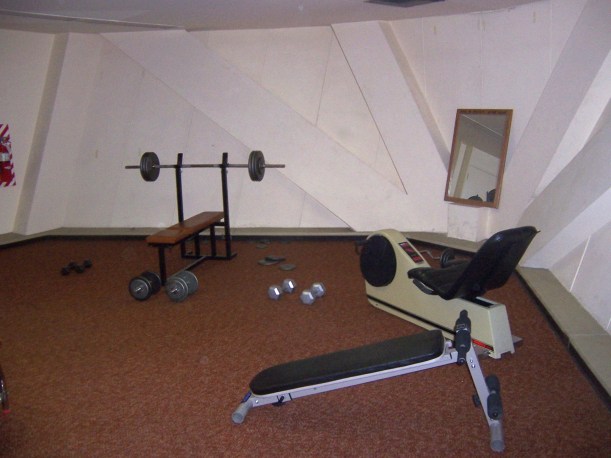
The inexplicable exercise room in the 4-meter. Preserved perfectly to reflect the spirit of 1981.

The inexplicable exercise room in the 4-meter. Preserved perfectly to reflect the spirit of 1981.

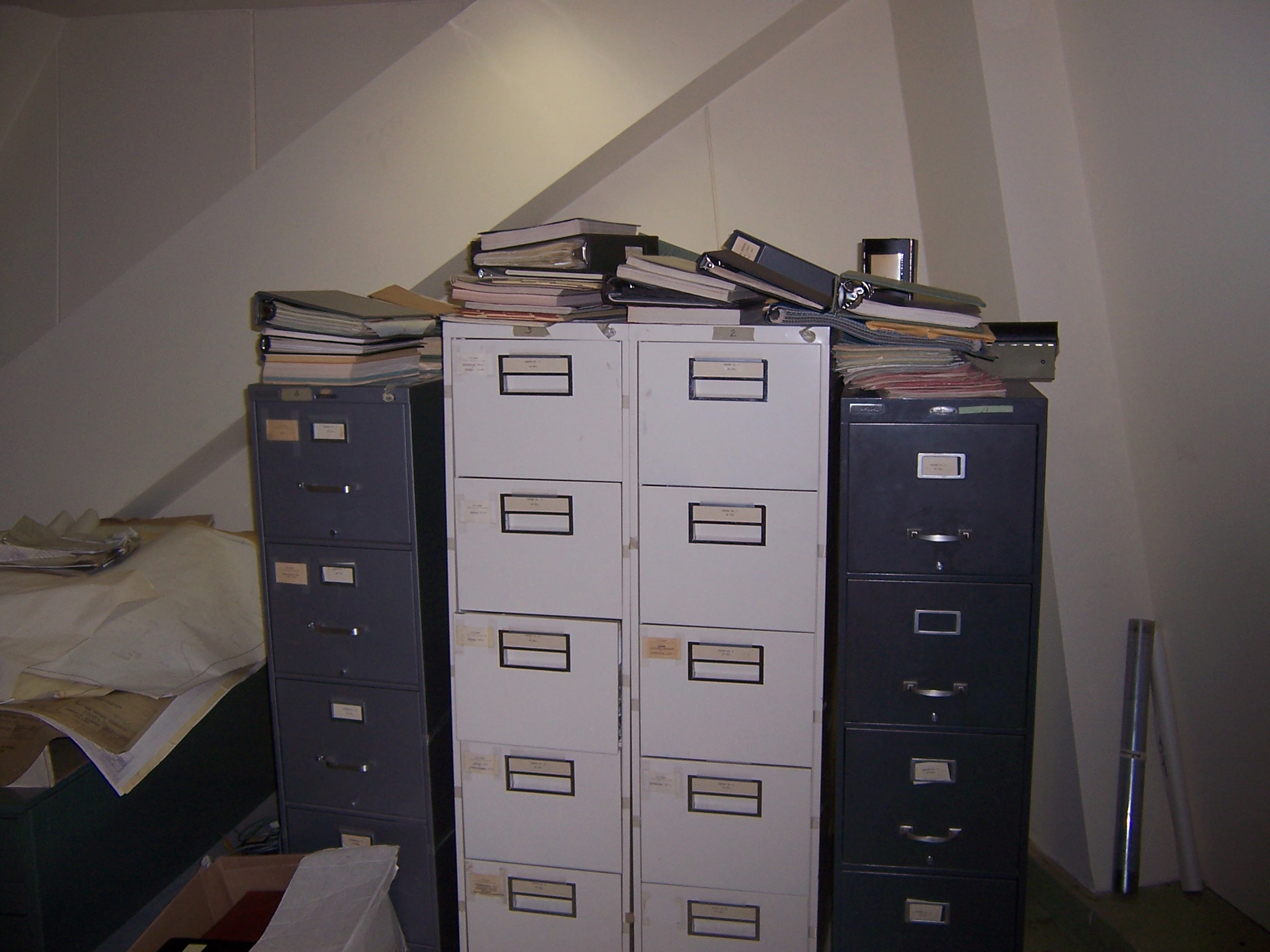
They also had a bit of stuff left over from the era of photographic plates. Fortunately for us, we now use CCD cameras, but when this telescope was inaugurated it still had the old-fashioned cameras. So there were instruments for measuring sizes of objects and the astrometry between them on the photographic plates, as well as cabinets full of data, back when our data was a physical thing.

The halcyon days when astronomy filled filing cabinets.
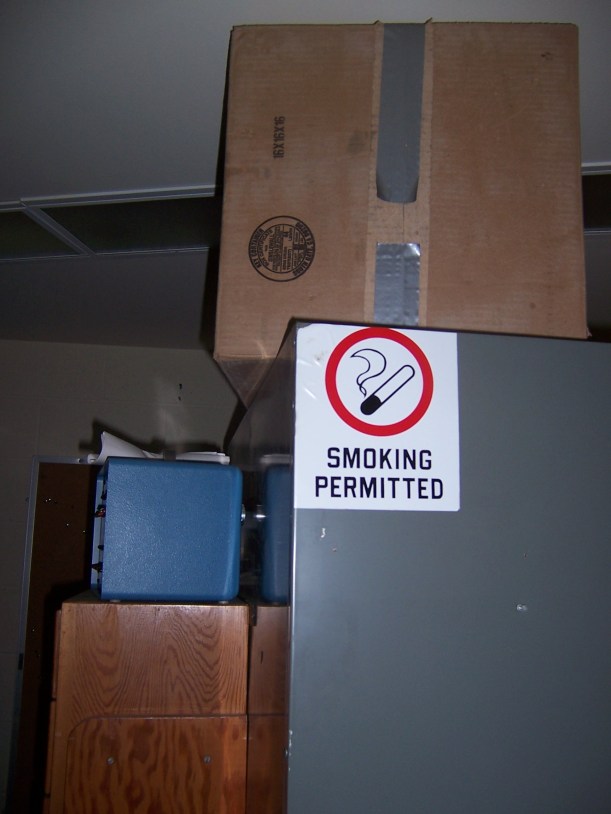
The halcyon days when astronomy filled filing cabinets.

Light up

Don’t see many of these in high-level scientific institutions.

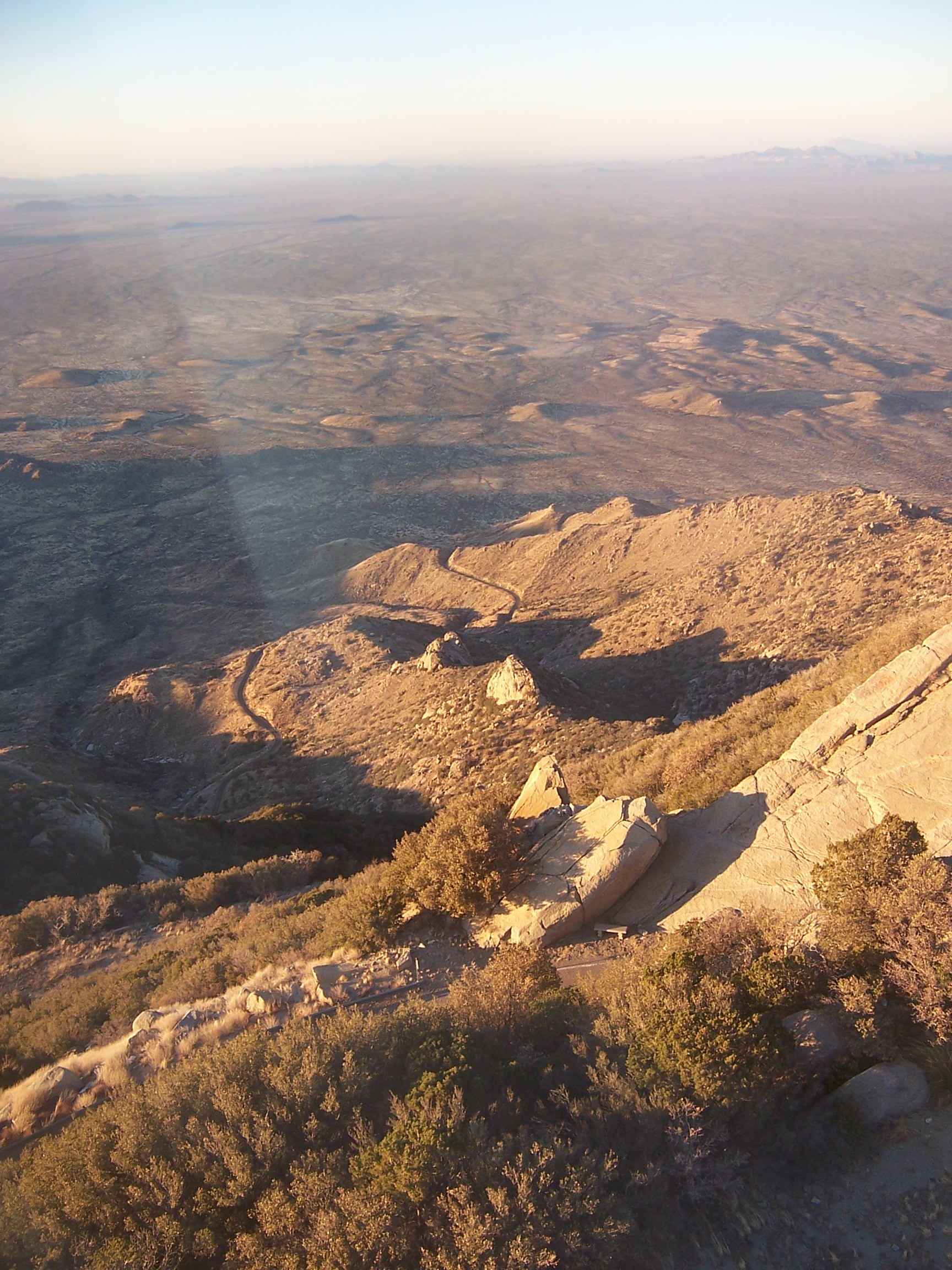
Going outside you really do feel like you’re isolated on top of some kind of desert ocean up there. You can’t see any signs of civilization until the nighttime, when little towns in the desert light up. I haven’t spent much time in deserts and the beauty is so striking.
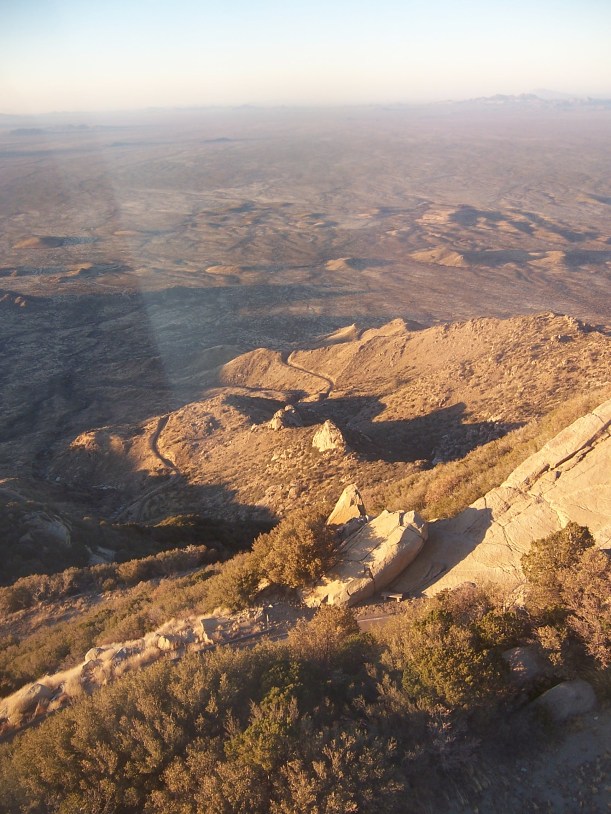
Looking roughly north about an hour before sunset. It doesn't look that far up in this picture, but it really really is.

Looking roughly north about an hour before sunset. It doesn’t look that far up in this picture, but it really really is.

Weather station and the distant horizon
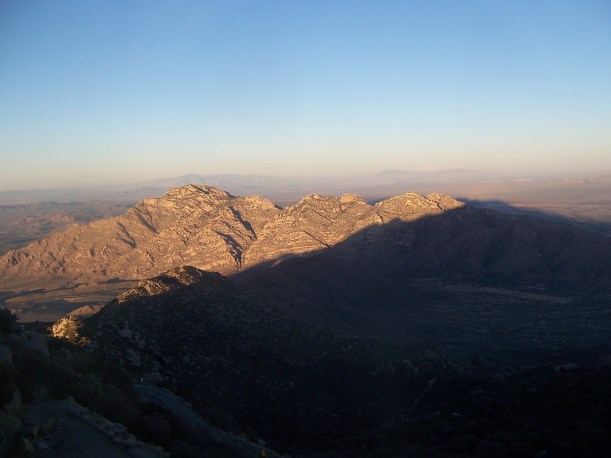
Weather station and the distant horizon

The mountain making a shadow on another mountain.

The mountain making a shadow on another mountain.

In conclusion: telescopes.

4-meter

The sky, and one of those things that looks at the sky.


Leave a comment

Possibly the Best Part of the Middle Ages

And you don't even need an icepick to read it.

We post the articles the Onion won’t.

Starvation, disease, persecution, outdoor toilets. There wasn’t a ton of upside to medieval Europe. Other than absurd names for stuff, of course. I’m just going to put this here, and let you worry about it. And presumably, never forget it.

Via Wikipedia, Source of All Eternal Truth:

Gropecunt Lane was a street name found in English towns and cities during the Middle Ages, believed to be a reference to the prostitution centred on those areas; it was normal practice for a medieval street name to reflect the street’s function or the economic activity taking place within it. Gropecunt, the earliest known use of which is in about 1230, appears to have been derived as a compound of the words grope and cunt. Streets with that name were often in the busiest parts of medieval towns and cities, and at least one appears to have been an important thoroughfare.

Although the name was once common throughout England, changes in attitude resulted in its replacement by more innocuous versions such as Grape Lane. Gropecunt was last recorded as a street name in 1561.

Variations include Gropecunte, Gropecountelane, Gropecontelane, Groppecountelane and Gropekuntelane. There were once many such street names in England, but all have now been bowdlerised.[1] In the city of York, for instance, Grapcunt Lane—grāp is the Old English word for grope[2]—was renamed as the more acceptable Grape Lane. […]

During the Middle Ages the word may often have been considered merely vulgar, having been in common use in its anatomical sense since at least the 13th century.[…] Gradually though the word became used more as the obscenity it is generally considered to be today. In John Garfield’s Wandring Whore II (1660) the word is applied to a woman, specifically a whore—”this is none of your pittiful Sneakesbyes and Raskalls that will offer a sturdy C— but eighteen pence or two shillings, and repent of the business afterwards”.[11][12] Francis Grose‘s A Classical Dictionary of The Vulgar Tongue (1785) lists the word as “C**t. The chonnos of the Greek, and the cunnus of the Latin dictionaries; a nasty name for a nasty thing: un con Miege.”[13]

Although some medieval street names such as Addle Street (stinking urine, or other liquid filth; mire[15]) and Fetter Lane (once Fewterer, meaning “idle and disorderly person”) have survived, others have been changed in deference to contemporary attitudes. Sherborne Lane in London was in 1272–73 known as Shitteborwelane, later Shite-burn lane and Shite-buruelane (possibly due to nearby cesspits).[16][17] Pissing Alley, one of several identically named streets whose names survived the Great Fire of London,[18] was called Little Friday Street in 1848, before being absorbed into Cannon Street in 1853–54.[19] Petticoat Lane, the meaning of which is sometimes misinterpreted as related to prostitution, was in 1830 renamed as Middlesex Street, following complaints about the street being named after an item of underwear.[20]

See also: Tickle Cock Bridge


Leave a comment

“Movie” Review: 2012: Supernova

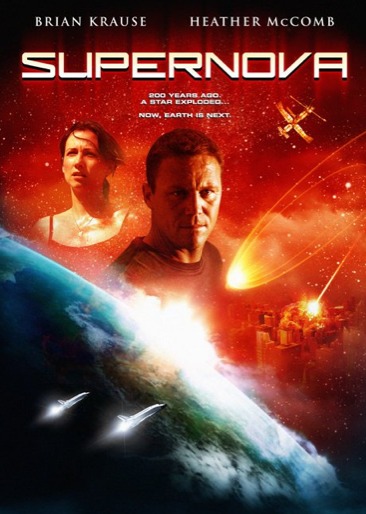
This poster is the most well-produced aspect of this film

This poster is the most well-produced aspect of the film

Two colons in the subject line? The review isn’t even underway and it’s already ruined. 2012: Supernova is another sanity-testing straight-to-DVD film-like-product by the Asylum Studios geniuses who have previously brought us such works as Boa vs. Python, HyperMoth vs. SuperLamp, and ExoFrog & EnormoToad. (Or whatever). It came out in 2009 to capitalize on the John Cusack 2012. The title of the movie has absolutely no bearing on anything that happens, the year is completely arbitrary. Asylum’s basic strategy is to make movies with titles similar enough to big-budget films that people doing searches in Netflix confuse the two, and when that’s your approach to filmmaking, the results are never far from miraculous. As such, they are sort of ‘facades’ of real movies, where they have titles and the characters in them look a lot like actors, and you have to assume that living people were actually hired to make the special effects, but you can tell that the paycheck these people get for it is essentially the only thing keeping them from borrowing their parent’s money in order to buy scratch cards for a living.

I was actually interested in this because the description sounds exactly like an idea I had for one of the only astronomical disaster scenarios to be unused in an action film: radiation from a nearby supernova threatens Earth. (And no, not in the idiotic way used in  JJ Abrams’ Star Trek that makes no sense). Problematically though, in real life, if we were hit by, say, a gamma-ray burst from a very nearby supernova, we’d get a neutrino signal a few hours in advance, the sky would get very bright, and then half the planet would just get blasted with deadly gamma rays for a minute or so, and then those people would die. Everyone on the other side of the planet would survive to gradually starve to death due to the mass extinction, or suffer fatal radiation exposure due to the depleted ozone layer. Sort of like The Road but more uplifting. And not a great situation for a movie, since there is almost no warning, and there isn’t really anything we could do about it before everyone was already dead. [Dara O’Briain’s breakdown of 2012’s apocalypse scenario is here, by the way, and it’s hilarious]

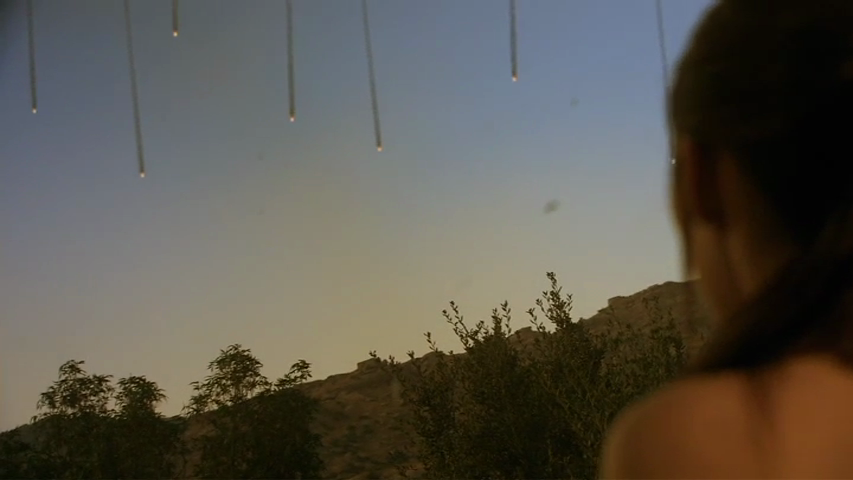
The first sign of a supernova apocalypse: meteors

The first sign of a supernova: meteors

For the purposes of a narrative, 2012: Supernova imagines that this supernova explosion is happening gradually and predictably, so our hero can have something to do. All the effects from astronomy’s only sudden and violent event occur gradually and take on completely inexplicable forms. The movie opens with a satellite in Earth orbit EXPLODING because an enormous bubble that expands out of nowhere destroys it. We then go down to Earth where an astrophysicist, Kelvin, waking up in his cavernous undecorated house. There are no photos or personal belongings anywhere— presumably this allows them to rent it out as a porn set on weekends. NASA has summoned him, the big scary thing is happening now, ahead of schedule, he needs to get to the base! And because there is impending disaster, he rounds up his wife and daughter, (who both appear to be roughly the same age), and packs them into his giant black science-SUV. They protest strongly despite the fact that there are now unexplained fireballs reigning down from the sky. Nonetheless, he refuses to tell them why it they’re leaving or what’s going on. Trust him, ladies, he’s an astrophysicist, OK? That is more than enough explanation for why you need to rush somewhere mysterious at a moment’s notice.
Continue reading


Leave a comment

Inaugural Linktopus

Congratulations! You are the first person to read this alt-text!

The Linktopus is honoring the legacy of Martin Luther King by tearing a frigate apart.

Here is some stuff that exists.

Words with no English equivalents

5. Zeg (Georgian)
It means “the day after tomorrow.” Seriously, why don’t we have a word for that in English?

7. Lagom (Swedish)
Maybe Goldilocks was Swedish? This slippery little word is hard to define, but means something like, “Not too much, and not too little, but juuuuust right.”

8. Tartle (Scots)
The nearly onomatopoeic word for that panicky hesitation just before you have to introduce someone whose name you can’t quite remember.

Steve Thomas - Mars

Steve Thomas – Mars

This art, by Steve Thomas is really cool. There are a series of solar system retro travel posters being sold as a 2013 calendar that was (unfortunately) already sold out by the time I saw it. Nonetheless, his site is worth checking out, because there are many more things like this excellent poster. And someday, there will be more calendars.

Alt-country rocker Ryan Adams got so sick of people yelling out “Summer of 69!” by 80’s crap rocker Bryan Adams that he finally just performed an aggrivated version of it. He had previously reacted by freaking out and throwing people out of his shows when they said it, which they frequently did. At the end he says “Can it finally stop now, please?” He sounds desperate, and I admire that. I can’t link to the song itself because there seems to have been some DRM weirdness, but you know, there’s google if you really want to hear it: the important part is that you know it happened.


Glee ripped off Jonathan Coulton’s arangement of ‘Baby Got Back’ – Really hard. It’s a cover already, but evidently, everything you change about a song you cover, is thereafter copyrighted by you. And in this case, where Coulton’s arrangement is totally new itself, with a melody that doesn’t have anything to do with the original, it’s extremely obvious it was copied. They even left in his change from “Mix-a-lot” to “Jonny C”…like they just ran this thing off in 15 minutes thinking no one would ever find out. JoCo was never even contacted. Hopefully this further shame the shameful series who’s ear-piercing covers are starting to show up before the original versions on sites like iTunes, to the horror of all right-thinking people.


Leave a comment

The Epidemic Threatening America

Image

Our national nightmare continues: for the second time in three months a girl has become stuck in between two buildings. This time in Portland. The victim actually fell from 2-storeys above to the alley between the buildings instead of forcing herself into the narrow passageway, so maybe she wasn’t blasted out of her mind. Except that it happened at 3:45 am, and this was Portland so…

Your move, Courtney Malloy.

Leave a comment

Les Automatóns

Bonjour Y'All

Bonjour Y’All!

Me: I just had a dream that I was in a production of Les Mis and the major action of the plot revolved around several of the major characters secretly being robots. For instance, that “I dreamed a dream of time gone by” song was about a robot who was hundreds of years old pining for the life he used to have 300 years ago in England.
Girlfriend: Have you ever seen Les Mis?

Me: No, and now I’m afraid I’m going to be disappointed.

Girlfriend: So the other characters were dressed as robots?

Me: No, I think they were actually being played by robots.

Girlfriend: This is the most magical conversation we’ve ever had.

Me: It might be the most magical dream I’ve ever had.


4 Comments

Two Seconds Hate: Britishisms

When I’m at a loss for stuff to write about, I should just crank out these diatribes. I never have trouble coming up with them, but I worry about transforming this blog into one whose format is just complaining about inaccurate use of phrases like “beg the question” or “the ship that made the Kessel Run in less than twelve parsecs.”

I don’t hate British slang. This isn’t a general complaint about UK-sian/Irish/Sometimes-Australian language differences. It isn’t stupid or bad that they use words differently, have colloquialisms that we don’t, or even that they spell words differently (though it’s dumb how vehemently they seem to believe it is important that color be spelled with a ‘u’). This is a complaint about some specific, annoying, obviously wrong ones.

I watch a lot of British shows, particularly comedy, (despite their stupid insistence that a season of a show should only be 6 episodes long and that a ‘season’ should be called a ‘series’) and I’m even fond of some radio things from over there, like Ricky Gervais’s XFM program that introduced the world to Karl Pilkington, Stephen Merchant’s late unlamented 6Music show, podcasts like The Bugle, Infinite Monkey Cage, and that kind of thing. It’s nice to listen or watch stuff that’s a little different (but not too different, because that would be scary). The point is that I’ve gotten a lot of exposure to how them people talk over there. But still, there are some things that make me cringe every time I hear them:

  • Drink Driving — instead of ‘drunk driving.’ This makes no sense. ‘Drunk’ describes the person’s state when they are doing the driving. Theirs is two verbs next to each other. Or at best, a noun and then a verb. But when we (both) use noun-verb pairs, the noun is the thing being acted on or used. Like ‘lawn mowing,’ ‘bar hopping,’ or ‘bird watching.’ (And I mean ‘use’ in the sense that that object is the fundamental part of what’s being done). ‘Drink driving’ is like saying ‘get drink’ instead of ‘get drunk.’ Obviously, no one would say that, unless they were really drink.
  • Fancy Dress — to mean ‘in costume.’ This is the term for any kind of costume, and ‘fancy dress party’ means costume party. This is simply misleading. Costumes are not necessarily fancy. And what if you’re trying to throw a party where people are supposed to dress like rich old fashioned people, and everyone shows up dressed like characters from Battlestar Galactica instead?
  • Middle Class — The way we use ‘Upper class.’ It seems like Upper Class over there is sort of reserved for nobility, permanently wealthy and otherwise super-fancy people (but not ‘fancy’ in the sense of ‘dressed like clowns or werewolves or whatever’). While more conventionally rich and refined people are called middle-class. This is very strange, and I can’t get used to how they refer to well-off twits as ‘middle-class’. I realize this sort of implies that I am calling for more of a distinction between poor and working-class people, but whatever, it’s strange to say that those in the upper portion of society are in the middle.
  • Public School — this means ‘private school.’ So they’ve essentially just chosen the opposite. This originates from the desire to distinguish between those who were educated on their vast estates by tutors, ‘privately’ and those who studied with others at a fancy boarding school, which was ‘public’ by comparison. I suppose nobody else went to school back then so it didn’t matter. Thus, in both England and America, Middle class kids usually go to public school…but those mean different things.
  • Maths instead of ‘math.’ This is due to different ways of abbreviating ‘mathematics’—they kept the ‘s’ and we didn’t. Presumably we decided that it was silly to drop the rest of the word but then keep the last letter, while they decided it was a plural ‘thing’ so they kept it. You can find both ways abbreviating in English so it is hard to make a case that either is superior. Sean Carroll covered it recently and came down on the American side (this stuff is much like the DH debate, it usually depends if you’re an AL or NL fan). In his words: “’Physics’ is just a word with an ‘s’ at the end, not an abbreviation. ‘Econ’ is an abbreviation for a singular concept, and doesn’t get an ‘s.’ ‘Stats’ is an abbreviation for a plural concept, and gets an ‘s.’ Because ‘mathematics’ is not the plural of ‘mathematic,’ there’s no reason for its abbreviation to retain the vestigal ‘s.'”
    It’s hard not to agree with this logic.
  • Dating System (21/12/12 instead of 12/21/12). This, in addition to looking stupid and illogical, is stupid and illogical. There was a graphic circulating around the internets recently, that purported to make the opposite point, while throwing in some other things like Fahrenheit vs Celsius. The little triangle they made (and basically everything else about that chart) illustrates only that they have never heard the phrase ‘begging the question’ (at least not in the sense that it means ‘tautology’). How far does this go then? Should clocks then go Seconds:Minutes:Hours? The point is that we really should be going Year:Month:Day: Hour:Min:Sec (as we do in most programming, and certainly in astronomical applications), but since we don’t always need to write the year, it’s the afterthought. Month is more important, so it comes first, and our system isn’t “arbitrary”—you only need to learn either one once.*
    Units
  • Cuppa — for ‘cup of tea.’ This is nails on a chalkboard. It’s an abbreviation that ends with an ‘of.’ Arrrgghgh!
  • Fag — for cigarette. C’mon people, not cool. I mean obviously it has a prior meaning that has nothing to do with the slur, but well, being uncomfortable with it is just a reflex.
  • Pronouncing lieutenant as ‘leftenant’ — I don’t know how they justify this— and I don’t want to know.

Americans make a big deal out of a lot of other stuff that is simply word choice differences, but that stuff is just random. I’m annoyed at Brits who think petrol is more correct than gas, or that jail should be spelled gaol. But that’s just pointless cultural hubris. Calling dinner tea is a bit ridiculous, but whatever, metonymy.

*The other stuff on there is kind of stupid too. Despite being pretty into science, as I am, unless you’re doing a ton of conversions, it doesn’t much matter which units you have in your daily life. And, in fact, for some things, the non-SI units are better. Celsius temperature differences are great for chemistry, but that system is ‘arbitrary’ as well: it’s based on water. Kelvin is the one that isn’t arbitrary in this sense, but we don’t use it because we’d always be using three digit temperatures where only significant, memorable, number is at 0° for a temp that has physical significance but no meaning in daily life. 0°-100° Fahrenheit is at least a range that roughly spans the temperatures you will actually encounter in habitable parts of Earth. In Celsius, most of the livable outdoor temperatures are within like 40 degrees of each other, and the variation between a crisp autumn day and a gusty winter one is like 5°. Pounds and ounces are arbitrary too, but unless you’re doing conversions, it’s not a big deal. Units aren’t more or less logical than each other, what matters most is what you’re using them for.