

Aitch-Bar

Writing About (Mostly) Not Astrophysics


Leave a comment

Saturnalian Christmas and the Chaotically Violent Christmases of Yesteryear

The Big Blue Bug.

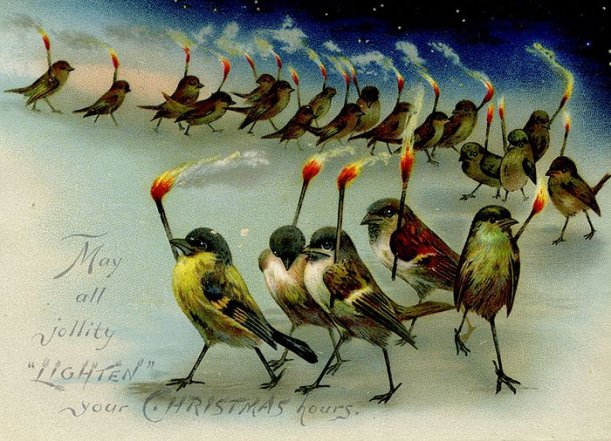
Yes, that’s a giant termite. It’s Christmas in Providence

As we gather around the roaring yule-log, sipping our rum laced with egg-nog, we too often fail to reflect on the true origins of our yearly holiday. And I certainly do not mean the Christ-y ones– I’m talking about the kind of origin that involves drunk rioters and talking farm animals. In times like these, I turn to my 1898 edition of Curiosities of Popular Customs, and of Rites, Ceremonies, Observances, and Miscellaneous Antiquities by William S. Walsh for the proper perspective. I bought my copy from the Tabor Academy library for $1, the reference librarian having concluded that it was too racist and outdated for a modern high school. It is an invaluable source of naïvely Anglo-centric information about holidays no one celebrates anymore, or celebrates widely now but which were new then, or stories about where pieces of saint’s bodies ended up. Or of the horrible blood-rites common in heathen lands.

As my X-Mas gift to you, people who read this, I will simply excerpt a large piece of the fascinating entry on Christmas. (It may be read starting on page 226). No where else can you see the history of Christmas explained using words like ‘pagan,’ ‘Govr‘ and ‘Popish’? Or outlandishly racist sentiment from the 1890’s. Or phrases such as “…citizens saluted his charred and mangled corpse, when it was last borne to the grave.” Enjoy!

Christmas. The reputed anniversary of the birth of Jesus Christ, December 25, and as such one of the greatest festivals of the Protestant, Catholic, and Greek Churches. It is essentially a day of thanksgiving and rejoicing,—a day of good cheer. Though Christians celebrate it as a Christian festival, though to them it is the anniversary of the most solemn event in all history, the meeting of heaven and earth in the birth of the God-Man, the festivities that mark the epoch are part of the universal history of the race. In pagan Rome and Greece, in the days of the Teutonic barbarians, in the remote times of ancient Egyptian civilization, in the infancy of the race East and West and North and South, the period of the winter solstice was ever a period of rejoicing and festivity.
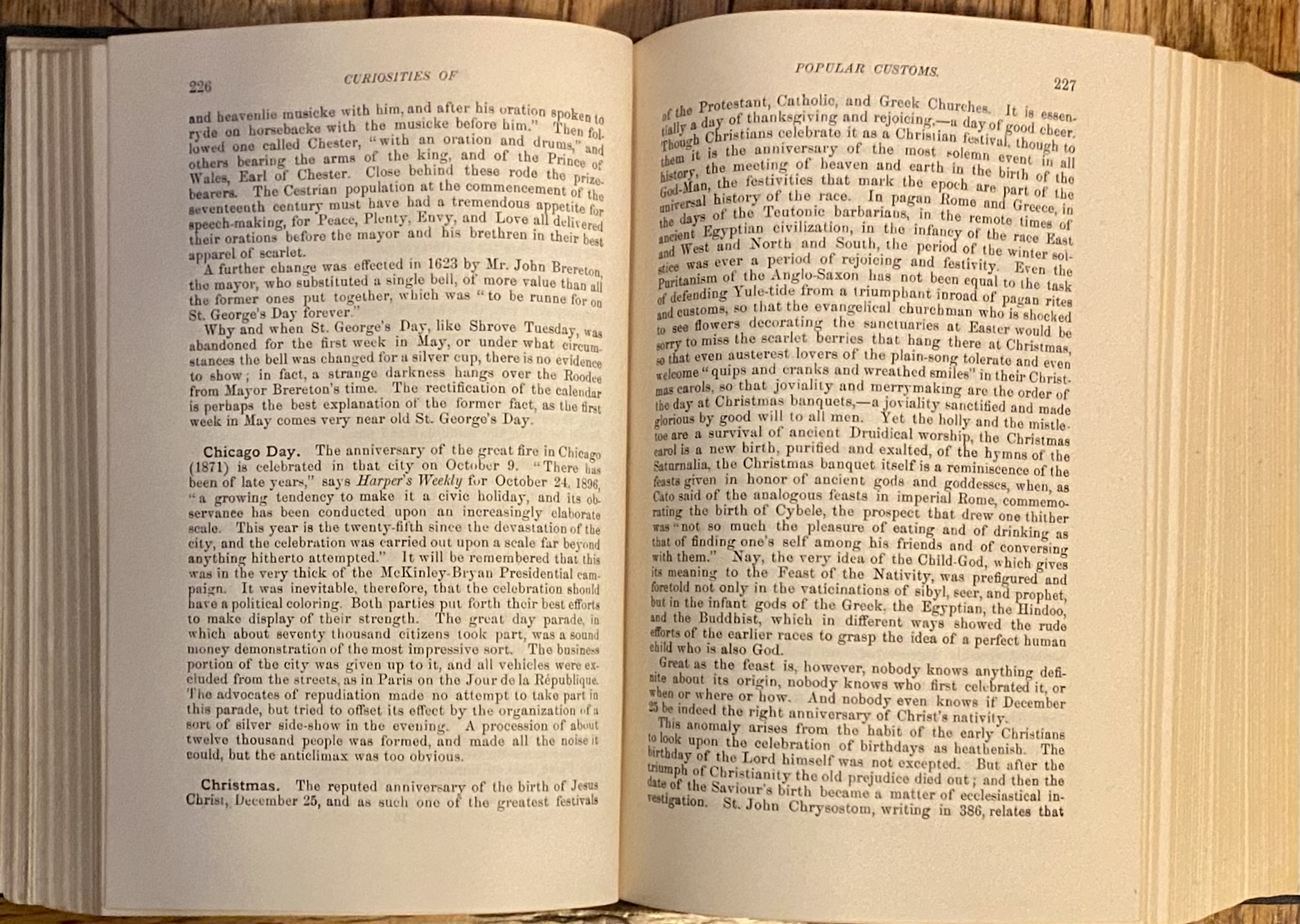
Even the Puritanism of the Anglo-Saxon has not been equal to the task of defending Yule-tide from a triumphant inroad of pagan rites and customs, so that the evangelical churchman who is shocked to see flowers decorating the sanctuaries at Easter would be sorry to miss the scarlet berries that hang there at Christmas, so that even austerest lovers of the plain-song tolerate and even weleome ” quips and cranks and wreathed smiles” in their Christmas carols, so that joviality and merrymaking are the order of the day at Christmas banquets,—a joviality sanctified and made glorious by good will to all men. Yet the holly and the mistletoe are a survival of ancient Druidical worship, the Christmas carol is a new birth, purified and exalted, of the hymns of the Saturnalia, the Christmas banquet itself is a reminiscence of the feasts given in honor of ancient gods and goddesses, when, as Cato said of the analogous feasts in imperial Rome, commemorating the birth of Cybele, the prospect that drew one thither was “not so much the pleasure of eating and of drinking as that of finding one’s self among his friends and of conversing with them.” Nay, the very idea of the Child-God, which gives its meaning to the Feast of the Nativity, was prefigured and foretold not only in the vaticinations of sibyl, seer, and prophet, but in the infant gods of the Greek, the Egyptian, the Hindoo, and the Buddhist, which in different ways showed the rude efforts of the earlier races to grasp the idea of a perfect human child who is also God.

Great as the feast is, however, nobody knows anything definite about its origin, nobody knows who first celebrated it, or when or where or how. And nobody even knows if December 25 be indeed the right anniversary of Christ’s nativity. Continue reading

Leave a comment

Physics Art Show Submission “Domeflat: SUPA00398520”

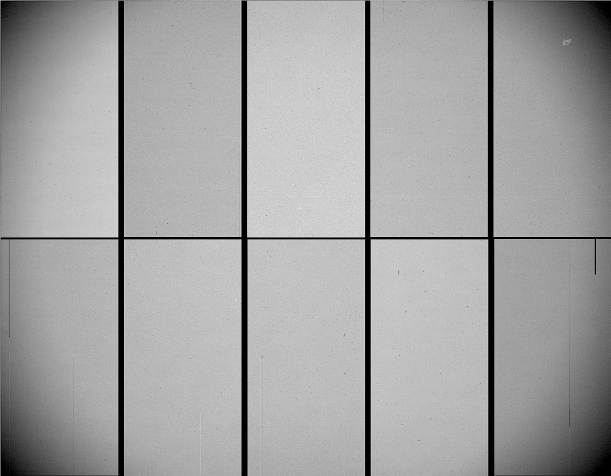
For the past few years my department has hosted an annual art show to showcase the various scientific and extrascientific artistic endeavors of students and faculty. This year I submitted a stitched-together domeflat from the dataset I’m working with—an image taken of an evenly lit telescope dome interior to better understand the imperfections of the telescope CCD. Since astronomy has a hard-earned reputation as the prettiest of the physics disciplines I thought it would really bring the hammer of day-to-day  tedium down on people’s expectations. Take THAT for assuming I’d give you something that looked good just because this is an art show! Here is the image and description I submitted:

Domeflat

“Domeflat: SUPA00398520”

This image, taken of the inside of the Subaru Telescope dome on Mauna Koa Hawaii poses the question: what is the nature of perception? Used to calibrate the properties of the telescope’s CCD cameras, the observers image a pure white field— thus, the emergent imperfections challenge the viewer to confront the fractured ways in which they view the world. Moreover, although the gaps in between CCDs create the appearance of windowpanes, the context is of a confined indoor space—a claustrophobic response to the telescope’s true potential and a visceral reminder of the futility of science to observe the substance of the soul.

The inability of the camera to detect the edges of its frame demonstrates the inner hollowness of incomplete perspective.  Are the didactic shackles of technology forcing a naturally circular field of view to be confined to a formalist rectangle? Or are we seeing a hi-fidelity instrument in a lo-fi world? What began as a white field, now viewed in ashen shades, confounds the arrêt d’annulation of the reality versus art paradigm.


Leave a comment

Happy Franksgiving!

Eleanor, pass me the cranberru sauce. And don't be such a bitch about it.

Not to be confused with Frankensteingiving.

Tonight, on the eve of our most greatest holiday (an evening where millions of Americans are blindly wandering the aisles of package stores to guess at what type of wine most effectively combines cheapness with not looking cheap, to bring to their family dinners tomorrow), I am taking a moment to flashback to 2007, on the way to flashing back to the 1930s. I somehow became aware of the historical footnote that was FDR’s unsuccessful attempt to change the date of Thanksgiving, and wrote about it on my previous blog. This year, I am thankful that I wrote a bunch of stuff no one really bothered reading, so that I can just repost it:

Some of the best holidays are the kind that you make up yourself. I certainly know this, and commemorate Kneecap Day annually in honor of my connective joints. FDR knew it too, and between 1939 and 1941 tried to get everyone to celebrate Thanksgiving a week earlier to boost retail sales. Had he succeeded, Turkey Day would be this Thursday. Unlike Social Security or fancy cigarette holders though, this is one of his ideas that didn’t quite catch on. Everyone made fun of it, derisively referring to the usurped holiday as ‘Franksgiving’ and sending him tons of hate mail. Evidentially, at the time, the date of Thanksgiving wasn’t fixed on the calendars, and a Presidential proclamation was needed to make it official as a public holiday. Roosevelt was asked by some retailers to move it up a week on the logic that people would shop more if there was more time between then and Christmas, and he agreed with this idea. Chaos ensued. Schools that had already scheduled vacations or football games all independently decided whether to keep or alter their plans. Businesses which had based their Novembers around a November 30th Thanksgiving had to reorganize everything. Calendar makers wet their pants. Furthermore, by the time November came around that year a bunch of states had decided to go against the President and celebrate the last Thursday as Thanksgiving, so someone traveling to another state to see their family might have the wrong week off. This national freak-out went on for 2 more years before New England, which gave our nation the holiday, threatened to take it away and the traditional date was reestablished formally by an act of Congress.


Leave a comment

Terror at 24 inches

Between a wall and hard place (another wall).

Our town of Providence, Rhode Island isn’t known for much. The birthplace of American religious freedom in the colony founded by Roger Williams, the world’s 4th-largest unsupported dome, some crooked politicians, and an ad for a local pest control business in the form of an enormous blue termite overlooking the highway. But now we have something we can truly be proud of: a girl who managed to get herself wedged so firmly in an 8-inch wide gap between two buildings that it took dozens of police and firefighters over an hour to free her.

Last Friday, Courtney Malloy, a 22-year-old woman in a state of considerable refreshment, went out the back door of a restaurant and made the inexplicable decision to try forcing herself through a passage no more than 8 inches across, as an unnecessary shortcut to the street. And, with an indomitable will to prevail over the forces of physics and common sense, she managed to push herself into the narrow space so vigorously that she was totally unable to free herself.

So far, you’re thinking, well, that’s a little stupid and unlikely, but it’s not THAT strange. And you’re right, except that every further detail just raises more questions. How is it even possible for an adult to get herself stuck in something in such a way that she cannot become unstuck? Did she expand? How can someone become stuck in such a way that firefighters couldn’t simply pull her out? (They had to break through one of the walls from the inside-out to get to her). When the firefighters got there, she had no idea how she’d gotten stuck— whether she walked into the alley, or fell from the roof of one the 3-story buildings that form the alley (it was later revealed that she started on ground level). And then, most importantly, there’s the fact that they found her wedged in there horizontally and 24 inches off the ground. Let me repeat that: horizontally and two feet off the ground. Like an extremely low-flying, drunk and bewildered Superman.

Someone pushed themselves into a space far to narrow to accommodate them, thought “this isn’t working” and proceeded to keep trying. In this way, no other news story in the past year more richly deserves  to be written about on Aitch-Bar, a blog that is to bullshit as narrow alleyways are to confused college students.

Indeed, no other story so adequately expresses the essence of the American dream, that looks at life and says “I bet I can jam more stuff into this.” It’s the spirit that built the iPhone, that invented the spork, that made that pizza with cheese inside the crust. Every time a middle-aged woman tries fitting herself into her old pair of leather pants, every time a child tries pushing together two non-interlocking lego pieces, every time a father looks at a thanksgiving turkey and asks himself “how many more birds can I shove in this thing?” this spirit is renewed. Even Rhode Island itself, wedged tightly as it is into the confined space between Massachusetts and Connecticut, is an embodiment of it. And as the personification of this spirit, Courtney Malloy deserves to be honored with a full sized statue, which will then be ceremonially wedged into that now famous alleyway, so that future generations can squint at it through a narrow tunnel and reflect on how THEY can make the world a better place…through shoving.


Leave a comment

A Speculative Account of the Transpiration of Events Culminating in the Publication of the Novel Micro

Michael Crichton reclines in his study, exhausted but satisfied. He has completed the first stage of what promises to be a highly-regarded novel; a lusty mix of speculative science, corporate intrigue, observations of the natural world, and horror. A framework is sketched. Characters are outlined: protagonists, antagonists, brain candy, cannon fodder. Three notes are jotted, one atop the other, in the lower right-hand corner. The first reads “Research plants.” The second: “Check basic physics.” And the third: “Need writing not to suck.” He completes the early ritual with a title page. Micro. He then secures the page and his draft notes to his abdomen with strips of duct tape. He dies two days later.

— —

Under the pale light of a quarter-moon, Richard Preston wipes a briny muck from his face as he digs under the grave marker of Michael Crichton. His pace is frenetic. The rumors still ring in his ears: a final manuscript, completed moments before his untimely demise, never having reached the eyes of any editor, never having been digitally transcribed, never found among his personal possessions. Taken to the grave. Richard Preston will have this story. Richard Preston will realize his dream of co-authoring a work with Michael Crichton. Richard Preston will ascend to greatness.

A thud. He has hit lacquered mahogany. He tosses the shovel aside and digs with bare hands, revealing his prize. He tears his shirt on a corner. He does not notice. The lid is opened. With assured purpose, he searches under the body, under the pillow, under the lining. He finds nothing. Panic rises. His frantic gaze then settles on the body. The burial suit is torn asunder. There: a stack of papers, secured to the abdomen by strips of duct tape. Richard Preston grabs at them, secreting them away in his waistband, hidden under torn shirt. In his mania, he tears the final bits. He does not notice a small piece of the lower right-hand corner left behind, hidden under a strip of tape.

— —

Richard Preston has retreated to his shack in the woods. The small room is lit by a trash can fire; smoke roils on the ceiling, escaping through narrow cracks in the thatch. The floor is naked boards. He is bent over a sun-bleached writing desk, poring over the notes. A rising despondency grips him by the throat. Where paragraphs should exist, there are only phrases. Where developed personality traits ought to be, there are only job descriptions. This is unlike any manuscript Richard Preston has encountered before. In fact, the manuscript reads like… draft notes.

The realization sweeps over him: Richard Preston must write words. He has dreaded this day for nearly eighteen years. He never intended to supply great stretches of narrative. The process of fictional composition is mysterious to him. One to whom it is not mysterious is Jezebeth, the demon of falsehoods. It is she who was the true author of The Hot Zone. For Richard Preston harbors a dark secret. Richard Preston is no writer.

Richard Preston is a wielder of arcane magicks.

He steels himself and reaches under his desk. He finds the old mason jar, and brings it to the flaming trash can. The top is discarded. Inside is a mixture of animal bones, widow’s tears, vulcanized rubber, and salvia. Eyes rolled back in his head, he recites a dark incantation and drops the brew into the fire.

— —

A lost child stumbles into the shack, finding Richard Preston face down upon the floorboards, naked, surrounded by aborted attempts at origami, unable to be roused. He steps gingerly over the prone form, avoiding a half-swan. He finds some food — a cabinet full of Triscuits, unpackaged and standing in stacks of twelve — and notices papers on the desk. The papers seem to be draft notes for a story. The child is intrigued. He won a writing award in seventh grade before running away from home. He spots something in the lower right corner: “Research plants” is scrawled just above a small tear in the paper.

He then notices a cardboard box in a far corner, decrepit with age and thorough with rot. He walks over to it and tugs at the top flap. The soggy material disintegrates, and a hundred unsold hardcovers of The Demon in the Freezer spill to the floorboards. He picks one up. It fills him with a sense of disquiet; he does not think of reading it. He turns it over instead. On the jacket cover is a picture of the author. He looks from the jacket to the man on the floor, and back again. He realizes that this is the Richard Preston, author of The Hot Zone, inspiration for him to quit school in the seventh grade after realizing that a world with ebola is a world without meaning. Clearly his hero has come into a bad way. The child will help Richard Preston in his time of need. He returns to the writing desk, grabs the draft notes, and strides purposefully out the door, stepping over a half-tulip, heading for the library.

— —

The child returns to the shack, a stack of paper clutched tightly to his breast. Again he steps over Richard Preston’s sprawled figure. He sets the papers neatly beside the typewriter. He has combined an old biology report on rainforests with a character narrative framed by the draft notes. He has followed all of the notes that were on the page. He has followed none of the notes that were not. He stokes the trash can fire, bends down, sweeps aside a half-sailboat, and gives Richard Preston a kiss on the forehead. He walks into the woods. He is eaten by wolves.

— —

Richard Preston has taken an upright position. His head swims, his hands shake, and his stomach seizes. This is Jezebeth’s toll; he can feel the gap left in his abdomen where she burrowed. He is ravenous for Triscuits.

He crawls through a family of half-frogs to his writing desk to see what the demon may have wrought on his typewriter. He is surprised to find a very neat font, with nonuniform letters, line widths bound precisely to one-inch margins around the page. This is not at all like what happened last time. And it is theoretically impossible for a typewriter. Such is the nature of the dark arts.

He quickly tucks the new manuscript into an envelope; to gaze upon it too carefully before it enters the editing process would be to undo the work entirely. But he does notice a Post-It affixed to the title page, with what appears to be the hesitant calligraphy of a childlike hand. Creepy. He tosses the note directly into the trash can fire, sending its demonic machinations back to Hell. He then seals the envelope and gives his story unto the mail, addressed to HarperCollins. Richard Preston returns to the floor, the weight of destiny pulling him down. He sleeps.


Leave a comment

Back on the Wagon

I was recently inspired to shovel some coal back into the tender engine running the Xbox. I enjoyed an eight-month run as a member of society, but falling temperatures and a primal desire to trade physical exertion for coziness have won over. This is a dangerous time, life chronometer-wise, to take up hobbies of any creed or mode of dress. The barometer has fallen sharply, and a dark and turbulent stretch of thesis writing is on the horizon. The air smells of ozone and poorly-constructed sentences on the nature of dark matter. This is a storm that must be weathered with all vigilance. I have asked Siri for directions from my Current Location to employment at a grocery store; Route 1 is a slippery slope.

Thus it was with a distinct feeling of illogic that I laid monies for a new game. The vessel of vicariousness I chose was one called Dishonored. The choice was not made lightly, but, as with all major life choices, was the culmination of a search through every Internet there is, tallying those anonymous spirits which point apparitional fingers toward that thing you want to do and say “yeah dude worht it.” Not that they could have easily dissuaded me, as the promise of a game where freedoms with consequences are introduced has strong allure. I don’t recall ever finishing Red Faction: Guerrilla; I think I was too busy knocking holes in walls and then walking through them repeatedly, manic grin on my face, recalling the days of Nintendo when your environment was immutable. Being able to approach a task from any particular angle is not only liberating, but rewires some rat’s nest of dendrites near the front of the brain, forever changing the way one perceives the world. I hardly use the door to my apartment anymore.

Dishonored seems to be about rolling in human filth and eating food found in sewers, in a time of plague. I have on occasion been known to miss the point, but this is the aspect outstanding to me. There isn’t a single facet of the game which is not constantly turning around to you and saying “bro, outbreak, not a good day for whatever it is you want to do.” There are literally posters on walls reminding you. NPCs will not shut up about it. Rats abound. It hardly seems appropriate to be eating tins of fish out of dumpsters. The outrageous bit is that the game rewards you for this behavior by increasing your health, rather than immediately laying you out with the flux.

In between episodes of consuming trash, you are expected to perform acrobatic feats and, optionally, get into fights. I avoid the latter, for three reasons: (1) I am my mother’s son; (2) I’ve played Halo too many times to be enticed by the prospect of battle with belligerent Englishmen; (3) the game doesn’t want me to. I am frequently offered incentives for passing by an opportunity to rumble, be they in the form of ethereal Achievement Points, or fewer rats down the line (seriously), or 10% off my next meal at Pizza Pie-er. This means doing battle of a different kind, with the ill-conceived notion of “hiding” in video games. One typically hides by concealing about 50% of your body behind a thing, and that is considered close enough, because legs are really the indicator of a troublemaker. Occasionally some enterprising individual spots you anyway, despite your efforts and intentions, which I guess is supposed to be a life lesson. You start to take exception, before you remember that, in fairness, you were just kind of standing in a bush and expecting that sort of thing to be okay. Rightfully you should have been spotted about five steps into the level, and you have thus far been saved only by a high level of unprofessionalism amongst the computer-controlled gestapo.

Then you turn into a dog or something, and that’s cool.


1 Comment

Midweekly Linktopus

Congratulations! You are the first person to read this alt-text!

If Linktopus sees one more article about the iPad Mini he’s going to kill you all

Since it’s rainy all of a sudden and I suffer from the autumnal version of seasonal affective disorder, I haven’t rocked you all with my truth recently. I think typing out the entire Chang opus probably ruined my respect for the written word. Oh well.

\scriptstyle\Box  Terrible Sex Advice. I had a girlfriend who used to read Cosmo. So while she was frantically casting around her room for the car keys she lost again, I’d casually flip through it to avoid wondering whether we’d actually be able to get to the airport in time. Between the onslaught of half-baked and frequently contradictory information about weight control and celebrity interviews that always seem to have been conducted entirely with publicists, there was the really bad sex advice. The attitude of it was usually actually fairly positive, if they stripped out all the tips themselves you’d just end up with something along the lines of: “try new things, be enthusiastic, don’t be afraid to take charge, and have fun!”…and that would be great advice. And there were 50/50 odds the flight would be delayed anyway. But…unfortunately for the women, (and men) of America, they can’t just write that over and over again every month, so it is easy to see how those articles eventually morphed into a freaky netherworld of activities no one in their right mind would actually engage in. Every other one seemed to involve a food. A weird, or at least messy, food, because they did all the ones involving chocolate sauce or strawberries—the only two sexy foodstuffs.

Someone else has noticed how funny those articles are. Those someone elses are Nerve.com, who have a running series of these, with commentary. Such as this one. And this one. You get the idea.

Before I let this link live as itself, I must mention the most memorable of these cosmo tips. It was thus, approximately: Find a smooth stone, possible while wondering in a meadow with your boyfriend. Is it smooth? If not, make sure to run it under a faucet for a while. So you have a smooth stone then, right? Good! Now, while intimacy is occurring with your boyfriend, stick it on his perineum. That was an actual tip that someone put in a magazine. Harrowing.

\scriptstyle\Box  Seagulls do the darndest things! Like stealing little cameras.

\scriptstyle\Box  Stephen Colbert’s new book, reviewed by, of course, Stephen Colbert.

\scriptstyle\Box  List of common phrases derived from obsolete technology. And then this even longer list. Including favorites such as: upper case, lower case, groggy, leeway, skyscraper, and many more!

\scriptstyle\Box  Aggressive takedown of the worst, but most inexplicably published comic strip, “Close To Home.” If you are like me, you have often wondered why this is a thing that is in newspapers.

It wasn’t funny the first time.


2 Comments

Zombs On The Tee-Vee

I am going to stick my neck out, or extend my arm outside of the moving vehicle, or avail myself of the glory hole, or whatever your preferred metaphor for risky behavior may be. I am going to make the statement that I enjoy watching The Walking Dead mostly because of the outrageous violence. Feel free to pontificate on character development, well-maintained evolving story lines, and great camera work. Agreed that those are all positives. But if you are a hardcore subscriber to those things, try tuning in to any other AMC production, because they do it much better. This show is made great by unrepentant head trauma infliction. I refuse to carry on bloviated discussions that dance around this core facet any longer. Along that line of thought, Talking Dead is a truly stupid thing, and Chris Hardwick irritates me to no end. Between that guy and the entire Ghost Hunters team, I have spent a lot of time recently praying for people to be reincarnated as toilets.

Edit: spolier alert, season 2 mid-season finale, next sentence.

Yes, the girl was in the barn the whole time and they had to put her down, that’s whatever. Consider that point as read. I tune in for the facial perforations. I do acknowledge that the folks doing makeup deserve all of their awards and nominations. Were I to be completely candid, however, this is just icing. The walkers could look like they just staggered out of an 8-bit video game, and I would not particularly mind. In fact, that might be preferable, vis-a-vis escapism. My entire life is a constantly evolving character-driven narrative, and I see people who look like they’re dead every time I leave the apartment. The only thing in that show that doesn’t resemble my daily routine is the use of a katana in anger.

I realize that claiming enjoyment of that sort of thing calls into question my entire moral character. To quote Biggie: fuck ’em, I didn’t want to go to Heaven anyway.


Leave a comment

Today in History: October 15th

Thanks a lot, Turkey

1529: The Siege of Vienna: Austrians fend off a Turkish invasion of Vienna, halting the tide of Ottoman conquest across Europe. This proves to be a turning point, and counterattacks eventually drive the Ottomans from the continent. In retaliation, the Turks cease their importation of Fezzes to Europe, cursing hat-wearers to endure brimmed headwear. They also withdraw the closely-guarded Turkish technique for removing the naturally-occurring buttons of hard fabric-covered material that form at the uppermost part of hats. The haberdashiary-schism is the origin of the unwanted “squatchee” found atop today’s baseball caps. For this reason, the schoolyard trick of slapping it to produce a sharp pain is known as the “Turkish Tap.”

1582: As decribed in a previous “Today in History” the Gregorian calendar is implemented in Italy, Portugal, Poland, and Spain, causing October 15th to directly follow October 4th. On the morning of the 15th, citizens of those countries awake groggily, with the nagging feeling that they have forgotten something important. They halfheartedly do old-timey things while gazing disorientatedly from their windows or wall-holes, and rack their brains over the strange, unsteady feeling that they woke up with. Meals across the continent are punctuated by awkward conversational silences as 16th century people find themselves unable to think of things to talk about. For roughly 10 days (presumably due to the amount of time skipped on the calendar), much of Catholic Europe hangs under a cloud of vague unease.

It happens that Pope Gregory XIII pushed back implementation to October 4th over the initial choice of October 1st because he was concerned that the Cardinals would forget about his birthday which fell on the 3rd. He had a strong suspicion that they had pooled their gift money to buy him a reeeeeally special new pope hat, and he always felt that he never got what he really wanted for his birthday. But 1582 might be the best one ever if he got the hat he wanted the most in the whole world!

1864: The Battle of Glasgow is fought. This is probably exactly what it sounds like. Some kind of Scottish insurrection or something. Don’t worry about it. Who would ever name a second place after Glasgow, one of Britain’s most dismal industrial towns? And even if someone else did, it would probably be in like, Australia or Canada or something… but since nothing really happened in any non-American former British colonies prior to at least the 1960s it wouldn’t have happened there. It doesn’t matter, just move along.

They put their jackets on for this photo.

1954: FORTRAN, the first high-level programming language, is released to the coding community for the first time. In 1954 the “coding community” consisted almost exclusively of men wearing horn-rimmed glasses, white short-sleeved shirts, narrow ties, and working in bright windowless rooms full of whirring machines. Developed by IBM, it was the first programming system consisting of readable statements rather than hard-coded machine language (though it still involved the use of punch cards). The first program run in FORTRAN was a sequence that would accept any input and return the statement “SEGMENTATION FAULT: NULL POINTER”