

Edited from a Crosspost to Adventures in Poor Taste
The AiPT crew asked if I could explain the weird physics in Fantastic Four #10, where an alien spaceship seems to struggle with its spacetime warping engines. I may not be a Fantastic Four expert, but I know the basics. All classic groups are foursomes, and the FF are no different. Ninja Turtles, A-Team, Beatles, Sex and the City, the four fundamental forces of nature, etc. The quadriad heroes tend to compliment each others’ skills, getting into lots of situations that are aided by a combination of invisible lady, stretchy guy, strong big guy, and fiery guy. Is one such situation a spacetime anomaly? We’re about to find out.
Ryan North and Leandro Fernández’s Fantastic Four #10 features a story told in five 100 year chunks, as the caretakers of an alien starship full of passengers in suspended animation ponder their vessel’s frozen state. The ship awakens them one by one to maintain the engines, but instead, they find that the starship is motionless in space. What’s more, they individually observe the Fantastic Four members (though they have no idea that’s what they are) moving within and outside the ship in extremely slow motion.
Someone familiar with special relativity might suspect this involves relativistic time dilation: the phenomena whereby something traveling near the speed of light experiences the passage of time more slowly than objects at rest. In fact, the ship is genuinely motionless. Or more specifically, frozen in a warped region of spacetime.
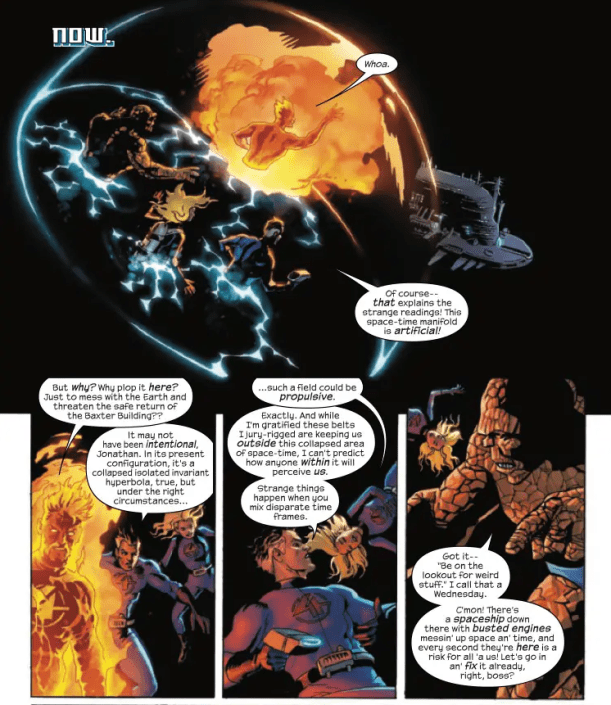
Fantastic Four #10–now with 50% more spacetime manifolds!
Of course–that explains the strange readings! This space-time manifold is artificial!
In its present configuration, it’s a collapsed isolated invariant hyperbola, true, but under the right circumstances…such a field could be propulsive.
Exactly. And while I’m gratified these belts I jury-rigged are keeping us outside this collapsed area of space-time, I can’t predict how anyone within it will perceive us. Strange things happen when you mix disparate time frames.
Fascinating. Their instantaneous appearance implies time is moving much faster for them than it is for us.
So to anyone on board, we look like–what, statues?
Given the temporal frame conflict, it’s likely we’re appearing at multiple and disparate times, locations and relative speeds. It would be quite challenging to predict.
It is interesting that the crew of a ship that operates through warping spacetime would be unfamiliar with the notion of different relativistic frames of reference. (It is implied that the shipbuilders were “ancient.” I guess their wisdom didn’t extend to the notion that they should make sure to pass down the basics of spaceflight.)
The description in the issue implies that the ship is designed to move by warping spacetime itself, without specifying how exactly. If that sounds like utter and complete gobbledegook, it may surprise you to learn that physicists merely consider it far-fetched-but-remotely-plausible gobbledegook. General relativity theorists have proposed spacetime geometries that would allow objects to circumvent light speed — the universe’s speed limit.
The best known of these is the Alcubierre drive, a hypothetical geometry first proposed in 1994 by Miguel Alcubierre, whereby space is contracted in front of an object, and expanded behind it. Superluminal travel is accomplished by moving space around the ship, which remains below light speed itself.
Easy enough, right? Wrong.
While dense matter or energy can contract spacetime, like a heavy object creating an indentation on a trampoline, there’s no known substance which can produce the opposite effect. Without a means of expanding space, like a source of negative energy, creating the spacetime geometry of a “warp bubble” is impossible.
Even if there were such a means, the amount of energy needed to distort space this way is implausibly enormous. Various proposals to operate an Alcubierre warp drive more efficiently have focused on methods that would reduce the amount of energy needed from that of the entire observable universe, to only that of several solar masses, or half a planet the size of Jupiter.
Other complications involve the fact that the warp bubble would violate relativistic causality – arriving at its destination before it would have seemed to have left. Light from the ship at its point of departure could reach the ship at its eventual end point, making it appear to exist in two places at once. The universe tends to have a problem with that sort of thing, as it implies a form of backwards time travel has occurred. Stephen Hawking’s chronology protection conjecture theorized that unspecified (maybe quantum) effects would intervene to prohibit the creation of time paradoxes. How or whether this would actually work, though, remains an open question.

Now if only we could get off this weird grid thing
Even if an Acubierre warp drive could work, it’s been calculated that a build-up of energetic particles caught up in the warp bubble over the trip would be released as the ship decelerated from superluminal velocity, and if a planet or object were along that direction of motion, this burst could destroy the destination itself.
Normally, an utter inability to accomplish something tends to dissuade people’s interest in it, but warp drive is a pretty tantalizing idea. As a result, nearly every article a theorist publishes relating to these models gets written up by pop-science sites. A sample of recent headlines include:
A warp drive is theoretically possible without breaking known physics
Alien ‘warp drives’ may leave telltale signals in the fabric of space-time, new paper claims
Warp Drives Might Be Real, and We’ll Find Them With Lasers: Study
Scientists Just Made a Breakthrough For Interstellar Travel
Faster-than-light ‘warp speed’ interstellar travel now thought to be possible
Scientists Get Serious in the Search for a Working Warp Drive
First-of-its-kind model makes warp drives feasible for space travel
Government-Funded Study Explores Warp Drives as Means of Faster-Than-Light Communication through “Hyperwaves”
If Warp Drives are Impossible, Maybe Faster Than Light Communication is Still on the Table?
I hate to be the bearer of bad news, but very little to increase the likelihood of warp travel within our lifetimes has actually transpired here. Rather, clickbait science sites are seizing on fairly hypothetical and insubstantial developments (like journal articles touching on minor refinements of theoretical work). Until humanity starts making big strides in folding spacetime around itself, we won’t be seeing anything like warp travel.
And it’s a shame! The universe is huge, and it would be exciting to be able to see more of it at close range. But without discovering some new physics, missions of interstellar exploration will require decades, if not centuries. We still have a lot to learn about gravity, so maybe 500 years stuck in one place would do it.


 A physicist wanting to make an impact on the field most often imagines his or her name attached to an Equation, or a Theory. Or even, if they really want to move mountains, a Law. I have no idea what mathematicians think about, but I would assume that they are hoping to come up with Theorems and Conjectures. Of course, not everyone is an Einstein or a Kepler, able to remake a subject and declare a Law. But if you carve out a niche for yourself, or invent a novel way of dealing with a certain topic, you’re virtually assured of getting something. For an elegant discovery, you could have an Angle named after you, or a Number. Or in a more bizarre direction, a Sea or Paradox. de Sitter has an entire Universe! Me? If I could become the first person since Isaac Newton with an eponymous Bucket I would consider myself a success. There are so many strange things you could find named in your honor that I have compiled an extensive list of them with some examples namesakes on the right-hand side.
 Aitch-Bar